 |
|
(c) 2010 Ken Fern & Plants For A Future |
 |
|
Translate this page:
Summary
Physical Characteristics

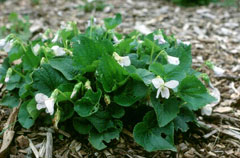
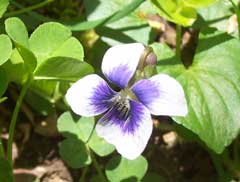
 Viola sororia is a PERENNIAL growing to 0.1 m (0ft 4in).
See above for USDA hardiness. It is hardy to UK zone 4. It is in flower from March to June. The species is hermaphrodite (has both male and female organs) and is pollinated by Insects.
Suitable for: light (sandy), medium (loamy) and heavy (clay) soils and prefers well-drained soil. Suitable pH: mildly acid and neutral soils. It can grow in semi-shade (light woodland) or no shade. It prefers moist soil.
UK Hardiness Map
US Hardiness Map
Synonyms
V. chalcosperma
Plant Habitats
Woodland Garden Sunny Edge; Dappled Shade;
Edible Uses
Edible Parts: Flowers Leaves
Edible Uses: Tea
Young leaves and flower buds - raw or cooked[159, 177]. A mild flavour, they make an acceptable addition to mixed salads[K]. The leaves are often mixed with stronger tasting leaves from the cabbage family[183]. When added to soup they thicken it in much the same way as Okra[62, 85, 159, 183]. The leaves are rich in vitamins A and C[159, 183]. Flowers - raw. A mild flavour, they are an excellent attractive garnish for salads[K]. Rich in vitamin C[159].The flowers can also be made into jams, jellies etc[183]. A tea can be made from the leaves[85] or from the flowers[159].
References More on Edible Uses
Medicinal Uses
Plants For A Future can not take any responsibility for any adverse effects from the use of plants. Always seek advice from a professional before using a plant medicinally.
Analgesic Dysentery Poultice Vitamin C
A poultice of the leaves has been used to allay the pain of a headache[257]. An infusion of the plant has been used in the treatment of dysentery, coughs and colds[257]. A poultice of the crushed root has been applied to boils[257].
References More on Medicinal Uses
The Bookshop: Edible Plant Books
Our Latest books on Perennial Plants For Food Forests and Permaculture Gardens in paperback or digital formats.
Edible Tropical Plants
Food Forest Plants for Hotter Conditions: 250+ Plants For Tropical Food Forests & Permaculture Gardens.
More
Edible Temperate Plants
Plants for Your Food Forest: 500 Plants for Temperate Food Forests & Permaculture Gardens.
More
More Books
PFAF have eight books available in paperback and digital formats. Browse the shop for more information.
Shop Now
Other Uses
Incense
An infusion of the root has been used to soak corn seeds before planting in order to keep off insects[257]. A dynamic accumulator gathering minerals or nutrients from the soil and storing them in a more bioavailable form - used as fertilizer or to improve mulch. Faunal Associations: The flowers are not often visited by insects (hence the need for cleistogamous flowers), but sometimes they attract bees (e.g., Mason, Halictid), skippers, Syrphid flies, and other insects. The Syrphid flies, however, feed only on stray pollen and are non-pollinating. The caterpillars of many Fritillary butterflies feed on the foliage, including Speyeria diane (Diana), Euptoieta claudia (Variegated Fritillary), Speyeria aphrodite (Aphrodite Fritillary), Boloria bellona (Meadow Fritillary), and Boloria selene myrina (Silver-Border Fritillary). The seeds have soft appendages that attract ants, which are in part distributed by them. Various upland gamebirds and small mammals occasionally eat the seeds, including the Wild Turkey, Bobwhite, Mourning Dove, and White-Footed Mouse. Wild Turkeys also eat the leaves and fleshy roots of Viola spp. (Violets). Although it is not a preferred food source, mammalian herbivores occasionally eat the foliage of violets, including the White-Tailed Deer, Cottontail Rabbit, and livestock [1-6].
Special Uses
Dynamic accumulator Food Forest
References More on Other Uses
Cultivation details
Prefers a cool moist well-drained humus-rich soil in partial or dappled shade and protection from scorching winds. Tolerates sandstone and limestone soils but becomes chlorotic if the pH is too high. Prefers a pH between 6 and 6.5. There are a number of named varieties selected for their ornamental value[187]. Plants produce cleistogamous flowers as well as the usual insect pollinated flowers[187]. All members of this genus have more or less edible leaves and flower buds, though those species with yellow flowers can cause diarrhoea if eaten in large quantities[62, 85, 159]. Sometimes misspelt as Viola sororaria For polyculture design as well as the above-ground architecture (form - tree, shrub etc. and size shown above) information on the habit and root pattern is also useful and given here if available. The plant growth habit is a runner spreading indefinitely by rhizomes or stolons [1-2]. The root pattern is rhizomatous with underground stems sending roots and shoots along their length [1-2].
References Carbon Farming Information and Carbon Sequestration Information
Temperature Converter
Type a value in the Celsius field to convert the value to Fahrenheit:
Fahrenheit:
The PFAF Bookshop
Plants For A Future have a number of books available in paperback and digital form. Book titles include Edible Plants, Edible Perennials, Edible Trees,Edible Shrubs, Woodland Gardening, and Temperate Food Forest Plants. Our new book is Food Forest Plants For Hotter Conditions (Tropical and Sub-Tropical).
Shop Now
Plant Propagation
Seed - best sown in the autumn in a cold frame. Sow stored seed in early spring in a cold frame. Prick out the seedlings into individual pots when they are large enough to handle and plant them out in the summer. Division in the autumn or just after flowering. Larger divisions can be planted out direct into their permanent positions, though we have found that it is best to pot up smaller divisions and grow them on in light shade in a greenhouse or cold frame until they are growing away well. Plant them out in the summer or the following spring.
Other Names
If available other names are mentioned here
Native Range
NORTHERN AMERICA: Canada, Northwest Territories, Québec, Nova Scotia, Ontario, Prince Edward Island, New Brunswick, Newfoundland and Labrador, Saskatchewan, Alberta, Manitoba, British Columbia, United States, Connecticut, Indiana, Maine, Massachusetts, Michigan, New Hampshire, New Jersey, New York, Ohio, Pennsylvania, Vermont, West Virginia, Illinois, Iowa, Kansas, Minnesota, Missouri, Nebraska, North Dakota, Oklahoma, South Dakota, Wisconsin, Colorado, Idaho, Montana, Oregon, Washington, Wyoming, Alabama, Arkansas, Florida, Georgia, Kentucky, Louisiana, Maryland, Mississippi, North Carolina, South Carolina, Tennessee, Virginia, New Mexico, Texas, Arizona, California, Nevada, Utah,
Weed Potential
Right plant wrong place. We are currently updating this section.
Please note that a plant may be invasive in one area but may not in your area so it's worth checking.
Conservation Status
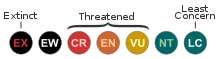
IUCN Red List of Threatened Plants Status :
| Related Plants
|
| Latin Name | Common Name | Habit | Height | Hardiness | Growth | Soil | Shade | Moisture | Edible | Medicinal | Other |
| Aconitum violaceum | | Perennial | 0.0 |
5-9
| | LMH | SN | M | 1 | 1 | |
| Cardamine violacea | | Perennial | 0.3 |
-
| | LMH | SN | M | 2 | 0 | |
| Gigantochloa atroviolacea | Black Bamboo. Giant Black bamboo | Bamboo | 12.0 |
9-11
| M | LMH | SN | M | 2 | 0 | 3 |
| Hardenbergia violacea | Coral Pea, Purple Coral Pea, False Sarsaparilla, Vine Lilac | Climber | 2.0 |
9-11
| F | LMH | SN | M | 1 | 0 | 1 |
| Hymenanthera dentata | Tree Violet | Shrub | 6.0 |
8-11
| | LMH | N | M | 0 | 0 | 2 |
| Melicytus ramiflorus | Whitey Wood | Tree | 9.0 |
8-11
| | LMH | N | M | 1 | 0 | 2 |
| Orychophragmus violaceus | | Annual/Biennial | 0.3 |
6-9
| | LMH | N | M | 1 | 0 | |
| Oxalis violacea | Violet Wood Sorrel | Bulb | 0.3 |
4-8
| | LMH | SN | DM | 3 | 1 | |
| Tulbaghia violacea | Society Garlic | Perennial | 0.3 |
7-11
| F | LMH | N | M | 4 | 2 | 3 |
| Viola acuminata | | Perennial | 0.3 |
-
| | LMH | SN | M | 2 | 0 | |
| Viola adunca | Western Dog Violet, Hookedspur violet, Kirk's violet | Perennial | 0.1 |
4-8
| | LMH | SN | M | 3 | 1 | 2 |
| Viola biflora | Twoflower Violet, Arctic yellow violet, Carlott's violet | Perennial | 0.2 |
0-0
| | LMH | S | M | 3 | 1 | 1 |
| Viola brevistipulata | | Perennial | 0.3 |
-
| | LMH | SN | M | 2 | 0 | |
| Viola canadensis | Canada Violet, Canadian white violet, Creepingroot violet | Perennial | 0.4 |
3-8
| | LMH | SN | M | 3 | 1 | 2 |
| Viola canina | Dog Violet | Perennial | 0.4 |
5-9
| | LMH | SN | M | 3 | 1 | 0 |
| Viola collina | | Perennial | 0.1 |
-
| | LMH | SN | M | 2 | 0 | |
| Viola cornuta | Horned Violet, Bedding Pansy, Tufted Pansy, | Perennial | 0.2 |
6-11
| F | LMH | SN | M | 3 | 0 | 3 |
| Viola cucullata | Marsh Blue Violet | Perennial | 0.2 |
3-8
| | LMH | SN | MWe | 3 | 1 | 3 |
| Viola diffusa | | Annual | 0.1 |
-
| | LMH | SN | M | 2 | 2 | |
| Viola epipsila | Dwarf Marsh Violet | Perennial | 0.1 |
4-8
| | LMH | SN | M | 3 | 0 | 1 |
| Viola esculenta | Salad violet | | 0.0 |
0-0
| | LMH | SN | M | 0 | 0 | |
| Viola glabella | Stream Violet, Pioneer violet | Perennial | 0.1 |
4-8
| | LMH | S | M | 2 | 0 | |
| Viola grypoceras | | Perennial | 0.3 |
-
| | LMH | SN | M | 2 | 0 | |
| Viola japonica | Japanese violet | Perennial | 0.2 |
0-0
| | LMH | SN | M | 3 | 2 | |
| Viola keiskei | | Perennial | 0.2 |
-
| | LMH | SN | M | 2 | 0 | |
| Viola labradorica | Labrador Violet, Alpine violet, Johnny Jump-Up, Alpine Violet | Perennial | 0.1 |
3-8
| F | LMH | FSN | M | 3 | 0 | 2 |
| Viola langsdorffii | Alaska Violet. Aleutian violet | Perennial | 0.1 |
-
| | LMH | SN | M | 3 | 0 | |
| Viola mandshurica | Manchurian Violet | Perennial | 0.2 |
7-10
| | LMH | SN | M | 3 | 0 | |
| Viola mirabilis | wonder violet | Perennial | 0.2 |
4-8
| | LMH | SN | M | 3 | 1 | |
| Viola obtusa | | Perennial | 0.1 |
-
| | LMH | SN | M | 2 | 0 | |
|
|
Growth: S = slow M = medium F = fast. Soil: L = light (sandy) M = medium H = heavy (clay). pH: A = acid N = neutral B = basic (alkaline). Shade: F = full shade S = semi-shade N = no shade. Moisture: D = dry M = Moist We = wet Wa = water.
Now available:
Food Forest Plants for Mediterranean Conditions
350+ Perennial Plants For Mediterranean and Drier Food Forests and Permaculture Gardens.
[Paperback and eBook]
This is the third in Plants For A Future's series of plant guides for food forests tailored to
specific climate zones. Following volumes on temperate and tropical ecosystems, this book focuses
on species suited to Mediterranean conditions—regions with hot, dry summers and cool, wet winters,
often facing the added challenge of climate change.
Read More
Expert comment
Author
Willd.
Botanical References
43200274
Links / References
For a list of references used on this page please go here
Readers comment
| Add a comment |
|
If you have important information about this plant that may help other users please add a comment or link below. Only comments or links that are felt to be directly relevant to a plant will be included. If you think a comment/link or information contained on this page is inaccurate or misleading we would welcome your feedback at [email protected]. If you have questions about a plant please use the Forum on this website as we do not have the resources to answer questions ourselves.
* Please note: the comments by website users are not necessarily those held by PFAF and may give misleading or inaccurate information.
|
|