 |
|
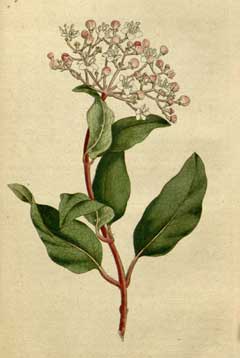
commons.wikimedia.org/wiki/File:The_Botanical_Magazine,_Plate_38_(Volume_2,_1788).png |
 |
|
Translate this page:
Summary
Bloom Color: Pink, White. Main Bloom Time: Early spring, Late spring, Late winter, Mid spring, Mid winter. Form: Oval, Upright or erect.
Physical Characteristics

 Viburnum tinus is an evergreen Shrub growing to 3.5 m (11ft) by 3.5 m (11ft) at a fast rate.
See above for USDA hardiness. It is hardy to UK zone 7. It is in leaf all year, in flower from December to February, and the seeds ripen from October to November. The species is hermaphrodite (has both male and female organs) and is pollinated by Insects. The plant is not self-fertile.
Suitable for: light (sandy), medium (loamy) and heavy (clay) soils and can grow in heavy clay soil. Suitable pH: mildly acid, neutral and basic (mildly alkaline) soils. It can grow in semi-shade (light woodland) or no shade. It prefers moist soil. The plant can tolerates strong winds but not maritime exposure.
UK Hardiness Map
US Hardiness Map
Synonyms
Plant Habitats
Woodland Garden Sunny Edge; Dappled Shade; Shady Edge; Hedge;
Edible Uses
References More on Edible Uses
Medicinal Uses
Plants For A Future can not take any responsibility for any adverse effects from the use of plants. Always seek advice from a professional before using a plant medicinally.
None known
References More on Medicinal Uses
The Bookshop: Edible Plant Books
Our Latest books on Perennial Plants For Food Forests and Permaculture Gardens in paperback or digital formats.
Edible Tropical Plants
Food Forest Plants for Hotter Conditions: 250+ Plants For Tropical Food Forests & Permaculture Gardens.
More
Edible Temperate Plants
Plants for Your Food Forest: 500 Plants for Temperate Food Forests & Permaculture Gardens.
More
More Books
PFAF have eight books available in paperback and digital formats. Browse the shop for more information.
Shop Now
Other Uses
Hedge Hedge
A fast growing informal hedge but it can be damaged in the most exposed positions[75]. Landscape Uses:Border, Massing, Screen, Specimen. Attracts butterflies, Fragrant flowers, Attractive flowers or blooms.
Special Uses
Hedge Hedge Scented Plants
References More on Other Uses
Cultivation details
An easily grown plant, succeeding in both acid and alkaline soils but it is ill-adapted for poor soils and dry situations[1, 202]. Prefers a deep rich loamy soil in sun or semi-shade[11] but flowers better in a sunny position[182]. Grows well in heavy clay soils. Best if given shade from the early morning sun in spring[200]. Thrives in moderate shade but is better in full sun[11]. A fairly wind resistant plant but it requires shelter from cold northerly and north-easterly winds[75, 200]. This species is hardy to about -10°c, it does not thrive in the colder areas of the country[182]. A very variable plant, there are a number of named varieties[11, 182]. Fast growing when young, though slowing with age[202]. Very tolerant of pruning, plants quickly regenerate even from old wood[202]. Plants give off an offensive smell in wet weather[182]. Plants occasionally self-sow in Britain[17]. Plants are self-incompatible and need to grow close to a genetically distinct plant in the same species in order to produce fruit and fertile seed[11, 200]. Special Features:Not North American native, Attracts butterflies, Fragrant flowers, Attractive flowers or blooms.
References Carbon Farming Information and Carbon Sequestration Information
Temperature Converter
Type a value in the Celsius field to convert the value to Fahrenheit:
Fahrenheit:
The PFAF Bookshop
Plants For A Future have a number of books available in paperback and digital form. Book titles include Edible Plants, Edible Perennials, Edible Trees,Edible Shrubs, Woodland Gardening, and Temperate Food Forest Plants. Our new book is Food Forest Plants For Hotter Conditions (Tropical and Sub-Tropical).
Shop Now
Plant Propagation
Seed - best sown in a cold frame as soon as it is ripe. Germination can be slow, sometimes taking more than 18 months. If the seed is harvested 'green' (when it has fully developed but before it has fully ripened) and sown immediately in a cold frame, it should germinate in the spring[80]. Stored seed will require 2 months warm then 3 months cold stratification and can still take 18 months to germinate[113]. Prick out the seedlings into individual pots when they are large enough to handle and grow them on in a cold frame or greenhouse. Plant out into their permanent positions in late spring or early summer of the following year. Cuttings of soft-wood, early summer in a frame[200]. Pot up into individual pots once they start to root and plant them out in late spring or early summer of the following year. Cuttings of half-ripe wood, 5 - 8 cm long with a heel if possible, July/August in a frame[78, 113]. Plant them into individual pots as soon as they start to root. These cuttings can be difficult to overwinter, it is best to keep them in a greenhouse or cold frame until the following spring before planting them out[113]. Cuttings of mature wood, winter in a frame. They should root in early spring - pot them up when large enough to handle and plant them out in the summer if sufficient new growth is made, otherwise keep them in a cold frame for the next winter and then plant them out in the spring. Layering of current seasons growth in July/August. Takes 15 months[78].
Other Names
If available other names are mentioned here
Laurier-tin
Native Range
TEMPERATE ASIA: Israel, Jordan, Lebanon, Syria, Turkey (w. (islands)) EUROPE: Albania, Greece (incl. Crete), Italy (incl. Sardinia, Sicily), Spain, France (incl. Corsica), Portugal AFRICA: Algeria (north), Libya (northwest), Morocco, Tunisia
Weed Potential
Right plant wrong place. We are currently updating this section.
Please note that a plant may be invasive in one area but may not
in your area so it's worth checking.
Conservation Status
IUCN Red List of Threatened Plants Status :
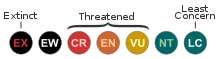
IUCN Red List
| Related Plants
|
| Latin Name | Common Name | Habit | Height | Hardiness | Growth | Soil | Shade | Moisture | Edible | Medicinal | Other |
| Viburnum betulifolium | | Shrub | 3.0 |
-
| | LMH | SN | M | 2 | 0 | |
| Viburnum cassinoides | Withe Rod, Appalachian Tea, Witherod Viburnum, Witherod, Wild Raisin Viburnum | Shrub | 2.5 |
2-8
| M | LMH | SN | M | 3 | 1 | 0 |
| Viburnum cordifolium | Viburnum | Tree | 6.0 |
8-9
| M | LMH | SN | M | 1 | 0 | 2 |
| Viburnum corylifolium | | Shrub | 3.0 |
5-9
| | LMH | SN | M | 1 | 0 | |
| Viburnum cotinifolium | | Shrub | 3.5 |
5-9
| | LMH | SN | M | 3 | 0 | 3 |
| Viburnum cylindricum | | Shrub | 5.0 |
5-9
| | LMH | SN | M | 1 | 1 | 3 |
| Viburnum dentatum | Arrow Wood, Southern arrowwood, Southern Arrowwood Viburnum | Shrub | 4.5 |
2-8
| F | LMH | SN | M | 2 | 1 | |
| Viburnum dilatatum | Linden Viburnum, Linden arrowwood | Shrub | 3.0 |
5-8
| M | LMH | SN | M | 3 | 1 | 2 |
| Viburnum edule | Mooseberry, Squashberry | Shrub | 2.5 |
4-8
| | LMH | SN | M | 3 | 1 | 3 |
| Viburnum erosum | Viburnum | Shrub | 1.8 |
6-9
| M | LMH | SN | M | 2 | 0 | |
| Viburnum erubescens | | Shrub | 5.0 |
5-9
| | LMH | SN | M | 2 | 1 | 2 |
| Viburnum erubescens gracilipes | | Shrub | 5.0 |
5-9
| | LMH | SN | M | 2 | 0 | 2 |
| Viburnum farreri | Culver's root, Fragrant Viburnum | Shrub | 3.0 |
5-8
| M | LMH | SN | M | 3 | 0 | 0 |
| Viburnum foetens | | Shrub | 3.0 |
5-9
| | LMH | SN | M | 3 | 0 | 3 |
| Viburnum fordiae | | Shrub | 0.0 |
-
| | LMH | SN | M | 1 | 0 | |
| Viburnum furcatum | | Shrub | 3.5 |
5-9
| | LMH | S | M | 1 | 0 | |
| Viburnum grandiflorum | Cranberry bush, | Shrub | 2.0 |
6-9
| | LMH | SN | M | 3 | 0 | 0 |
| Viburnum japonicum | | Shrub | 1.8 |
6-9
| S | LMH | SN | M | 2 | 0 | |
| Viburnum lantana | Wayfaring Tree, Wayfaring Tree Viburnum | Shrub | 5.0 |
4-7
| M | LMH | SN | DM | 1 | 0 | 1 |
| Viburnum lantanoides | Hobbleberry | Shrub | 3.0 |
3-7
| | LMH | FSN | M | 3 | 1 | 0 |
| Viburnum lentago | Sheepberry, Nannyberry, Nannyberry Viburnum | Tree | 9.0 |
2-8
| M | LMH | SN | M | 4 | 1 | 3 |
| Viburnum mongolicum | | Shrub | 2.0 |
4-8
| | LMH | SN | M | 1 | 0 | |
| Viburnum mullaha | | Shrub | 3.0 |
8-11
| | LMH | SN | M | 2 | 1 | 2 |
| Viburnum nudum | Smooth Withe Rod, Possumhaw, Withe-rod, Swamp Haw, Smooth Witherod, Possum Haw Viburnum, Possum Haw | Shrub | 4.5 |
5-9
| M | LMH | SN | M | 3 | 1 | |
| Viburnum odoratissimum | Sweet Viburnum | Shrub | 5.0 |
8-10
| S | LMH | SN | M | 1 | 0 | |
| Viburnum opulus | Guelder Rose, Cramp Bark, European cranberrybush, American cranberrybush, Crampbark, European Highb | Shrub | 5.0 |
3-8
| M | LMH | SN | MWe | 3 | 3 | 3 |
| Viburnum phlebotrichum | | Shrub | 2.5 |
5-9
| | LMH | SN | M | 1 | 0 | |
| Viburnum plicatum | Japanese Snowball, Japanese Snowball Viburnum, Doublefile Viburnum | Shrub | 4.0 |
5-8
| M | LMH | SN | M | 1 | 0 | |
| Viburnum prunifolium | Stagberry, Black Haw, Hybrid blackhaw, Smooth Blackhaw, Blackhaw Viburnum | Tree | 7.5 |
3-9
| S | LMH | SN | DM | 2 | 3 | 3 |
| Viburnum rufidulum | Southern Black Haw, Rusty blackhaw | Shrub | 12.0 |
4-8
| | LMH | SN | M | 3 | 1 | 1 |
|
|
Growth: S = slow M = medium F = fast. Soil: L = light (sandy) M = medium H = heavy (clay). pH: A = acid N = neutral B = basic (alkaline). Shade: F = full shade S = semi-shade N = no shade. Moisture: D = dry M = Moist We = wet Wa = water.
Now available:
Food Forest Plants for Mediterranean Conditions
350+ Perennial Plants For Mediterranean and Drier Food Forests and Permaculture Gardens.
[Paperback and eBook]
This is the third in Plants For A Future's series of plant guides for food forests tailored to
specific climate zones. Following volumes on temperate and tropical ecosystems, this book focuses
on species suited to Mediterranean conditions—regions with hot, dry summers and cool, wet winters,
often facing the added challenge of climate change.
Read More
Expert comment
Author
L.
Botanical References
11200
Links / References
For a list of references used on this page please go here
Readers comment