 |
|
commons.wikimedia.org/wiki/User:Oyoyoy |
 |
| commons.wikimedia.org/wiki/User:CatherineMunro |
Translate this page:
Summary
Taxonomic Note: This genus was formerly classified in the family Alliaceae. Modern classifications include it within the Amaryllidaceae.
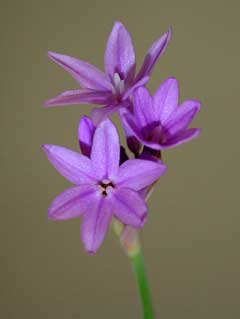
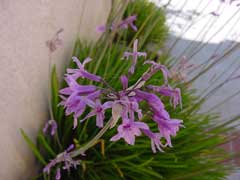
Tulbaghia violacea,
Society Garlic, native to South Africa, is an evergreen perennial spreading slowly by its rhizomes and making a good ground cover. The flowers are ornamental, with a sweet, onion-like heat in the mouth. Leaves and stems, available all year, have a mild garlic flavour and are used as a substitute for garlic and chives in soups and salads. The silver Lace cultivar, a dwarf clumping plant, is more attractive with larger flowers.
Harvesting: Leaves and flowers are typically harvested in summer, but leaves are available all year and can be harvested from the first year. Flowers are harvested in summer.
Physical Characteristics

 Tulbaghia violacea is an evergreen Perennial growing to 0.3 m (1ft) by 0.3 m (1ft in) at a fast rate.
See above for USDA hardiness. It is hardy to UK zone 7. It is in flower from June to September. The species is hermaphrodite (has both male and female organs) and is pollinated by Bees. The plant is self-fertile.
Suitable for: light (sandy), medium (loamy) and heavy (clay) soils and prefers well-drained soil. Suitable pH: mildly acid, neutral and basic (mildly alkaline) soils. It cannot grow in the shade. It prefers moist soil.
UK Hardiness Map
US Hardiness Map
Synonyms
Plant Habitats
Cultivated Beds; South Wall. By. West Wall. By.
Edible Uses
Edible Parts: Flowers Leaves Root
Edible Uses:
Leaves and stems - raw or cooked. A mild garlic flavour, they are used as a flavouring in soups and salads[183]. A substitute for chives and garlic. Flowers - raw or cooked. They can be added to salads, used as a garnish or flavouring in cooked foods[183]. The flowers are very ornamental, they have a sweet, onion-like heat in the mouth.
References More on Edible Uses
Medicinal Uses
Plants For A Future can not take any responsibility for any adverse effects from the use of plants. Always seek advice from a professional before using a plant medicinally.
There is some evidence that Society Garlic has antifungal properties. It is used locally as a herbal remedy to treat several ailments.
References More on Medicinal Uses
The Bookshop: Edible Plant Books
Our Latest books on Perennial Plants For Food Forests and Permaculture Gardens in paperback or digital formats.

Edible Tropical Plants
Food Forest Plants for Hotter Conditions: 250+ Plants For Tropical Food Forests & Permaculture Gardens.
More

Edible Temperate Plants
Plants for Your Food Forest: 500 Plants for Temperate Food Forests & Permaculture Gardens.
More

More Books
PFAF have eight books available in paperback and digital formats. Browse the shop for more information.
Shop Now
Other Uses
Companion Cut flowers
Agroforestry uses: Society Garlic is used as a ground cover and can help deter pests due to its garlic scent, making it beneficial in companion planting. Landscape Uses: Border, Container, Ground cover, Rock garden, Seashore. Special Features: Attractive foliage, Not North American native. Suitable for cut flowers. Fragrant flowers. Attractive flowers or blooms. Ornamental. Society Garlic and the cultivars Purple Eye' and 'Silver Lace', with cream-margined leaves, have all gained the Royal Horticultural Society's Award of Garden Merit. 1. Nectary - Flowers rich in nectar and pollen:
Yes – Society garlic produces clusters of small purple flowers that attract pollinators such as bees and butterflies, providing a source of nectar and pollen.
2. Wildlife - Food (Fruit, Seeds, Leaf litter, Shelter, Nesting, Roosting):
No – While the flowers can attract pollinators, the plant does not provide significant food for wildlife. Its foliage is not typically consumed by animals.
3. Invertebrate Shelter (Overwintering sites, Leaf litter, Groundcover):
Yes – Society garlic can serve as ground cover, providing some shelter for invertebrates and helping retain moisture in the soil.
4. Pest Confuser (Smell):
Yes – The plant has a strong garlic scent, which can deter some pests, making it useful in companion planting to help protect other plants in the garden.
Special Uses
Food Forest Ground Cover Scented Plants
References More on Other Uses
Cultivation details
Requires a well-drained soil in a sunny sheltered position[200]. Hardy in the mildest areas of Britain, tolerating temperatures down to about -10°c, it can be grown as a bedding plant or at the base of a warm wall[200]. Plants succeed outdoors at Edinburgh botanical gardens[90]. Plants grow from a cluster of small bulbs attached to a basal plate that is sometimes regarded as a rhizome[200]. The flowers are very fragrant at night, the whole plant has a garlic-like aroma[200]. There are some named varieties, selected for their ornamental value[200]. 'Silver Lace' is a dwarf clumping plant that grows well in containers and is more attractive with larger flowers than the type[183, 200]. Bloom Color: Lavender, Pink. Main Bloom Time: Early summer, Early fall, Early spring, Late summer, Late fall, Late spring, Mid summer, Mid fall, Mid spring. Form: Upright or erect. Society Garlic is self-fertile. The leaves and flowers are typically harvested in summer, specifically from late spring to early autumn for culinary use.
Society Garlic usually flowers in summer, from late spring to early summer, producing clusters of lavender to white flowers. Society Garlic grows relatively quickly and can establish itself in the garden within one growing season.
References Carbon Farming Information and Carbon Sequestration Information
Temperature Converter
Type a value in the Celsius field to convert the value to Fahrenheit:
Fahrenheit:
The PFAF Bookshop
Plants For A Future have a number of books available in paperback and digital form. Book titles include Edible Plants, Edible Perennials, Edible Trees,Edible Shrubs, Woodland Gardening, and Temperate Food Forest Plants. Our new book is Food Forest Plants For Hotter Conditions (Tropical and Sub-Tropical).
Shop Now
Plant Propagation
Seed - best sown as soon as it is ripe in the greenhouse[200]. Sow stored seed in early spring in the greenhouse[200]. Prick out the seedlings into individual pots once they are large enough to handle and grow them on in the greenhouse for at least their first winter. If planting them outdoors, this is best done in late summer when the plants are dormant. Division of the dormant plants in late summer.
Other Names
If available other names are mentioned here
Pink Agapanthus, Wild Garlic, Sweet Garlic, Spring Bulbs, or Spring Flowers
Native Range
AFRICA: South Africa, Cape Province, KwaZulu-Natal, .
Weed Potential
Right plant wrong place. We are currently updating this section.
Please note that a plant may be invasive in one area but may not in your area so it's worth checking.
Conservation Status
IUCN Red List of Threatened Plants Status :

Growth: S = slow M = medium F = fast. Soil: L = light (sandy) M = medium H = heavy (clay). pH: A = acid N = neutral B = basic (alkaline). Shade: F = full shade S = semi-shade N = no shade. Moisture: D = dry M = Moist We = wet Wa = water.
Now available:
Food Forest Plants for Mediterranean Conditions
350+ Perennial Plants For Mediterranean and Drier Food Forests and Permaculture Gardens.
[Paperback and eBook]
This is the third in Plants For A Future's series of plant guides for food forests tailored to
specific climate zones. Following volumes on temperate and tropical ecosystems, this book focuses
on species suited to Mediterranean conditions—regions with hot, dry summers and cool, wet winters,
often facing the added challenge of climate change.
Read More
Expert comment
Author
Harv.
Botanical References
200
Links / References
For a list of references used on this page please go here
Readers comment