 |
|
|
 |
| http://commons.wikimedia.org/wiki/File:Schisandra_chinensis_berries_w5rub.jpg |
Translate this page:
Summary
Physical Characteristics

 Schisandra chinensis is a deciduous Climber growing to 9 m (29ft 6in) at a medium rate.
See above for USDA hardiness. It is hardy to UK zone 4 and is not frost tender. It is in flower from April to May, and the seeds ripen from August to October. The species is dioecious (individual flowers are either male or female, but only one sex is to be found on any one plant so both male and female plants must be grown if seed is required). . The plant is not self-fertile.
Suitable for: light (sandy), medium (loamy) and heavy (clay) soils and prefers well-drained soil. Suitable pH: mildly acid, neutral and basic (mildly alkaline) soils. It can grow in full shade (deep woodland) or semi-shade (light woodland). It prefers moist soil.
UK Hardiness Map
US Hardiness Map
Synonyms
S. japonica. Kadsura chinensis. Maximowiczia chinensis. Sphaerostema japonicum.
Plant Habitats
Woodland Garden Dappled Shade; Shady Edge; not Deep Shade; North Wall. By. East Wall. By.
Edible Uses
Edible Parts: Fruit Leaves
Edible Uses: Gum
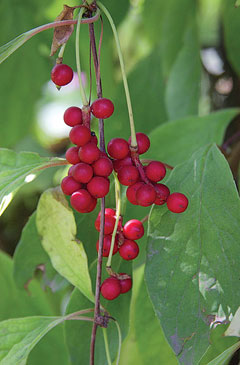
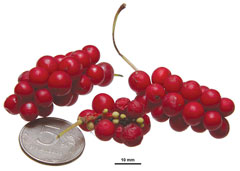
Fruit - raw or cooked[183]. Usually dried and used on journeys, it is very sustaining[74]. Rich in sugars[74], it has a sweet/sour flavour[178]. In Russia a paste made from the fruit is mixed with Actinidia arguta in order to counteract the insufficient acidity of that species[183]. The fruit is about 6mm in diameter and is borne in a grape-like bunch about 10cm long[200]. Young leaves - cooked and used as a vegetable[105, 177, 183].
References More on Edible Uses
Medicinal Uses
Plants For A Future can not take any responsibility for any adverse effects from the use of plants. Always seek advice from a professional before using a plant medicinally.
Antirheumatic Antitussive Aphrodisiac Astringent Cancer Cardiotonic Cholagogue Dysentery
Expectorant Hepatic Lenitive Nervine Pectoral Sedative Stimulant
Tonic Urinary
Wu Wei Zi is commonly used in Chinese herbalism, where it is considered to be one of the 50 fundamental herbs[218]. It is an excellent tonic and restorative, helping in stressful times and increasing zest for life[254]. It is considered to be a substitute for ginseng and is said to be a tonic for both the male and the female sex organs[238]. The fruit is antitussive, aphrodisiac, hepatic, astringent, cardiotonic, cholagogue, expectorant, hypotensive, lenitive, nervine, pectoral, sedative, stimulant and tonic[174, 176, 178, 218]. Low doses of the fruit are said to stimulate the central nervous system whilst large doses depress it[218]. The fruit also regulates the cardiovascular system[218]. It is taken internally in the treatment of dry coughs, asthma, night sweats, urinary disorders, involuntary ejaculation, chronic diarrhoea, palpitations, insomnia, poor memory, hyperacidity, hepatitis and diabetes[238]. Externally, it is used to treat irritating and allergic skin conditions[238]. The fruit is harvested after the first frosts and sun-dried for later use[238]. The fruit contains lignans[254]. These have a pronounced protective action on the liver. In one clinical trial there was a 76% success rate in treating patients with hepatitis, no side effects were noticed[254]. The seed is used in the treatment of cancer[218]. The plant is antirheumatic[218]. A mucilaginous decoction obtained from the branches is useful in the treatment of coughs, dysentery and gonorrhoea[218].
References More on Medicinal Uses
The Bookshop: Edible Plant Books
Our Latest books on Perennial Plants For Food Forests and Permaculture Gardens in paperback or digital formats.

Edible Tropical Plants
Food Forest Plants for Hotter Conditions: 250+ Plants For Tropical Food Forests & Permaculture Gardens.
More

Edible Temperate Plants
Plants for Your Food Forest: 500 Plants for Temperate Food Forests & Permaculture Gardens.
More

More Books
PFAF have eight books available in paperback and digital formats. Browse the shop for more information.
Shop Now
Other Uses
Gum Hair Size Wood
A viscid mucoid material is obtained from the fruit and the branches, it is used as a size for paper and as a hair dressing[178]. The dried wood is charmingly fragrant[11].
Special Uses
Food Forest Scented Plants
References More on Other Uses
Cultivation details
Prefers a rich well-drained moisture retentive soil[11, 200]. Prefers a slightly acid soil but tolerates some alkalinity if plenty of organic matter is added to the soil[200]. Requires some protection from the most intense sunlight[200]. Plants succeed in quite deep shade and are suitable for north-facing walls[219]. Plants are intolerant of drought[K]. The fully dormant plant is hardy to about -17°c, though the young growth in spring can be damaged by late frosts. Plants climb by twining around supports. Any pruning is best carried out in the spring[219]. The flowers are sweetly scented[245]. The leaves are also aromatic[245]. Dioecious. Male and female plants must be grown if seed is required. The plant is heat tolerant in zones 9 through 7. (Plant Hardiness Zones show how well plants withstand cold winter temperatures.
Plant Heat Zones show when plants would start suffering from the heat.
The Plant Heat Zone map is based on the number of "heat days" experienced in a given area where the temperature climbs to over 86 degrees F (30°C).
At this temperature, many plants begin to suffer physiological damage. Heat Zones range from 1 (no heat days) to 12 (210 or more heat days).
For example Heat Zone. 11-1 indicates that the plant is heat tolerant in zones 11 through 1.) For polyculture design as well as the above-ground architecture (form - tree, shrub etc. and size shown above) information on the habit and root pattern is also useful and given here if available. Growth habit is a single or multiple shooting vine from a crown [1-2].
References Carbon Farming Information and Carbon Sequestration Information
Temperature Converter
Type a value in the Celsius field to convert the value to Fahrenheit:
Fahrenheit:
The PFAF Bookshop
Plants For A Future have a number of books available in paperback and digital form. Book titles include Edible Plants, Edible Perennials, Edible Trees,Edible Shrubs, Woodland Gardening, and Temperate Food Forest Plants. Our new book is Food Forest Plants For Hotter Conditions (Tropical and Sub-Tropical).
Shop Now
Plant Propagation
Seed - best sown in the autumn in a cold frame[200, 238]. Pre-soak stored seed for 12 hours in warm water and sow in a greenhouse in the spring[238]. Germination can be slow and erratic. Prick out the seedlings into individual pots when they are large enough to handle and grow them on in light shade in the greenhouse for their first 2 years. Plant them out into their permanent positions in early summer. Cuttings of half-ripe wood, 5 - 8cm with a heel, August in a frame. Overwinter in the greenhouse and plant out in late spring[11, 78]. Good percentage[78]. Layering of long shoots in the autumn[200].
Other Names
If available other names are mentioned here
Native Range
TEMPERATE ASIA: Amur, China, Gansu Sheng, Habarovskij kraj, Hebei Sheng, Heilongjiang Sheng, Hokkaidô, Honshu (north & central), Japan, Jilin Sheng, Korea, Liaoning Sheng, Nei Mongol Zizhiqu, Ningxia Huizi Zizhiqu, Primorye, Sakhalin, Shandong Sheng, Shanxi Sheng,Russian Federation.
Weed Potential
Right plant wrong place. We are currently updating this section.
Please note that a plant may be invasive in one area but may not in your area so it's worth checking.
Conservation Status
IUCN Red List of Threatened Plants Status :

Growth: S = slow M = medium F = fast. Soil: L = light (sandy) M = medium H = heavy (clay). pH: A = acid N = neutral B = basic (alkaline). Shade: F = full shade S = semi-shade N = no shade. Moisture: D = dry M = Moist We = wet Wa = water.
Now available:
Food Forest Plants for Mediterranean Conditions
350+ Perennial Plants For Mediterranean and Drier Food Forests and Permaculture Gardens.
[Paperback and eBook]
This is the third in Plants For A Future's series of plant guides for food forests tailored to
specific climate zones. Following volumes on temperate and tropical ecosystems, this book focuses
on species suited to Mediterranean conditions—regions with hot, dry summers and cool, wet winters,
often facing the added challenge of climate change.
Read More
Expert comment
Author
(Turcz.)Baill.
Botanical References
1174266
Links / References
For a list of references used on this page please go here
Readers comment