 |
|
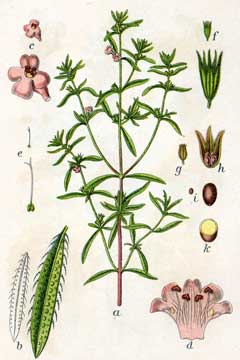
http://commons.wikimedia.org/wiki/File:Satureja_hortensis_Sturm51.jpg |
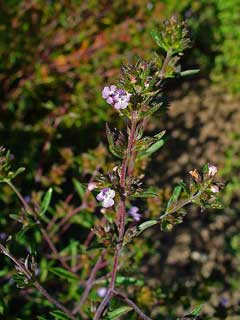 |
| http://commons.wikimedia.org/wiki/User:LlezSatureja montana |
Translate this page:
Summary
Physical Characteristics

 Satureja hortensis is a ANNUAL growing to 0.3 m (1ft) by 0.4 m (1ft 4in).
See above for USDA hardiness. It is hardy to UK zone 6. It is in flower from July to August, and the seeds ripen from August to September. The species is hermaphrodite (has both male and female organs) and is pollinated by Insects. The plant is self-fertile.
It is noted for attracting wildlife.
Suitable for: light (sandy) and medium (loamy) soils and prefers well-drained soil. Suitable pH: mildly acid, neutral and basic (mildly alkaline) soils and can grow in very alkaline soils.
It cannot grow in the shade. It prefers dry or moist soil and can tolerate drought.
UK Hardiness Map
US Hardiness Map
Synonyms
Plant Habitats
Cultivated Beds;
Edible Uses
Edible Parts: Leaves Shoots
Edible Uses: Condiment Tea
Leaves - raw or cooked[1, 2, 20, 27, 34, 37, 52]. An aromatic, slightly peppery flavour, they are used mainly as a flavouring for cooked foods, especially the more difficult to digest foods such as beans where they compliment the flavour and reduce flatulence[183, 244]. They are also used as a garnish for salads etc[183]. The leaves can be used fresh or dried[183]. A herb tea is made from the leaves[14]. The leaves are harvested just before the plant comes into flower[183]. A tangy, marjoram-like flavour[183]. The flowering shoots contain about 0.5% essential oil[7], this is used as a food flavouring[46, 61, 105].
References More on Edible Uses
Medicinal Uses
Plants For A Future can not take any responsibility for any adverse effects from the use of plants. Always seek advice from a professional before using a plant medicinally.
Antirheumatic Antiseptic Aromatic Carminative Digestive Expectorant Stings Stomachic
Summer savory is most often used as a culinary herb, but it also has marked medicinal benefits, especially upon the whole digestive system[254]. The plant has a milder action than the closely related winter savory, S. montana[254]. The whole herb, and especially the flowering shoots, is antiseptic, aromatic, carminative, digestive, expectorant and stomachic[4, 7, 14, 21]. Taken internally, it is said to be a sovereign remedy for colic and a cure for flatulence[4], whilst it is also used to treat nausea, diarrhoea, bronchial congestion, sore throat and menstrual disorders[238]. It should not be prescribed for pregnant women[238]. A sprig of the plant, rubbed onto bee or wasp stings, brings instant relief[4]. The plant is harvested in the summer when in flower and can be used fresh or dried[238]. The essential oil forms an ingredient in lotions for the scalp in cases of incipient baldness[7]. An ointment made from the plant is used externally to relieve arthritic joints[7].
References More on Medicinal Uses
The Bookshop: Edible Plant Books
Our Latest books on Perennial Plants For Food Forests and Permaculture Gardens in paperback or digital formats.
Edible Tropical Plants
Food Forest Plants for Hotter Conditions: 250+ Plants For Tropical Food Forests & Permaculture Gardens.
More
Edible Temperate Plants
Plants for Your Food Forest: 500 Plants for Temperate Food Forests & Permaculture Gardens.
More
More Books
PFAF have eight books available in paperback and digital formats. Browse the shop for more information.
Shop Now
Other Uses
References More on Other Uses
Cultivation details
A very easily grown plant when given suitable conditions, it prefers a rich light soil with plenty of moisture[1, 4, 14, 27] and succeeds in a hot dry sunny position[200]. It prefers growing in an alkaline soil[200] but is not too fussy. It is very intolerant of soils that remain damp and dislikes shade[200]. Summer savory is often grown as a culinary herb. It is a good companion plant in the garden, where it helps to repel insect pests and grows especially well with onions and beans[14, 18, 20]. A fast-growing plant, it can be harvested within 2 months of sowing the seed[244]. If cut back as the flower buds appear, it will produce a fresh flush of leaves[1]. Summer savory seeds can prevent the germination of nearby seeds[201]. The leaves have an aromatic fragrance[245]. The flowers are very attractive to bees[7, 14]. Members of this genus are rarely if ever troubled by browsing deer[233].
References Carbon Farming Information and Carbon Sequestration Information
Temperature Converter
Type a value in the Celsius field to convert the value to Fahrenheit:
Fahrenheit:
The PFAF Bookshop
Plants For A Future have a number of books available in paperback and digital form. Book titles include Edible Plants, Edible Perennials, Edible Trees,Edible Shrubs, Woodland Gardening, and Temperate Food Forest Plants. Our new book is Food Forest Plants For Hotter Conditions (Tropical and Sub-Tropical).
Shop Now
Plant Propagation
Seed - sow April in situ and only just cover[1]. Germinates in about 2 weeks. The plant strongly resents root disturbance so do not transplant it. In areas with mild winters an autumn sowing will provide an earlier supply of leaves[200].
Other Names
If available other names are mentioned here
Native Range
TEMPERATE ASIA: Turkey EUROPE: Russian Federation (European part), Ukraine (Krym (incl. Krym)), Former Yugoslavia, Albania, Greece, Spain, France (incl. Corsica)
Weed Potential
Right plant wrong place. We are currently updating this section.
Please note that a plant may be invasive in one area but may not
in your area so it's worth checking.
Conservation Status
IUCN Red List of Threatened Plants Status :

IUCN Red List
Growth: S = slow M = medium F = fast. Soil: L = light (sandy) M = medium H = heavy (clay). pH: A = acid N = neutral B = basic (alkaline). Shade: F = full shade S = semi-shade N = no shade. Moisture: D = dry M = Moist We = wet Wa = water.
Now available:
Food Forest Plants for Mediterranean Conditions
350+ Perennial Plants For Mediterranean and Drier Food Forests and Permaculture Gardens.
[Paperback and eBook]
This is the third in Plants For A Future's series of plant guides for food forests tailored to
specific climate zones. Following volumes on temperate and tropical ecosystems, this book focuses
on species suited to Mediterranean conditions—regions with hot, dry summers and cool, wet winters,
often facing the added challenge of climate change.
Read More
Expert comment
Author
L.
Botanical References
74200
Links / References
For a list of references used on this page please go here
Readers comment
| Add a comment |
|
If you have important information about this plant that may help other users please add a comment or link below. Only comments or links that are felt to be directly relevant to a plant will be included. If you think a comment/link or information contained on this page is inaccurate or misleading we would welcome your feedback at [email protected]. If you have questions about a plant please use the Forum on this website as we do not have the resources to answer questions ourselves.
* Please note: the comments by website users are not necessarily those held by PFAF and may give misleading or inaccurate information.
|
Subject : Satureja hortensis
|
|
|
|