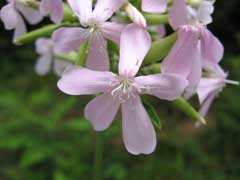
 |
|
www.flickr.com/people/simonjoan |
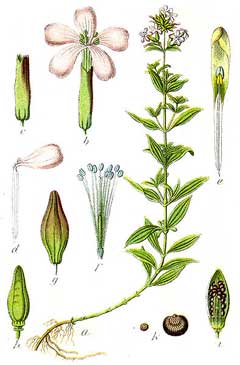 |
| http://commons.wikimedia.org/wiki/File:Caryophyllaceae_sp_Sturm25.jpg |
Translate this page:
Summary
Bloom Color: Pink. Main Bloom Time: Early summer, Late summer, Mid summer. Form: Upright or erect.
Physical Characteristics

 Saponaria officinalis is a PERENNIAL growing to 1 m (3ft 3in) by 1 m (3ft 3in) at a medium rate.
See above for USDA hardiness. It is hardy to UK zone 4 and is not frost tender. It is in flower from July to September, and the seeds ripen from August to September. The species is hermaphrodite (has both male and female organs) and is pollinated by Lepidoptera (Moths & Butterflies).
It is noted for attracting wildlife.
Suitable for: light (sandy), medium (loamy) and heavy (clay) soils and prefers well-drained soil. Suitable pH: mildly acid, neutral and basic (mildly alkaline) soils. It can grow in semi-shade (light woodland) or no shade. It prefers moist soil.
UK Hardiness Map
US Hardiness Map
Synonyms
Bootia saponaria. Bootia vulgaris. Lychnis officinalis. Silene saponaria.
Plant Habitats
Woodland Garden Sunny Edge; Dappled Shade; Ground Cover; Meadow; Hedgerow;
Edible Uses
References More on Edible Uses
Medicinal Uses
Plants For A Future can not take any responsibility for any adverse effects from the use of plants. Always seek advice from a professional before using a plant medicinally.
Alterative Antipruritic Antirheumatic Antiscrophulatic Cholagogue Cytotoxic Depurative Diaphoretic
Diuretic Expectorant Purgative Skin Sternutatory Tonic
Soapwort's main medicinal use is as an expectorant. Its strongly irritant action within the gut is thought to stimulate the cough reflex and increase the production of a more fluid mucus within the respiratory passages[254]. The whole plant, but especially the root, is alterative, antiscrophulatic, cholagogue, depurative, diaphoretic, mildly diuretic, expectorant, purgative, sternutatory and tonic[4, 7, 9, 13, 21, 218]. A decoction of the whole plant can be applied externally to treat itchy skin[4, 201, 238]. The plant has proved of use in the treatment of jaundice and other visceral obstructions[4], but is rarely used internally in modern herbalism due to its irritant effect on the digestive system[238]. When taken in excess, it destroys red blood cells and causes paralysis of the vasomotor centre[238]. See also the notes above on toxicity[4, 7]. The root is harvested in the spring and can be dried for later use[7]. One of the saponins in this plant is proving of interest in the treatment of cancer, it is cytotoxic to the Walker Carcinoma in vitro[218]. The German Commission E Monographs, a therapeutic guide to herbal medicine, approve Saponaria officinalis Soapwort. Bouncingbet for coughs/bronchitis (see [302] for critics of commission E).
References More on Medicinal Uses
The Bookshop: Edible Plant Books
Our Latest books on Perennial Plants For Food Forests and Permaculture Gardens in paperback or digital formats.

Edible Tropical Plants
Food Forest Plants for Hotter Conditions: 250+ Plants For Tropical Food Forests & Permaculture Gardens.
More

Edible Temperate Plants
Plants for Your Food Forest: 500 Plants for Temperate Food Forests & Permaculture Gardens.
More

More Books
PFAF have eight books available in paperback and digital formats. Browse the shop for more information.
Shop Now
Other Uses
Soap
A soap can be obtained by boiling the whole plant (but especially the root) in water[6, 13]. It is a gentle effective cleaner[7, 95], used especially on delicate fabrics that can be harmed by modern synthetic soaps (it has been used to clean the Bayeaux tapestry). It effects a lustre in the fabric[171]. The best soap is obtained by infusing the plant in warm water[169]. The roots can be dried and stored for later use[169]. The plant is sometimes recommended as a hair shampoo, though it can cause eye irritations[238]. The plant spreads vigorously and can be used as a ground cover when planted about 1 metre apart each way[208].
Special Uses
Attracts Wildlife Food Forest Ground cover Scented Plants
References More on Other Uses
Cultivation details
Landscape Uses:Border, Rock garden. Succeeds in any moderately fertile well-drained soil in sun or semi-shade[200]. Prefers a neutral to alkaline soil[238]. Hardy to about -20°c[187]. A very ornamental plant[1], soapwort is often grown in the herb garden and is sometimes cultivated for the soap that can be obtained from the roots. There are some named forms, usually with double flowers, that have been selected for their ornamental value[187]. Plants can be very invasive when grown in good conditions[K]. Soapwort should not be grown next to a pond with amphibians or fish in it since if the plant trails into the water it can cause poisoning[238]. The flowers are slightly scented with a sweet aroma that has an undertone of clove[245]. Hybridizes with other members of this genus[200]. A good moth plant[13, 24]. Special Features:Edible, Fragrant foliage, Not North American native, Invasive, Naturalizing, Attracts butterflies, Suitable for cut flowers, Fragrant flowers.
References Carbon Farming Information and Carbon Sequestration Information
Temperature Converter
Type a value in the Celsius field to convert the value to Fahrenheit:
Fahrenheit:
The PFAF Bookshop
Plants For A Future have a number of books available in paperback and digital form. Book titles include Edible Plants, Edible Perennials, Edible Trees,Edible Shrubs, Woodland Gardening, and Temperate Food Forest Plants. Our new book is Food Forest Plants For Hotter Conditions (Tropical and Sub-Tropical).
Shop Now
Plant Propagation
Seed - best if given a short cold stratification. Sow autumn or late winter in a cold frame. The seed usually germinates within 4 weeks. Prick out the seedlings into individual pots when they are large enough to handle and plant them out in early summer. Division in spring or autumn. Very easy, it can be successfully done at any time in the growing season if the plants are kept moist until they are re-established. Larger divisions can be planted out direct into their permanent positions. We have found it best to pot up the smaller divisions and grow them on in a lightly shaded position in a cold frame, planting them out once they are well established in the summer.
Other Names
If available other names are mentioned here
Native Range
TEMPERATE ASIA: Turkey, Russian Federation-Ciscaucasia (Ciscaucasia), Armenia, Azerbaijan, Georgia, Russian Federation-Western Siberia (Western Siberia (south)) EUROPE: Austria, Belgium, Switzerland, Czech Republic, Germany, Hungary, Netherlands, Poland, Slovakia, Russian Federation (European part), Belarus, Lithuania, Ukraine (incl. Krym), Albania, Bulgaria, Bosnia and Herzegovina, Greece, Croatia, Italy (incl. Sardinia, Sicily), North Macedonia, Montenegro, Romania, Serbia, Slovenia, Spain (incl. Baleares), France (incl. Corsica), Portugal
Weed Potential
Right plant wrong place. We are currently updating this section.
Please note that a plant may be invasive in one area but may not in your area so it's worth checking.
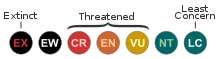
Conservation Status
IUCN Red List of Threatened Plants Status :
Growth: S = slow M = medium F = fast. Soil: L = light (sandy) M = medium H = heavy (clay). pH: A = acid N = neutral B = basic (alkaline). Shade: F = full shade S = semi-shade N = no shade. Moisture: D = dry M = Moist We = wet Wa = water.
Now available:
Food Forest Plants for Mediterranean Conditions
350+ Perennial Plants For Mediterranean and Drier Food Forests and Permaculture Gardens.
[Paperback and eBook]
This is the third in Plants For A Future's series of plant guides for food forests tailored to
specific climate zones. Following volumes on temperate and tropical ecosystems, this book focuses
on species suited to Mediterranean conditions—regions with hot, dry summers and cool, wet winters,
often facing the added challenge of climate change.
Read More
Expert comment
Author
L.
Botanical References
17200
Links / References
For a list of references used on this page please go here
Readers comment