 |
|
http://commons.wikimedia.org/wiki/User:Stan_Shebs |
 |
| http://commons.wikimedia.org/wiki/User:Digigalos |
Translate this page:
Summary
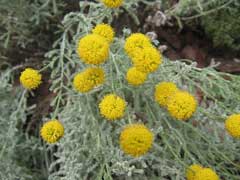
Bloom Color: Yellow. Main Bloom Time: Early summer, Early fall, Late summer, Mid summer. Form: Upright or erect.
Physical Characteristics

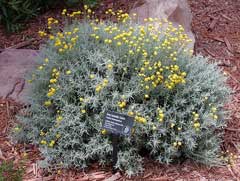
 Santolina chamaecyparissus is an evergreen Shrub growing to 0.6 m (2ft) by 1 m (3ft 3in) at a fast rate.
See above for USDA hardiness. It is hardy to UK zone 7. It is in leaf all year, in flower from July to August, and the seeds ripen from August to September. The species is hermaphrodite (has both male and female organs) and is pollinated by Insects.
Suitable for: light (sandy) and medium (loamy) soils, prefers well-drained soil and can grow in nutritionally poor soil. Suitable pH: mildly acid, neutral and basic (mildly alkaline) soils and can grow in very alkaline soils.
It cannot grow in the shade. It prefers dry or moist soil and can tolerate drought. The plant can tolerate maritime exposure.
UK Hardiness Map
US Hardiness Map
Synonyms
S. incana.
Plant Habitats
Woodland Garden Sunny Edge; Ground Cover; Hedge; Cultivated Beds; East Wall. In. South Wall. In. West Wall. In.
Edible Uses
Edible Parts:
Edible Uses: Condiment
The aromatic leaves are used as a flavouring for broths, sauces, grain dishes etc[15, 183].
References More on Edible Uses
Medicinal Uses
Plants For A Future can not take any responsibility for any adverse effects from the use of plants. Always seek advice from a professional before using a plant medicinally.
Antispasmodic Disinfectant Emmenagogue Stings Vermifuge
The leaves and flowering tops are antispasmodic, disinfectant, emmenagogue, stimulant and vermifuge[4, 7, 11, 201]. Cotton lavender is rarely used medicinally[238], though it is sometimes used internally as a vermifuge for children and to treat poor digestion and menstrual problems[4, 238]. When finely ground and applied to insect stings or bites, the plant will immediately ease the pain[7]. Applied to surface wounds, it will hasten the healing process by encouraging the formation of scar tissue[7]. The leaves and flowering stems are harvested in the summer and dried for later use[238].
References More on Medicinal Uses
The Bookshop: Edible Plant Books
Our Latest books on Perennial Plants For Food Forests and Permaculture Gardens in paperback or digital formats.
Edible Tropical Plants
Food Forest Plants for Hotter Conditions: 250+ Plants For Tropical Food Forests & Permaculture Gardens.
More
Edible Temperate Plants
Plants for Your Food Forest: 500 Plants for Temperate Food Forests & Permaculture Gardens.
More
More Books
PFAF have eight books available in paperback and digital formats. Browse the shop for more information.
Shop Now
Other Uses
Disinfectant Dye Essential Hedge Hedge Pot-pourri Repellent
Plants can be grown as a low formal hedge and used as an edging plant[200]. The plant is very tolerant of shearing[200]. In less exposed areas the plants can be trimmed in the autumn, otherwise they need to be cut by early April if they are to be allowed to flower[245]. Plants can also be grown for ground cover[190]. They are best spaced about 60cm apart each way[208]. The leaves are strewn amongst clothes to repel moths etc[4, 15, 18, 20, 100]. The growing plant repels various insect pests, especially cabbage moths[201]. The dried leaves are used in pot-pourri[238]. An essential oil from the leaves is used in perfumery[4], the oil is also obtained from the flowers[168].
Special Uses
Ground cover Hedge Hedge Scented Plants
References More on Other Uses
Cultivation details
Landscape Uses:Border, Foundation, Ground cover, Massing, Rock garden, Seashore. An easy and undemanding plant that does not require a rich soil, though it strongly dislikes wet conditions around the roots[1, 11, 15, 200]. Prefers a light sandy fairly poor soil on a sunny slope[200]. Prefers a chalky soil[190]. Established plants are drought tolerant[190]. They succeed in a hot dry position[190]. Hardy to about -15°c when in a well-drained soil. A very wind hardy plant, it succeeds on the top of Cornish dry-stone walls[49]. A very ornamental plant[1], there are several named varieties[245]. Cotton lavender tolerates shearing so long as this is not done at times of low resistance (winter?)[200]. Plants can be cut back hard in spring to maintain their form[200, 208], though this will prevent them flowering[208]. A good companion plant for roses[201]. Flowers are produced on two year old wood[182]. The leaves are very aromatic[190]. The bruised leaves are pleasantly pungent, though the flowers have an unpleasant smell[245]. The form S. chamaecyparissus nana has a more pungent aroma than the type[245]. Plants in this genus are notably resistant to honey fungus[200]. Special Features:
Attractive foliage, Fragrant foliage, Not North American native, Suitable for dried flowers.
References Carbon Farming Information and Carbon Sequestration Information
Temperature Converter
Type a value in the Celsius field to convert the value to Fahrenheit:
Fahrenheit:
The PFAF Bookshop
Plants For A Future have a number of books available in paperback and digital form. Book titles include Edible Plants, Edible Perennials, Edible Trees,Edible Shrubs, Woodland Gardening, and Temperate Food Forest Plants. Our new book is Food Forest Plants For Hotter Conditions (Tropical and Sub-Tropical).
Shop Now
Plant Propagation
Seed - sow spring in a greenhouse. Does not require pre-treatment[113]. Prick out the seedlings into individual pots when they are large enough to handle and grow them on in the greenhouse for their first winter. Plant them out in late spring or early summer of the following year. Cuttings of half-ripe side shoots, 5 - 8 cm long with a heel, July/August in a frame. Roots within 2 weeks. High percentage[78]. The heeled cuttings can also be placed direct into the open garden in early July and should be well-rooted by the winter[245]. Division in spring or autumn[111]. Larger divisions can be planted out direct into their permanent positions. We have found it best to pot up the smaller divisions and grow them on in a lightly shaded position in a cold frame, planting them out once they are well established in the summer. Layering.
Other Names
If available other names are mentioned here
Native Range
EUROPE: Croatia, Italy (incl. Sardinia, Sicily), Spain (incl. Baleares), France (incl. Corsica)
Weed Potential
Right plant wrong place. We are currently updating this section.
Please note that a plant may be invasive in one area but may not in your area so it's worth checking.
Conservation Status
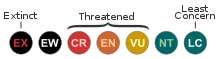
IUCN Red List of Threatened Plants Status :
Growth: S = slow M = medium F = fast. Soil: L = light (sandy) M = medium H = heavy (clay). pH: A = acid N = neutral B = basic (alkaline). Shade: F = full shade S = semi-shade N = no shade. Moisture: D = dry M = Moist We = wet Wa = water.
Now available:
Food Forest Plants for Mediterranean Conditions
350+ Perennial Plants For Mediterranean and Drier Food Forests and Permaculture Gardens.
[Paperback and eBook]
This is the third in Plants For A Future's series of plant guides for food forests tailored to
specific climate zones. Following volumes on temperate and tropical ecosystems, this book focuses
on species suited to Mediterranean conditions—regions with hot, dry summers and cool, wet winters,
often facing the added challenge of climate change.
Read More
Expert comment
Author
L.
Botanical References
11100200
Links / References
For a list of references used on this page please go here
Readers comment
© 2010, Plants For A Future. Plants For A Future is a charitable company limited by guarantee, registered in England and Wales. Charity No. 1057719, Company No. 3204567.