 |
|
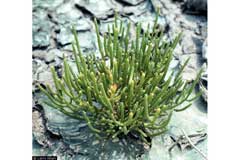
Larry Allain @ USDA-NRCS PLANTS Database |
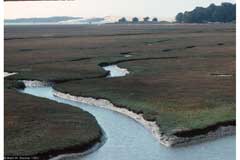 |
| Mark W. Skinner @ USDA-NRCS PLANTS Database |
Translate this page:
Summary
Taxonomic Note: This genus was formerly classified in the family Chenopodiaceae. Modern classifications include it within the Amaranthaceae.
A perennial of coastal marshes, Virginia glasswort is important for erosion control and wildlife. While edible, its salt content restricts its culinary use to garnish-sized servings or traditional preparations. Virginia glasswort provides edible stems and seeds, both salty but nutritious. Its value lies more in small-scale wild foraging than large-scale food use.
Physical Characteristics

 Salicornia virginica is a PERENNIAL growing to 0.3 m (1ft).
See above for USDA hardiness. It is hardy to UK zone 7. The species is hermaphrodite (has both male and female organs).
Suitable for: light (sandy), medium (loamy) and heavy (clay) soils. Suitable pH: mildly acid, neutral and basic (mildly alkaline) soils and can grow in very alkaline soils.
It cannot grow in the shade. It prefers moist soil.
UK Hardiness Map
US Hardiness Map
Synonyms
Salicornia depressa Standl.
Plant Habitats
Cultivated Beds;
Edible Uses
Edible Parts: Leaves
Edible Uses:
Young stems and seeds are edible. The stems are crisp and salty, suitable for eating raw, cooked, or pickled, but excessive salt intake is a concern. Seeds are small and enclosed in tough utricles, but once processed, they can be made into flour or porridge. Native Americans used the seeds as a grain in coastal areas [2-3]. Leaves - raw or cooked[172]. A salty flavour[207].
References More on Edible Uses
Medicinal Uses
Plants For A Future can not take any responsibility for any adverse effects from the use of plants. Always seek advice from a professional before using a plant medicinally.
Analgesic
The plant has been used externally in the treatment of arthritic pain, rheumatism, aches, pains and swellings[257].
References More on Medicinal Uses
The Bookshop: Edible Plant Books
Our Latest books on Perennial Plants For Food Forests and Permaculture Gardens in paperback or digital formats.
Edible Tropical Plants
Food Forest Plants for Hotter Conditions: 250+ Plants For Tropical Food Forests & Permaculture Gardens.
More
Edible Temperate Plants
Plants for Your Food Forest: 500 Plants for Temperate Food Forests & Permaculture Gardens.
More
More Books
PFAF have eight books available in paperback and digital formats. Browse the shop for more information.
Shop Now
Other Uses
Potash
The ashes of burnt plants are used in making glass and soap[207]. Useful for shoreline stabilization in estuarine restoration. Provides food for waterfowl and habitat for invertebrates.
Special Uses
References More on Other Uses
Cultivation details
Perennial halophyte forming dense mats. Helps bind soils in estuaries and contributes to wetland biodiversity. Common in coastal salt marshes, tidal flats, and brackish estuaries along both Atlantic and Pacific coasts of North America. We have very little information on this species and do not know if it will be hardy in Britain, though judging by its native range it should succeed outdoors in most parts of the country. There is some doubt over the correct application of this name, it probably refers to S. depressa[270]. The plants native habitat will give some idea of its cultivation needs. 20–70 cm tall, bushy with jointed succulent stems. Best grown in saline wet soils with periodic tidal flooding. Prefers full sun.
References Carbon Farming Information and Carbon Sequestration Information
Temperature Converter
Type a value in the Celsius field to convert the value to Fahrenheit:
Fahrenheit:
The PFAF Bookshop
Plants For A Future have a number of books available in paperback and digital form. Book titles include Edible Plants, Edible Perennials, Edible Trees,Edible Shrubs, Woodland Gardening, and Temperate Food Forest Plants. Our new book is Food Forest Plants For Hotter Conditions (Tropical and Sub-Tropical).
Shop Now
Plant Propagation
Seed - we have no information for this species but suggest sowing the seed as soon as it is ripe if this is possible, otherwise in spring, in a greenhouse in a light sandy compost. When they are large enough to handle, prick the seedlings out into individual pots and plant them out in the summer. Division might be possible in the spring.
Other Names
If available other names are mentioned here
Salicornia depressa Standl. (= Salicornia virginica L.). Virginia glasswort
Native Range
TEMPERATE ASIA: Afghanistan, Cyprus, Egypt (Sinai), Iran, Israel, Jordan, Lebanon, Syria, Turkey, Russian Federation-Ciscaucasia (Ciscaucasia), Azerbaijan, Georgia, Russian Federation (Dagestan), Russian Federation-Western Siberia (Western Siberia), Russian Federation-Eastern Siberia (Eastern Siberia), Kazakhstan, Kyrgyzstan, Tajikistan, Turkmenistan, Uzbekistan, Mongolia, Russian Federation (Primorye), China (Hebei Sheng, Gansu Sheng, Jiangsu Sheng, Liaoning Sheng, Shanxi Sheng, Shandong Sheng, Shaanxi Sheng, Qinghai Sheng, Nei Mongol Zizhiqu, Ningxia Huizi Zizhiqu, Xinjiang Uygur Zizhiqu), Korea, Japan TROPICAL ASIA: India EUROPE: Denmark, Finland, United Kingdom, Ireland, Norway, Sweden, Belgium, Czech Republic, Germany, Netherlands, Poland, Russian Federation-European part (European part (n. & s.)), Estonia, Lithuania, Latvia, Moldova, Ukraine (incl. Krym), Albania, Bulgaria, Greece (incl. Crete), Croatia, Italy (incl. Sicily), Romania, Slovenia, France (incl. Corsica) AFRICA: Egypt, Morocco
Weed Potential
Right plant wrong place. We are currently updating this section.
Please note that a plant may be invasive in one area but may not
in your area so it's worth checking.
Low – confined to saline wetlands.
Conservation Status
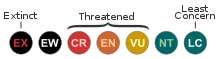
IUCN Red List of Threatened Plants Status :
IUCN Red List
Growth: S = slow M = medium F = fast. Soil: L = light (sandy) M = medium H = heavy (clay). pH: A = acid N = neutral B = basic (alkaline). Shade: F = full shade S = semi-shade N = no shade. Moisture: D = dry M = Moist We = wet Wa = water.
Now available:
Food Forest Plants for Mediterranean Conditions
350+ Perennial Plants For Mediterranean and Drier Food Forests and Permaculture Gardens.
[Paperback and eBook]
This is the third in Plants For A Future's series of plant guides for food forests tailored to
specific climate zones. Following volumes on temperate and tropical ecosystems, this book focuses
on species suited to Mediterranean conditions—regions with hot, dry summers and cool, wet winters,
often facing the added challenge of climate change.
Read More
Expert comment
Author
L.
Botanical References
60
Links / References
For a list of references used on this page please go here
Readers comment
© 2010, Plants For A Future. Plants For A Future is a charitable company limited by guarantee, registered in England and Wales. Charity No. 1057719, Company No. 3204567.