 |
|
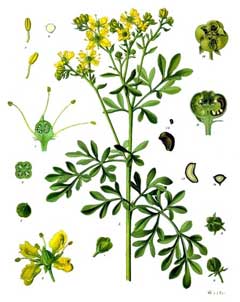
http://commons.wikimedia.org/wiki/File:Koeh-259.jpg |
 |
| http://commons.wikimedia.org/wiki/User:Llez |
Translate this page:
Summary
Ruta graveolens,
Rue leaves are edible but used cautiously due to their strong aromatic and bitter flavour and slight toxicity. The leaves are occasionally added to salads or used as a seasoning in small quantities, offering a bitter taste. Despite its toxicity, the plant has some health benefits as its leaves contain rutin, a compound known for improving circulatory health. The leaves can also be brewed into a tea. Historically, Rue was seen as a symbol of repentance, purification, and protection and used in religious ceremonies. In some European traditions, it was known as the “Herb of Grace” when sprinkled into holy water during ceremonies.
Rue is a resilient plant that can thrive in various soils but prefers well-drained, dry, or rocky soils. Once established, Rue is highly drought-tolerant. It is hardy to about -10°C and possibly lower if the soil is kept dry.
Rue is native to parts of the Balkan Peninsula and Krym. It has been introduced to many areas, including Algeria, the Balearic Islands, California, the Canary Islands, Corsica, France, Greece, Italy, Texas and Spain.
Harvesting: Leaves are used throughout the growing season, but the best time is late spring to early summer, just before flowering. Bloom Color: Yellow. Main Bloom Time: Early fall, Late summer. Form: Upright or erect.
Physical Characteristics

 Ruta graveolens is an evergreen Shrub growing to 0.5 m (1ft 8in) by 0.5 m (1ft 8in) at a medium rate.
See above for USDA hardiness. It is hardy to UK zone 5 and is not frost tender. It is in leaf all year, in flower from June to September, and the seeds ripen from August to October. The species is hermaphrodite (has both male and female organs) and is pollinated by Butterflies. The plant is self-fertile.
It is noted for attracting wildlife.
Suitable for: light (sandy), medium (loamy) and heavy (clay) soils, prefers well-drained soil and can grow in nutritionally poor soil. Suitable pH: mildly acid, neutral and basic (mildly alkaline) soils. It can grow in semi-shade (light woodland) or no shade. It prefers dry or moist soil and can tolerate drought.
UK Hardiness Map
US Hardiness Map
Synonyms
Ruta hortensis Mill.
Plant Habitats
Woodland Garden Sunny Edge; Dappled Shade; Ground Cover; Cultivated Beds; East Wall. In. South Wall. In. West Wall. In.
Edible Uses
Edible Parts: Leaves
Edible Uses: Condiment Rutin Tea
Leaves - raw or used as a seasoning[2, 7, 19, 21, 27, 89]. It is occasionally eaten in salads[4], but is strongly aromatic and slightly toxic, so should only be used in small quantities[7, 19, 148, 183]. The taste is strong and bitter[238]. The leaves contain rutin, which has a beneficial effect upon the circulatory system[218]. Some caution is advised, see notes on toxicity above. The leaves can be brewed into a tea[183].
References More on Edible Uses
Medicinal Uses
Plants For A Future can not take any responsibility for any adverse effects from the use of plants. Always seek advice from a professional before using a plant medicinally.
Abortifacient Anthelmintic Antidiarrhoeal Antidote Antiinflammatory Antispasmodic Carminative Emetic
Emmenagogue Expectorant Haemostatic Homeopathy Ophthalmic Rubefacient Stimulant
Stomachic
Rue has a long history of use as a domestic remedy, being especially valued for its strengthening action on the eyes[4]. The plant contains flavonoids (notably rutin) that reduce capillary fragility, which might explain the plants reputation as an eye strengthener[238]. Some caution is advised in its use internally, however, since in large doses it is toxic and it can also cause miscarriages[4, 7, 238]. The whole herb is abortifacient, anthelmintic, antidote, antispasmodic, carminative, emetic, emmenagogue, expectorant, haemostatic, ophthalmic, rubefacient, strongly stimulant, mildly stomachic and uterotonic[4, 7, 21, 165, 218]. The tops of fresh shoots are the most active medicinally, they should be gathered before the plant flowers and can be used fresh or dried[4]. An infusion is used in the treatment of hysterical affections, coughs, flatulence etc[4]. The juice of the plant has been used in treating earaches and chewing a leaf or two is said to quickly bring relief from giddiness, nervous headaches, palpitations etc[4]. An alkaloid found in the plant is abortifacient, anti-inflammatory and antispasmodic[218]. A homeopathic remedy is obtained from the fresh herb, harvested in early summer shortly before flowering begins[232]. This is used in the treatment of a variety of complaints including eye strain, headache and sprains[232].
References More on Medicinal Uses
The Bookshop: Edible Plant Books
Our Latest books on Perennial Plants For Food Forests and Permaculture Gardens in paperback or digital formats.

Edible Tropical Plants
Food Forest Plants for Hotter Conditions: 250+ Plants For Tropical Food Forests & Permaculture Gardens.
More

Edible Temperate Plants
Plants for Your Food Forest: 500 Plants for Temperate Food Forests & Permaculture Gardens.
More

More Books
PFAF have eight books available in paperback and digital formats. Browse the shop for more information.
Shop Now
Other Uses
Dye Essential Repellent Strewing
Agroforestry uses: Rue can be used as a companion plant to repel pests, making it useful in integrated pest management. Its strong scent can deter certain insects. The growing or the dried plant can be used to repel insects, it is most useful when the plant is grown near roses and raspberries[4, 14, 18, 20, 148]. Landscape Uses:Border, Container, Massing, Rock garden, Specimen. The dried herb can also be put in the linen cupboard to repel moths[14, 18]. The growing plant is also said to repel cats[20]. A red dye is obtained from the plant[148]. An essential oil is obtained from the leaves and young shoots, it is used in perfumery and as a food flavouring[61]. The plant was formerly used as a strewing herb[148]. Plants can be grown for ground cover when planted about 45cm apart each way[208]. They can be trimmed back in spring to keep them bushy[208]. 1. Nectary - Flowers rich in nectar and pollen:
Yes – Rue flowers provide nectar and pollen that attract pollinators like bees and some beneficial insects.
2. Wildlife - Food (Fruit, Seeds, Leaf litter, Shelter, Nesting, Roosting):
No – Rue does not produce fruits or seeds typically eaten by wildlife. However, its dense foliage can offer some shelter, though it’s not widely used for nesting or roosting.
3. Invertebrate Shelter (Overwintering sites, Leaf litter, Groundcover):
Yes – Rue’s structure, with its small leaf litter and rough bark, can provide shelter for some invertebrates, especially beneficial insects like predatory wasps.
4. Pest Confuser (Smell):
Yes – Rue has a strong, pungent scent that repels certain pests and can confuse herbivores, making it a good companion plant in gardens to deter insects and small mammals.
Special Uses
Ground cover Scented Plants
References More on Other Uses
Cultivation details
Succeeds in any soil but is hardier in a poor dry soil[4, 37, 200]. Prefers an open sunny position[7, 182]. Prefers a partially shaded sheltered dry position but succeeds in full sun[1, 4, 200]. Prefers a well-drained or rocky soil[200]. Likes some lime in the soil[11]. Established plants are drought tolerant[190]. Hardy to about -10°c, possibly to lower temperatures when it is grown in a dry soil[187]. Often cultivated as a culinary and medicinal herb, there are some named varieties[187]. The bruised leaves have a pleasant orange-like fragrance[245]. It is one of the most pleasant herbs to inhale[245]. Rue releases its scent in a remarkable way. The essential oil is contained in a cavity immediately beneath the surface of the leaf, above which is a thin layer of cells pierced by a cavity in the middle. The cells swell up and bend inwards, pressing on the essential oil beneath, which is driven to the surface of the leaf and there released[245]. Rue is a poor companion plant for many other species, growing badly with sage, cabbage and sweet basil[14, 18, 20, 201]. It is a good companion for roses and raspberries[201]. Plants in this genus are notably resistant to honey fungus[200]. Special Features:Attractive foliage, Edible, Not North American native, Suitable for cut flowers, Suitable for dried flowers. Rue leaves can be harvested throughout the growing season, but the best time is late spring to early summer, just before flowering.
Rue typically flowers in late spring to early summer, usually between May and July (Northern Hemisphere). Rue is a relatively slow-growing plant, taking about 2 to 3 years to establish fully and reach maturity. Rue is generally self-fertile.
References Carbon Farming Information and Carbon Sequestration Information
Temperature Converter
Type a value in the Celsius field to convert the value to Fahrenheit:
Fahrenheit:
The PFAF Bookshop
Plants For A Future have a number of books available in paperback and digital form. Book titles include Edible Plants, Edible Perennials, Edible Trees,Edible Shrubs, Woodland Gardening, and Temperate Food Forest Plants. Our new book is Food Forest Plants For Hotter Conditions (Tropical and Sub-Tropical).
Shop Now
Plant Propagation
Seed - best sown as soon as it is ripe in a cold frame[200], it can also be sown in early to mid spring in a cold frame[14, 27]. When they are large enough to handle, prick the seedlings out into individual pots and grow them on in the greenhouse for their first winter. Plant them out into their permanent positions in late spring or early summer, after the last expected frosts. Cuttings of young shoots in late spring[1]. Cuttings of half-ripe wood, July/August in a frame[200]. Very easy[K]. Layering in early summer. Old plants often self-layer[200].
Other Names
If available other names are mentioned here
Rue, Common rue, Herb of Grace, Garden Rue
Native Range
EUROPE: Ukraine (Krym), Former Yugoslavia, Albania, Bulgaria
Weed Potential
Right plant wrong place. We are currently updating this section.
Please note that a plant may be invasive in one area but may not in your area so it's worth checking.
Conservation Status
IUCN Red List of Threatened Plants Status :

| Related Plants
|
| Latin Name | Common Name | Habit | Height | Hardiness | Growth | Soil | Shade | Moisture | Edible | Medicinal | Other |
| Aegle marmelos | Bael Tree, Golden Apple, Bengal Quince | Tree | 10.0 |
10-12
| S | LMH | N | M | 3 | 3 | 4 |
| Afraegle paniculata | Nigerian Powder-Flask Fruit. African afraegle | Tree | 12.0 |
10-12
| F | LM | N | DM | 2 | 3 | 2 |
| Asplenium ruta-muraria | Wall Rue, Lance asplenium | Fern | 0.1 |
5-9
| S | LM | S | M | 0 | 2 | |
| Boenninghausenia albiflora | | Shrub | 1.0 |
7-10
| | LM | N | M | 0 | 2 | 2 |
| Boronia pinnata | Pinnate Boronia | Shrub | 2.0 |
8-11
| | L | N | DM | 0 | 0 | 2 |
| Casimiroa edulis | White Sapote, Mexican Apple | Tree | 16.0 |
8-11
| M | LMH | N | M | 5 | 3 | 2 |
| Cedrelopsis grevei | Katrafay, Kathrafay | Tree | 22.0 |
10-12
| S | LMH | N | DM | 2 | 4 | 3 |
| Chloroxylon swietenia | East Indian Satinwood | Tree | 18.0 |
10-12
| F | LMH | N | M | 0 | 3 | 4 |
| Choisya ternata | Mexican Orange Flower | Shrub | 3.0 |
6-9
| M | LM | FSN | M | 0 | 0 | 3 |
| Citrofortunella floridana | Limequat | Tree | 3.0 |
8-11
| | LMH | N | M | 2 | 0 | 0 |
| Citrofortunella microcarpa | Calamondin Orange | Tree | 5.0 |
0-0
| | LMH | N | M | 3 | 0 | 0 |
| Citrofortunella swinglei | Limequat | Tree | 0.0 |
0-0
| | LMH | N | M | 2 | 0 | 0 |
| Citroncirus | Citrumelo, Citroncirus, Citrange | Shrub | 3.0 |
7-10
| | LMH | N | M | 2 | 0 | |
| Citroncirus webberi | Citrange | Tree | 0.0 |
6-9
| | LMH | N | M | 2 | 0 | 1 |
| Citropsis gilletiana | Gillet's cherry-orange | Tree | 9.0 |
10-12
| M | LMH | N | M | 0 | 0 | 3 |
| Citrus aurantiifolia | Lime, Key Lime, Mexican Lime, Mexican Thornless Key Lime | Tree | 6.0 |
10-12
| M | LMH | N | M | 4 | 2 | 3 |
| Citrus aurantium | Bitter Orange, Sour orange, Bergamot orange | Tree | 9.0 |
8-11
| M | MH | N | M | 3 | 3 | 4 |
| Citrus hystrix | Kaffir Lime | Shrub | 6.0 |
9-12
| M | LMH | N | M | 3 | 2 | 3 |
| Citrus ichangensis | Ichang Papeda | Shrub | 4.5 |
7-10
| | LMH | N | M | 2 | 2 | |
| Citrus latifolia | Citrus Tahitian Lime | Tree | 5.0 |
9-11
| M | LMH | S | M | 4 | 2 | 2 |
| Citrus limon | Lemon | Shrub | 3.0 |
8-11
| M | MH | N | DM | 4 | 5 | 5 |
| Citrus medica | Citron | Shrub | 4.0 |
9-11
| M | LMH | N | DM | 3 | 2 | 3 |
| Citrus reticulata | Mandarin, Tangerine, Unshu orange, Satsuma Orange,Temple Orange, Tangerine | Tree | 4.5 |
9-11
| M | MH | N | M | 3 | 3 | 2 |
| Citrus sinensis | Sweet Orange | Tree | 9.0 |
9-11
| M | MH | N | M | 4 | 3 | 3 |
| Citrus x junos | Yuzu | Tree | 4.0 |
8-10
| M | LMH | SN | M | 3 | 1 | 3 |
| Citrus x meyeri | Lemon | Shrub | 3.0 |
8-11
| M | MH | N | M | 3 | 5 | 5 |
| Citrus x paradisi | Grapefruit, Pomelo, Pamplemousse | Tree | 7.0 |
9-11
| M | LMH | N | DM | 4 | 1 | 2 |
| Correa alba | Cape Barren Tea | Shrub | 1.5 |
8-11
| | LM | N | M | 1 | 0 | |
| Dictamnus albus | Burning Bush, Gasplant, White Dittany, | Perennial | 1.0 |
4-9
| S | LM | N | DM | 2 | 3 | 2 |
| Esenbeckia leiocarpa | Brazilian Boxwood, Guaranta | Tree | 25.0 |
10-12
| M | LMH | FS | M | 0 | 0 | 4 |
|
|
Growth: S = slow M = medium F = fast. Soil: L = light (sandy) M = medium H = heavy (clay). pH: A = acid N = neutral B = basic (alkaline). Shade: F = full shade S = semi-shade N = no shade. Moisture: D = dry M = Moist We = wet Wa = water.
Now available:
Food Forest Plants for Mediterranean Conditions
350+ Perennial Plants For Mediterranean and Drier Food Forests and Permaculture Gardens.
[Paperback and eBook]
This is the third in Plants For A Future's series of plant guides for food forests tailored to
specific climate zones. Following volumes on temperate and tropical ecosystems, this book focuses
on species suited to Mediterranean conditions—regions with hot, dry summers and cool, wet winters,
often facing the added challenge of climate change.
Read More
Expert comment
Author
L.
Botanical References
1189200
Links / References
For a list of references used on this page please go here
Readers comment