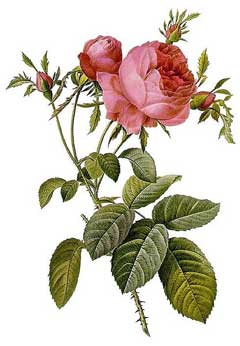
 |
|
http://commons.wikimedia.org/wiki/File:Rosa_centifolia_foliacea_17.jpg |
 |
| http://commons.wikimedia.org/wiki/User:Cillas |
Translate this page:
Summary
Physical Characteristics

 Rosa centifolia is a deciduous Shrub growing to 1.5 m (5ft).
See above for USDA hardiness. It is hardy to UK zone 6. It is in flower from June to July, and the seeds ripen from August to November. The species is hermaphrodite (has both male and female organs) and is pollinated by Insects. The plant is self-fertile.
Suitable for: light (sandy), medium (loamy) and heavy (clay) soils, prefers well-drained soil and can grow in heavy clay soil. Suitable pH: mildly acid, neutral and basic (mildly alkaline) soils. It can grow in semi-shade (light woodland) or no shade. It prefers moist soil.
UK Hardiness Map
US Hardiness Map
Synonyms
R. gallica centifolia. R. provincialis. non J.Herrm.
Plant Habitats
Woodland Garden Sunny Edge; Dappled Shade;
Edible Uses
Edible Parts: Flowers Fruit Seed
Edible Uses: Tea
Fruit - raw or cooked. A pulpy flesh[11]. It is best after it has been softened and sweetened by frost. There is only a thin layer of flesh surrounding the many seeds[K]. Some care has to be taken when eating this fruit, see the notes above on known hazards. The seed is a good source of vitamin E, it can be ground and mixed with flour or added to other foods as a supplement[102, 183]. Be sure to remove the seed hairs[102]. The blossoms are used for scenting tea[2, 46, 177, 183]. The petals are preserved in sugar and used as a delicacy[183]. They can also be added to fruit pies as a flavouring[183].
References More on Edible Uses
Medicinal Uses
Plants For A Future can not take any responsibility for any adverse effects from the use of plants. Always seek advice from a professional before using a plant medicinally.
Aromatherapy Astringent Cancer Laxative
The root is astringent[240]. The petals are laxative[240]. A syrup made from the petals is used to treat constipation in infants[240]. The fruit of many members of this genus is a very rich source of vitamins and minerals, especially in vitamins A, C and E, flavanoids and other bio-active compounds. It is also a fairly good source of essential fatty acids, which is fairly unusual for a fruit. It is being investigated as a food that is capable of reducing the incidence of cancer and also as a means of halting or reversing the growth of cancers[214]. The essential oil is used in aromatherapy. Its keyword is 'Cleansing'[210].
References More on Medicinal Uses
The Bookshop: Edible Plant Books
Our Latest books on Perennial Plants For Food Forests and Permaculture Gardens in paperback or digital formats.
Edible Tropical Plants
Food Forest Plants for Hotter Conditions: 250+ Plants For Tropical Food Forests & Permaculture Gardens.
More
Edible Temperate Plants
Plants for Your Food Forest: 500 Plants for Temperate Food Forests & Permaculture Gardens.
More
More Books
PFAF have eight books available in paperback and digital formats. Browse the shop for more information.
Shop Now
Other Uses
Essential Pot-pourri
An essential oil is obtained from the flowers, it is used in perfumery[57, 61, 171]. The dried petals are used in pot-pourri[4].
Special Uses
Scented Plants
References More on Other Uses
Cultivation details
Succeeds in most soils[11], preferring a circumneutral soil and a sunny position[200]. Grows well in heavy clay soils. Dislikes water-logged soils[200]. A very ornamental plant[1], there are many named forms developed for their ornamental value[245]. The flowers are fragrant[245]. The Provence rose is often cultivated for its essential oil in southern France and Morocco[4, 61]. It is closely related to R. damascena and R. gallica[11]. Grows well with alliums, parsley, mignonette and lupins[18, 20]. Garlic planted nearby can help protect the plant from disease and insect predation[18, 20]. Grows badly with boxwood[18]. Plants produce a few suckers[200]. Hybridizes freely with other members of this genus[80]. Plants in this genus are notably susceptible to honey fungus[200].
References Carbon Farming Information and Carbon Sequestration Information
Temperature Converter
Type a value in the Celsius field to convert the value to Fahrenheit:
Fahrenheit:
The PFAF Bookshop
Plants For A Future have a number of books available in paperback and digital form. Book titles include Edible Plants, Edible Perennials, Edible Trees,Edible Shrubs, Woodland Gardening, and Temperate Food Forest Plants. Our new book is Food Forest Plants For Hotter Conditions (Tropical and Sub-Tropical).
Shop Now
Plant Propagation
Seed. Rose seed often takes two years to germinate. This is because it may need a warm spell of weather after a cold spell in order to mature the embryo and reduce the seedcoat[80]. One possible way to reduce this time is to scarify the seed and then place it for 2 - 3 weeks in damp peat at a temperature of 27 - 32°c (by which time the seed should have imbibed). It is then kept at 3°c for the next 4 months by which time it should be starting to germinate[80]. Alternatively, it is possible that seed harvested 'green' (when it is fully developed but before it has dried on the plant) and sown immediately will germinate in the late winter. This method has not as yet(1988) been fully tested[80]. Seed sown as soon as it is ripe in a cold frame sometimes germinates in spring though it may take 18 months. Stored seed can be sown as early in the year as possible and stratified for 6 weeks at 5°c[200]. It may take 2 years to germinate[200]. Prick out the seedlings into individual pots when they are large enough to handle. Plant out in the summer if the plants are more than 25cm tall, otherwise grow on in a cold frame for the winter and plant out in late spring. Cuttings of half-ripe wood with a heel, July in a shaded frame. Overwinter the plants in the frame and plant out in late spring[78]. High percentage[78]. Cuttings of mature wood of the current seasons growth. Select pencil thick shoots in early autumn that are about 20 - 25cm long and plant them in a sheltered position outdoors or in a cold frame[78, 200]. The cuttings can take 12 months to establish but a high percentage of them normally succeed[78]. Division of suckers in the dormant season. Plant them out direct into their permanent positions. Layering. Takes 12 months[11].
Other Names
If available other names are mentioned here
Native Range
Coming Soon
Weed Potential
Right plant wrong place. We are currently updating this section.
Please note that a plant may be invasive in one area but may not in your area so it's worth checking.
Conservation Status
IUCN Red List of Threatened Plants Status :

| Related Plants
|
| Latin Name | Common Name | Habit | Height | Hardiness | Growth | Soil | Shade | Moisture | Edible | Medicinal | Other |
| Acaenia anserinifolia | Pirri-Pirri Bur | Perennial | 0.1 |
5-9
| F | LMH | SN | M | 1 | 1 | 3 |
| Aciphylla squarrosa | Speargrass | Perennial | 2.5 |
4-8
| | LM | N | DM | 2 | 0 | 1 |
| Adenostoma fasciculatum | Greasewood | Shrub | 3.0 |
7-10
| | LMH | N | DM | 0 | 1 | 2 |
| Adenostoma sparsifolium | Redshank | Shrub | 6.0 |
7-10
| | LMH | N | DM | 1 | 1 | 2 |
| Agrimonia eupatoria | Agrimony, Churchsteeples | Perennial | 0.6 |
0-0
| | LMH | SN | DM | 2 | 3 | 1 |
| Agrimonia parviflora | Harvestlice | Perennial | 2.0 |
-
| | LMH | SN | DM | 0 | 2 | |
| Agrimonia pilosa | Hairy Agrimony | Perennial | 0.6 |
-
| | LMH | SN | DM | 2 | 3 | |
| Agrimonia striata | Roadside agrimony | | 0.0 |
0-0
| | LMH | SN | M | 0 | 2 | 0 |
| Alchemilla alpina | Alpine Lady's Mantle, Mountain Lady's Mantle | Perennial | 0.2 |
3-7
| M | LMH | SN | DM | 2 | 3 | |
| Alchemilla mollis | Lady's-mantle | Perennial | 0.6 |
3-8
| M | LMH | FSN | M | 0 | 0 | 3 |
| Alchemilla xanthochlora | Lady's Mantle | Perennial | 0.3 |
0-0
| | LMH | SN | DM | 2 | 3 | 3 |
| Amelanchier alnifolia | Saskatoon, Saskatoon serviceberry, Serviceberry | Shrub | 4.0 |
2-7
| M | LMH | SN | M | 5 | 2 | 3 |
| Amelanchier alnifolia cusickii | Cusick's Serviceberry | Shrub | 3.0 |
0-0
| | LMH | SN | M | 4 | 1 | 0 |
| Amelanchier alnifolia semiintegrifolia | Pacific Serviceberry | Shrub | 3.0 |
0-0
| S | LMH | SN | M | 5 | 1 | 1 |
| Amelanchier arborea | Downy Serviceberry, Alabama serviceberry, Juneberry, Common Serviceberry, Downy Serviceberry | Tree | 10.0 |
5-8
| S | LMH | SN | M | 3 | 1 | 2 |
| Amelanchier asiatica | Korean Juneberry | Tree | 8.0 |
4-8
| | LMH | SN | M | 3 | 0 | |
| Amelanchier bartramiana | Oblongfruit serviceberry | Shrub | 3.0 |
4-8
| | LMH | SN | M | 3 | 0 | 0 |
| Amelanchier basalticola | Dwarf Service-berry | Shrub | 3.0 |
4-8
| | LMH | SN | M | 4 | 0 | 0 |
| Amelanchier canadensis | Juneberry, Canadian serviceberry, Serviceberry Downy, Shadblow, Shadbush, Serviceberry | Shrub | 6.0 |
4-7
| M | LMH | SN | M | 4 | 1 | 4 |
| Amelanchier confusa | Apple Serviceberry | Shrub | 5.0 |
4-8
| | LMH | SN | M | 5 | 0 | 0 |
| Amelanchier humilis | Low serviceberry | Shrub | 1.8 |
4-8
| | LMH | SN | M | 3 | 0 | |
| Amelanchier huroensis | | Tree | 6.0 |
5-9
| | LMH | SN | M | 3 | 0 | |
| Amelanchier interior | Pacific serviceberry | Tree | 9.0 |
5-9
| | LMH | SN | M | 3 | 0 | |
| Amelanchier intermedia | June berry, | Shrub | 6.0 |
4-8
| | LMH | SN | M | 3 | 0 | 0 |
| Amelanchier laevis | Allegheny Shadberry, Allegheny serviceberry, Smooth Serviceberry | Shrub | 9.0 |
5-8
| M | LMH | SN | M | 5 | 1 | 2 |
| Amelanchier lamarckii | Apple Serviceberry | Shrub | 6.0 |
3-3
| | LMH | SN | M | 5 | 0 | 0 |
| Amelanchier obovalis | Southern Juneberry, Coastal serviceberry | Tree | 1.5 |
5-9
| | LMH | SN | M | 3 | 0 | 1 |
| Amelanchier ovalis | Snowy Mespilus, Dwarf Garden Serviceberry | Shrub | 5.0 |
5-7
| S | LMH | N | M | 2 | 0 | |
| Amelanchier ovalis integrifolia | | Shrub | 4.0 |
5-9
| | LMH | SN | M | 2 | 0 | |
| Amelanchier pallida | Pale Serviceberry | Shrub | 4.0 |
-
| | LMH | SN | M | 3 | 1 | |
|
|
Growth: S = slow M = medium F = fast. Soil: L = light (sandy) M = medium H = heavy (clay). pH: A = acid N = neutral B = basic (alkaline). Shade: F = full shade S = semi-shade N = no shade. Moisture: D = dry M = Moist We = wet Wa = water.
Now available:
Food Forest Plants for Mediterranean Conditions
350+ Perennial Plants For Mediterranean and Drier Food Forests and Permaculture Gardens.
[Paperback and eBook]
This is the third in Plants For A Future's series of plant guides for food forests tailored to
specific climate zones. Following volumes on temperate and tropical ecosystems, this book focuses
on species suited to Mediterranean conditions—regions with hot, dry summers and cool, wet winters,
often facing the added challenge of climate change.
Read More
Expert comment
Author
L.
Botanical References
11200
Links / References
For a list of references used on this page please go here
Readers comment
| Add a comment |
|
If you have important information about this plant that may help other users please add a comment or link below. Only comments or links that are felt to be directly relevant to a plant will be included. If you think a comment/link or information contained on this page is inaccurate or misleading we would welcome your feedback at [email protected]. If you have questions about a plant please use the Forum on this website as we do not have the resources to answer questions ourselves.
* Please note: the comments by website users are not necessarily those held by PFAF and may give misleading or inaccurate information.
|
Subject : Rosa centifolia
|
|
|
|