 |
|
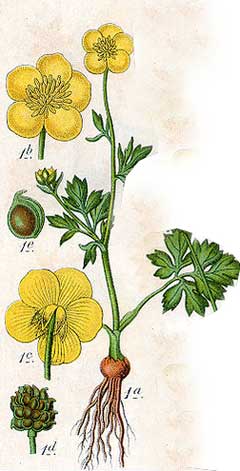
http://commons.wikimedia.org/wiki/File:Ranunculus_spp_Sturm51.jpg |
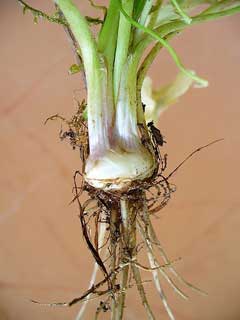 |
| http://commons.wikimedia.org/wiki/User:Llez |
Translate this page:
Summary
Physical Characteristics

 Ranunculus bulbosus is a PERENNIAL growing to 0.3 m (1ft) by 1 m (3ft 3in) at a fast rate.
It is not frost tender. It is in flower from March to June. The species is hermaphrodite (has both male and female organs) and is pollinated by Bees, flies, beetles, Lepidoptera (Moths & Butterflies).
Suitable for: light (sandy), medium (loamy) and heavy (clay) soils. Suitable pH: mildly acid, neutral and basic (mildly alkaline) soils. It can grow in semi-shade (light woodland) or no shade. It prefers moist soil.
UK Hardiness Map
US Hardiness Map
Synonyms
Plant Habitats
Lawn; Meadow;
Edible Uses
Edible Parts: Leaves Root
Edible Uses:
Leaves - cooked. A famine food used when all else fails[177], and I would rather give it a miss even then[K]! Root - must be dried beforehand and thoroughly cooked[105, 183]. When boiled, the roots are said to become so mild as to be eatable[2], though personally, I would rather give this one a miss as well[K]. See the notes above on toxicity.
References More on Edible Uses
Medicinal Uses
Plants For A Future can not take any responsibility for any adverse effects from the use of plants. Always seek advice from a professional before using a plant medicinally.
Acrid Anodyne Antirheumatic Antispasmodic Diaphoretic Rubefacient VD
The whole plant, and especially the sap, is acrid, anodyne, antispasmodic, diaphoretic, rubefacient[4, 21]. It was at one time rubbed on the skin by beggars in order to produce open sores and thereby excite sympathy[4]. The root has been placed in a tooth cavity to act as a painkiller[257]. A decoction of the plant has been used in the treatment of VD[257]. Use this remedy with caution, see the notes above on toxicity[21].
References More on Medicinal Uses
The Bookshop: Edible Plant Books
Our Latest books on Perennial Plants For Food Forests and Permaculture Gardens in paperback or digital formats.
Edible Tropical Plants
Food Forest Plants for Hotter Conditions: 250+ Plants For Tropical Food Forests & Permaculture Gardens.
More
Edible Temperate Plants
Plants for Your Food Forest: 500 Plants for Temperate Food Forests & Permaculture Gardens.
More
More Books
PFAF have eight books available in paperback and digital formats. Browse the shop for more information.
Shop Now
Other Uses
References More on Other Uses
Cultivation details
Prefers a moist loamy soil[1]. A common weed of lawns and gardens, it can be very difficult to eradicate when established[4]. It is a polymorphic species[17] and there is at least one named variety which has been selected for its ornamental value[187]. A greedy plant, inhibiting the growth of nearby plants, especially legumes[54].
References Carbon Farming Information and Carbon Sequestration Information
Temperature Converter
Type a value in the Celsius field to convert the value to Fahrenheit:
Fahrenheit:
The PFAF Bookshop
Plants For A Future have a number of books available in paperback and digital form. Book titles include Edible Plants, Edible Perennials, Edible Trees,Edible Shrubs, Woodland Gardening, and Temperate Food Forest Plants. Our new book is Food Forest Plants For Hotter Conditions (Tropical and Sub-Tropical).
Shop Now
Plant Propagation
Seed - sow spring in a cold frame. This species is a common weed and doesn't really need any help from us. Division in spring. Very easy, though probably totally unnecessary, larger divisions can be planted out direct into their permanent positions.
Other Names
If available other names are mentioned here
Native Range
TEMPERATE ASIA: Cyprus, Turkey, Russian Federation-Ciscaucasia (Ciscaucasia), Armenia, Azerbaijan, Georgia, Russian Federation (Dagestan) EUROPE: Denmark, Finland (south), United Kingdom, Ireland, Norway (south), Sweden (south), Austria, Belgium, Czech Republic, Germany, Hungary, Netherlands, Poland, Slovakia, Russian Federation-European part (European part (c.)), Belarus, Estonia, Lithuania, Latvia, Ukraine (w. & Krym), Albania, Bulgaria, Bosnia and Herzegovina, Greece (incl. Crete), Croatia, Italy (incl. Sardinia, Sicily), North Macedonia, Montenegro, Romania, Serbia, Slovenia, Spain (incl. Baleares), France (incl. Corsica), Portugal AFRICA: Algeria (north), Egypt (north), Morocco, Tunisia
Weed Potential
Right plant wrong place. We are currently updating this section.
Please note that a plant may be invasive in one area but may not in your area so it's worth checking.
Conservation Status
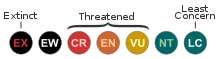
IUCN Red List of Threatened Plants Status :
| Related Plants
|
| Latin Name | Common Name | Habit | Height | Hardiness | Growth | Soil | Shade | Moisture | Edible | Medicinal | Other |
| Ranunculus acris | Meadow Buttercup, Tall buttercup, Showy buttercup | Perennial | 1.0 |
0-0
| | LMH | SN | MWe | 1 | 2 | 0 |
| Ranunculus aquatilis | Water Crowfoot, White water crowfoot | Annual/Perennial | 0.0 |
4-8
| | LMH | SN | MWeWa | 1 | 1 | |
| Ranunculus arvensis | Corn Buttercup | Annual | 0.5 |
0-0
| | LMH | SN | M | 0 | 1 | 0 |
| Ranunculus californicus | California Buttercup | Perennial | 0.6 |
6-9
| | LMH | SN | M | 1 | 0 | |
| Ranunculus chinensis | Hui Hui Suan | Perennial | 0.6 |
-
| | LMH | SN | MWe | 1 | 0 | |
| Ranunculus ficaria | Lesser Celandine - Pilewort, Fig buttercup | Perennial | 0.2 |
0-0
| F | LMH | SN | M | 1 | 2 | 3 |
| Ranunculus flammula | Lesser Spearwort, Greater creeping spearwort | Perennial | 0.6 |
4-8
| | LMH | SN | MWeWa | 0 | 1 | |
| Ranunculus hirtus | | Perennial | 0.0 |
-
| | LMH | SN | M | 0 | 1 | |
| Ranunculus inamoeus | Graceful Buttercup | Perennial | 0.3 |
-
| | LMH | SN | M | 1 | 0 | |
| Ranunculus japonicus | Mao Gen | Perennial | 0.1 |
-
| | LMH | SN | M | 1 | 1 | |
| Ranunculus kochii | | Perennial | 0.1 |
5-9
| | LMH | N | M | 1 | 0 | |
| Ranunculus muricatus | Rough-Seed Buttercup, Spinyfruit buttercup | Annual | 0.3 |
0-0
| | LMH | SN | M | 0 | 1 | |
| Ranunculus nipponicus | | Perennial | 0.0 |
-
| | LMH | SN | WeWa | 1 | 0 | |
| Ranunculus occidentalis | Western Buttercup | Perennial | 0.6 |
-
| | LMH | SN | M | 1 | 0 | |
| Ranunculus pallasii | Buttercup, Pallas' buttercup | Perennial | 0.1 |
0-0
| | LMH | SN | MWe | 1 | 0 | |
| Ranunculus pennsylvanicus | Pennsylvania Buttercup | Annual/Perennial | 1.0 |
-
| | LMH | SN | MWe | 1 | 1 | 2 |
| Ranunculus quelpaertensis | | Perennial | 0.6 |
-
| | LMH | SN | MWe | 1 | 0 | |
| Ranunculus repens | Creeping Buttercup, Prairie Double-flowered Buttercup, Water Buttercup, Creeping Buttercup | Perennial | 0.3 |
3-8
| F | LMH | SN | M | 1 | 1 | 0 |
| Ranunculus reptans | Creeping Spearwort | Perennial | 0.2 |
-
| F | LMH | SN | MWe | 1 | 0 | |
| Ranunculus rivularis | | Perennial | 0.0 |
-
| | LMH | SN | M | 0 | 1 | |
| Ranunculus sceleratus | Celery-Leaved Buttercup, Cursed buttercup | Perennial | 0.6 |
0-0
| | LMH | SN | MWeWa | 1 | 1 | 1 |
| Ranunculus tachreoi | | Perennial | 1.0 |
-
| | LMH | SN | M | 1 | 0 | |
| Ranunculus ternatus | | Perennial | 0.3 |
-
| | LMH | SN | M | 0 | 1 | |
|
Growth: S = slow M = medium F = fast. Soil: L = light (sandy) M = medium H = heavy (clay). pH: A = acid N = neutral B = basic (alkaline). Shade: F = full shade S = semi-shade N = no shade. Moisture: D = dry M = Moist We = wet Wa = water.
Now available:
Food Forest Plants for Mediterranean Conditions
350+ Perennial Plants For Mediterranean and Drier Food Forests and Permaculture Gardens.
[Paperback and eBook]
This is the third in Plants For A Future's series of plant guides for food forests tailored to
specific climate zones. Following volumes on temperate and tropical ecosystems, this book focuses
on species suited to Mediterranean conditions—regions with hot, dry summers and cool, wet winters,
often facing the added challenge of climate change.
Read More
Expert comment
Author
L.
Botanical References
17
Links / References
For a list of references used on this page please go here
Readers comment