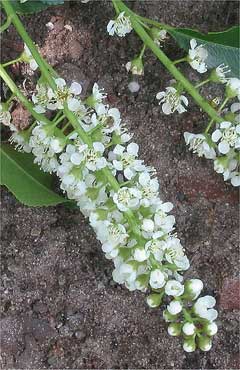
 |
|
http://commons.wikimedia.org/wiki/User:Rasbak |
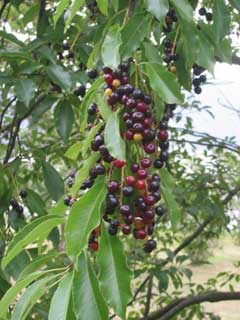 |
| http://commons.wikimedia.org/wiki/User:Rasbak |
Translate this page:
Summary
Bloom Color: White. Main Bloom Time: Early spring, Late spring, Mid spring. Form: Oval.
Physical Characteristics

 Prunus serotina is a deciduous Tree growing to 18 m (59ft) by 8 m (26ft) at a fast rate.
See above for USDA hardiness. It is hardy to UK zone 3. It is in flower from May to June, and the seeds ripen in September. The species is hermaphrodite (has both male and female organs) and is pollinated by Insects.
Suitable for: light (sandy), medium (loamy) and heavy (clay) soils and prefers well-drained soil. Suitable pH: mildly acid, neutral and basic (mildly alkaline) soils. It cannot grow in the shade. It prefers moist soil.
UK Hardiness Map
US Hardiness Map
Synonyms
Cerasus capollin Ser. ex DC. Prunus capuli Cav. Prunus salicifolia Kunth.
Plant Habitats
Woodland Garden Canopy;
Edible Uses
Edible Parts: Fruit Seed
Edible Uses: Condiment Drink
Fruit - raw or cooked in pies, jellies, stews etc[2, 11, 34, 55, 62, 101, 149, 183]. It must be fully ripe or else it will have a bitter flavour. The fruit can taste sweet or bitter[43]. The better fruits have a thin skin and a juicy flesh with a pleasant vinous flavour[82]. The fruit can also be used as a flavouring[149]. The taste is best when the plant is grown in a sunny position[159]. The fruit is about 9mm in diameter and contains one large seed[200]. Seed - raw or cooked. Do not eat the seed if it is too bitter - see the notes above on toxicity. An infusion of the twigs is used as a beverage[161, 257]. An extract from the bark is used commercially as a flavouring in soft drinks, sweets, syrups and baked goods[183].
References More on Edible Uses
Medicinal Uses
Plants For A Future can not take any responsibility for any adverse effects from the use of plants. Always seek advice from a professional before using a plant medicinally.
Antidiarrhoeal Antitussive Astringent Dysentery Pectoral Sedative Stomachic Tonic
Rum cherry was widely employed medicinally by various native North American Indian tribes who used it to treat a variety of complaints[257]. It is little, if at all, used in modern herbalism. The bark of the root, trunk and branches is antitussive, astringent, pectoral, sedative, stomachic, tonic[4, 21, 95, 165, 238]. The medicinal properties of this plant are destroyed by boiling, so the plant should only be allowed to steep in warm water[213]. The root bark and the aromatic inner bark have expectorant and mild sedative properties and a tea made from either of them has been used to ease pain in the early stages of labour[213, 222]. The tea is also used in the treatment of fevers, colds, sore throats, diarrhoea etc[222, 257]. The bark is harvested in the autumn and should not be stored for longer than one year since it quickly loses its medicinal properties[4, 213]. Young thin bark is preferred[213]. A decoction of the inner bark has been used in the treatment of laryngitis[257]. The root bark has been used as a wash on old sores and ulcers[257]. The bark contains the glycoside prunasin, which is converted in the digestive tract to the highly toxic hydrocyanic acid[222]. Prunasin is at its highest level in the bark in the autumn[222] so the bark is harvested at this time and can be dried for later use[254]. In small amounts this exceedingly poisonous compound stimulates respiration, improves digestion and gives a sense of well-being[238]. The fruit is astringent and has been used in the treatment of dysentery[213].
References More on Medicinal Uses
The Bookshop: Edible Plant Books
Our Latest books on Perennial Plants For Food Forests and Permaculture Gardens in paperback or digital formats.

Edible Tropical Plants
Food Forest Plants for Hotter Conditions: 250+ Plants For Tropical Food Forests & Permaculture Gardens.
More

Edible Temperate Plants
Plants for Your Food Forest: 500 Plants for Temperate Food Forests & Permaculture Gardens.
More

More Books
PFAF have eight books available in paperback and digital formats. Browse the shop for more information.
Shop Now
Other Uses
Dye Wood
A green dye can be obtained from the leaves[168]. A dark grey to green dye can be obtained from the fruit[168]. Wood - close and straight-grained, light, strong, rather hard, highly shock resistant[46, 82, 149, 171, 229]. It bends well, works well, finishes smoothly, glues well, seasons well, shrinks moderately and is moderately free from checking and warping[227]. It weighs about 36lb per cubic foot and takes a beautiful polish[227]. It is widely used for furniture, cabinet making, the interior finish of buildings etc[46, 82, 149, 171, 229].
Special Uses
References More on Other Uses
Cultivation details
Requires a well-drained moisture retentive soil[1, 11]. Requires a warm sunny position[11, 159]. Thrives in a loamy soil, doing well on limestone[11]. Prefers some chalk in the soil but apt to become chlorotic if too much is present[1]. A fast-growing and moderately long-lived tree in the wild, producing a heavy fruit crop about once every 4 years[229]. It is cultivated for its timber in C. Europe[50]. This species produces an abundance of flowers and usually fruits well in Britain[11]. In the wild the tree begins to fruit when about 10 years old and then continues for about 100 years, fruiting well in most years[149]. Most members of this genus are shallow-rooted and will produce suckers if the roots are damaged[238]. Plants in this genus are notably susceptible to honey fungus[200]. Special Features:
Attracts birds, North American native, Naturalizing, All or parts of this plant are poisonous, Attracts butterflies, Fragrant flowers, Attractive flowers or blooms.
References Carbon Farming Information and Carbon Sequestration Information
Temperature Converter
Type a value in the Celsius field to convert the value to Fahrenheit:
Fahrenheit:
The PFAF Bookshop
Plants For A Future have a number of books available in paperback and digital form. Book titles include Edible Plants, Edible Perennials, Edible Trees,Edible Shrubs, Woodland Gardening, and Temperate Food Forest Plants. Our new book is Food Forest Plants For Hotter Conditions (Tropical and Sub-Tropical).
Shop Now
Plant Propagation
Seed - requires 2 - 3 months cold stratification and is best sown in a cold frame as soon as it is ripe[200]. Sow stored seed in a cold frame as early in the year as possible[200]. Protect the seed from mice etc. The seed can be rather slow, sometimes taking 18 months to germinate[113]. Prick out the seedlings into individual pots when they are large enough to handle. Grow them on in a greenhouse or cold frame for their first winter and plant them out in late spring or early summer of the following year. Cuttings of half-ripe wood with a heel, July/August in a frame[11, 200]. Softwood cuttings from strongly growing plants in spring to early summer in a frame[200]. Layering in spring.
Other Names
If available other names are mentioned here
Native Range
NORTHERN AMERICA: Canada (Québec, New Brunswick (southeast)), United States (Indiana, Maine (east & south), Massachusetts, Michigan, New Hampshire, New York, Ohio, Pennsylvania, Vermont, West Virginia, Illinois, Iowa, Missouri, Oklahoma, Wisconsin, Alabama, Arkansas, Delaware, Florida, Georgia, Kentucky, Louisiana, Maryland, Mississippi, North Carolina, South Carolina, Tennessee, Virginia, Texas), Mexico (Chihuahua, Coahuila de Zaragoza, Durango, Sonora, Veracruz de Ignacio de la Llave) SOUTHERN AMERICA: Guatemala
Weed Potential
Right plant wrong place. We are currently updating this section.
Please note that a plant may be invasive in one area but may not in your area so it's worth checking.
Conservation Status
IUCN Red List of Threatened Plants Status :
| Related Plants
|
| Latin Name | Common Name | Habit | Height | Hardiness | Growth | Soil | Shade | Moisture | Edible | Medicinal | Other |
| Prunus africana | Pygeum | Tree | 18.0 |
10-12
| F | LM | N | M | 0 | 5 | 2 |
| Prunus alabamensis | Alabama Cherry | Tree | 8.0 |
-
| | LMH | SN | M | 2 | 1 | 1 |
| Prunus alleghaniensis | Allegheny Plum, Davis' plum | Tree | 3.5 |
4-8
| F | LMH | SN | M | 3 | 1 | 2 |
| Prunus americana | American Plum, American Wild Plum, Wild Plum | Tree | 6.0 |
3-8
| M | LMH | SN | M | 3 | 2 | 3 |
| Prunus americana lanata | | Tree | 10.0 |
3-7
| | LMH | SN | M | 3 | 1 | 2 |
| Prunus andersonii | Desert Peach | Shrub | 1.8 |
-
| | LMH | SN | M | 2 | 2 | 1 |
| Prunus angustifolia | Chickasaw Plum, Watson's plum, Hally Jolivette Cherry | Tree | 3.0 |
5-9
| M | LMH | SN | M | 3 | 1 | 3 |
| Prunus angustifolia watsonii | Sand Plum | Shrub | 3.0 |
5-9
| | LMH | SN | M | 4 | 1 | 2 |
| Prunus apetala | Clove Cherry | Shrub | 7.0 |
-
| | LMH | SN | M | 2 | 1 | 1 |
| Prunus arabica | | Shrub | 0.0 |
-
| | LMH | SN | DM | 2 | 1 | 2 |
| Prunus armeniaca | Apricot | Tree | 9.0 |
5-7
| M | LM | SN | M | 4 | 3 | 4 |
| Prunus armeniaca mandschurica | Manchurian apricot | Tree | 6.0 |
3-9
| M | LM | SN | M | 4 | 3 | 3 |
| Prunus avium | Wild Cherry, Sweet cherry | Tree | 18.0 |
3-7
| F | LMH | SN | M | 4 | 2 | 4 |
| Prunus besseriana | Dwarf Almond | Tree | 0.0 |
-
| | LMH | SN | M | 2 | 1 | 2 |
| Prunus besseyi | Western Sand Cherry | Shrub | 1.2 |
3-6
| M | LMH | SN | M | 4 | 1 | 2 |
| Prunus bifrons | | Shrub | 1.8 |
-
| | LMH | SN | M | 2 | 1 | 1 |
| Prunus bokharensis | Bokhara Plum | Tree | 0.0 |
-
| | LMH | SN | M | 2 | 1 | 1 |
| Prunus brigantina | Briançon Apricot | Tree | 6.0 |
6-9
| M | LMH | SN | DM | 4 | 1 | 3 |
| Prunus buergeriana | | Tree | 9.0 |
4-8
| | LMH | SN | M | 2 | 1 | 1 |
| Prunus campanulata | Taiwan Cherry | Tree | 7.0 |
7-9
| M | LMH | SN | M | 2 | 1 | 1 |
| Prunus canescens | Greyleaf Cherry | Shrub | 3.0 |
5-9
| | LMH | SN | M | 3 | 1 | 2 |
| Prunus capsica | | Tree | 0.0 |
-
| | LMH | SN | M | 2 | 1 | 1 |
| Prunus caroliniana | American Cherry Laurel, Carolina laurelcherry, Laurel Cherry, | Shrub | 12.0 |
7-10
| F | LMH | SN | DM | 2 | 1 | 3 |
| Prunus cerasifera | Cherry Plum, Myrobalan Plum, Newport Cherry Plum, Pissard Plum | Tree | 9.0 |
5-8
| M | LMH | SN | M | 4 | 1 | 3 |
| Prunus cerasifera divaricata | | Tree | 10.0 |
4-8
| | LMH | SN | M | 4 | 1 | 1 |
| Prunus cerasoides | Wild Himalayan Cherry | Tree | 30.0 |
7-10
| | LMH | SN | M | 2 | 2 | 2 |
| Prunus cerasus | Sour Cherry | Tree | 6.0 |
3-7
| | LMH | SN | M | 1 | 2 | 3 |
| Prunus cerasus austera | Morello Cherry | Tree | 9.0 |
3-7
| | LMH | SN | M | 3 | 1 | 3 |
| Prunus cerasus caproniana | Kentish Red Cherry | Tree | 9.0 |
3-7
| | LMH | SN | M | 3 | 1 | 3 |
| Prunus cerasus frutescens | Bush Sour Cherry | Tree | 1.0 |
3-7
| | LMH | SN | M | 3 | 1 | 3 |
|
|
Growth: S = slow M = medium F = fast. Soil: L = light (sandy) M = medium H = heavy (clay). pH: A = acid N = neutral B = basic (alkaline). Shade: F = full shade S = semi-shade N = no shade. Moisture: D = dry M = Moist We = wet Wa = water.
Now available:
Food Forest Plants for Mediterranean Conditions
350+ Perennial Plants For Mediterranean and Drier Food Forests and Permaculture Gardens.
[Paperback and eBook]
This is the third in Plants For A Future's series of plant guides for food forests tailored to
specific climate zones. Following volumes on temperate and tropical ecosystems, this book focuses
on species suited to Mediterranean conditions—regions with hot, dry summers and cool, wet winters,
often facing the added challenge of climate change.
Read More
Expert comment
Author
Ehrh.
Botanical References
1143200
Links / References
For a list of references used on this page please go here
Readers comment
| Add a comment |
|
If you have important information about this plant that may help other users please add a comment or link below. Only comments or links that are felt to be directly relevant to a plant will be included. If you think a comment/link or information contained on this page is inaccurate or misleading we would welcome your feedback at [email protected]. If you have questions about a plant please use the Forum on this website as we do not have the resources to answer questions ourselves.
* Please note: the comments by website users are not necessarily those held by PFAF and may give misleading or inaccurate information.
|
Subject : Prunus serotina
|
|
|
|