Translate this page:
Summary
Physical Characteristics

 Potentilla anserina is a PERENNIAL growing to 0.3 m (1ft) by 1 m (3ft 3in) at a fast rate.
See above for USDA hardiness. It is hardy to UK zone 5 and is not frost tender. It is in flower from June to August. The species is hermaphrodite (has both male and female organs) and is pollinated by Bees, flies, beetles. The plant is self-fertile.
Suitable for: light (sandy), medium (loamy) and heavy (clay) soils and prefers well-drained soil. Suitable pH: mildly acid, neutral and basic (mildly alkaline) soils. It can grow in semi-shade (light woodland) or no shade. It prefers moist soil. The plant can tolerate maritime exposure.
UK Hardiness Map
US Hardiness Map
Synonyms
Argentina anserina. Dactylophyllum anserinam. Fragaria anserina.
Plant Habitats
Woodland Garden Sunny Edge; Dappled Shade; Lawn; Meadow; Cultivated Beds;
Edible Uses
Edible Parts: Leaves Root
Edible Uses: Tea
Root - raw or cooked[66, 74, 183]. It can also be dried and ground into a powder then used in soups etc or mixed with cereals[5, 12, 13, 54]. A nice taste, crisp and nutty with a somewhat starchy flavour[85, 183]. The roots are rather thin, though perhaps their size cold be improved in cultivation[K]. Edible young shoots - raw[74]. A tea is made from the leaves.
References More on Edible Uses
Medicinal Uses
Plants For A Future can not take any responsibility for any adverse effects from the use of plants. Always seek advice from a professional before using a plant medicinally.
Analgesic Antidiarrhoeal Antispasmodic Astringent Diuretic Foot care Haemostatic Odontalgic
Tonic
Contemporary medical herbalists believe that silverweed's main medicinal value lies in its astringency. It is less astringent than the related P. erecta, but it has a gentler action within the gastro-intestinal tract[254]. The whole plant is antispasmodic, mildly astringent, diuretic, foot care, haemostatic, odontalgic and tonic[4, 7, 9, 21]. A strong infusion is used to check the bleeding of piles and to treat diarrhoea, it is also used as a gargle for sore throats[4]. Externally, it is used as a powder to treat ulcers and haemorrhoids whilst the whole bruised plant, placed over a painful area, will act as a local analgesic[7, 254]. The roots are the most astringent part of the plant[4], they are harvested in late summer or autumn and dried for later use[254]. The leaves are harvested in early summer and dried for later use[4]. The German Commission E Monographs, a therapeutic guide to herbal medicine, approve Potentilla anserina Silverweed for diarrhoea, inflammation of the mouth and pharynx, premenstrual syndrome (see [302] for critics of commission E).
References More on Medicinal Uses
The Bookshop: Edible Plant Books
Our Latest books on Perennial Plants For Food Forests and Permaculture Gardens in paperback or digital formats.

Edible Tropical Plants
Food Forest Plants for Hotter Conditions: 250+ Plants For Tropical Food Forests & Permaculture Gardens.
More

Edible Temperate Plants
Plants for Your Food Forest: 500 Plants for Temperate Food Forests & Permaculture Gardens.
More

More Books
PFAF have eight books available in paperback and digital formats. Browse the shop for more information.
Shop Now
Other Uses
Cleanser Tannin
A sprig placed in the shoe can help prevent blisters[66]. An infusion of the leaves makes an excellent skin cleansing lotion[66], it is also used cosmetically as a soothing lotion for reddened skin and for the delicate skins of babies[7]. All parts of the plant contain tannin, though the report does not give quantities[4]. A dynamic accumulator gathering minerals or nutrients from the soil and storing them in a more bioavailable form - used as fertilizer or to improve mulch.
Special Uses
Dynamic accumulator Food Forest
References More on Other Uses
Cultivation details
A very easily grown plant, succeeding in almost any soil, thriving in moist clays, though rather dwarfed in dry dusty soils[4]. It grows best in a well-drained loam, preferring a position in full sun but tolerating shade[1]. Prefers an alkaline soil but tolerates a slightly acid soil[200]. Silverweed was formerly cultivated for its edible root[5, 67]. It is still possibly cultivated in parts of Scotland (1992)[183]. This plant spreads vigorously by its running roots and can be very invasive[1, 4]. It grows well in a meadow, or places where the grass is only cut occasionally[K]. Members of this genus are rarely if ever troubled by browsing deer[233]. For polyculture design as well as the above-ground architecture (form - tree, shrub etc. and size shown above) information on the habit and root pattern is also useful and given here if available. The plant growth habit is a runner spreading indefinitely by rhizomes or stolons [1-2]. The root pattern is a tap root similar to a carrot going directly down [1-2]. The root pattern is stoloniferous rooting from creeping stems above the ground [1-2].
References Carbon Farming Information and Carbon Sequestration Information
Temperature Converter
Type a value in the Celsius field to convert the value to Fahrenheit:
Fahrenheit:
The PFAF Bookshop
Plants For A Future have a number of books available in paperback and digital form. Book titles include Edible Plants, Edible Perennials, Edible Trees,Edible Shrubs, Woodland Gardening, and Temperate Food Forest Plants. Our new book is Food Forest Plants For Hotter Conditions (Tropical and Sub-Tropical).
Shop Now
Plant Propagation
Seed - sow early spring or autumn in a cold frame. Prick out the seedlings into individual pots once they are large enough to handle and plant them out into their permanent positions in the summer. Division in spring. Division is also very easy at almost any time the plant is in growth. Larger divisions can be planted out direct into their permanent positions. We have found that it is better to pot up the smaller divisions and grow them on in light shade in a cold frame until they are well established before planting them out in late spring or early summer.
Other Names
If available other names are mentioned here
Native Range
TEMPERATE ASIA: Altay, Amur, Armenia, Azerbaijan, Buryatia, China, Chita, Ciscaucasia, Dagestan, Gansu Sheng, Georgia, Gorno-Altay, Hebei Sheng, Heilongjiang Sheng, Hokkaidô, Honshu, Iran, Irkutsk, Japan, Jilin Sheng, Kamcatskij kraj, Kazakhstan, Kemerovskaja oblast, Krasnoyarsk, Kurganskaja oblast, Kurile Islands, Kyrgyzstan, Lebanon, Liaoning Sheng, Mongolia, Nei Mongol Zizhiqu, Ningxia Huizi Zizhiqu, Novosibirsk, Omsk, Primorye, Qinghai Sheng, Respublika, Russian Federation, Russian Federation, Russian Federation, Russian Federation-Ciscaucasia, Sakhalin, Shaanxi Sheng, Shanxi Sheng, Sichuan Sheng, Tajikistan, Tomsk, Turkey, Turkmenistan, Tyumen, Tyva, Uzbekistan, Xinjiang Uygur Zizhiqu, Xizang Zizhiqu, Yakutia-Sakha, Yunnan Sheng,Afghanistan. TROPICAL ASIA: Bhutan, India (northwest), Nepal, Pakistan, NORTHERN AMERICA: Canada, Yukon, Québec, Nova Scotia, Ontario, Prince Edward Island, New Brunswick, Newfoundland and Labrador, Saskatchewan, Alberta, Manitoba, Greenland, United States, Alaska, Connecticut, Indiana (north), Maine, Massachusetts, Michigan, New York, Ohio (north), Pennsylvania (northwest), Rhode Island, Vermont, Illinois (north), Iowa (west), Minnesota (west), Nebraska, North Dakota, South Dakota, Wisconsin, Colorado, Idaho, Montana, Oregon (east), Washington (east), Wyoming, New Mexico, Arizona, California, Utah, EUROPE: Denmark, Finland, Faroe Islands, United Kingdom (U.K.), Ireland, Iceland, Norway, Sweden, Austria, Belgium, Switzerland, Czech Republic, Germany, Hungary, Netherlands, Poland, Slovakia, Russian Federation-European part, European part, Belarus, Estonia, Lithuania, Latvia, Moldova, Ukraine (incl. Krym), Bulgaria, Bosnia and Herzegovina, Croatia, Italy, Montenegro, Romania, Serbia, Slovenia, Spain, France, Portugal,
Weed Potential
Right plant wrong place. We are currently updating this section.
Please note that a plant may be invasive in one area but may not
in your area so it's worth checking.
Conservation Status
IUCN Red List of Threatened Plants Status :
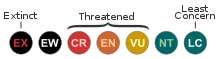
IUCN Red List
| Related Plants
|
| Latin Name | Common Name | Habit | Height | Hardiness | Growth | Soil | Shade | Moisture | Edible | Medicinal | Other |
| Potentilla bicolor | | Perennial | 1.0 |
5-9
| | LMH | SN | M | 1 | 0 | |
| Potentilla chinensis | Chinese Cinquefoil | Perennial | 0.6 |
-
| | LMH | SN | M | 1 | 1 | |
| Potentilla cryptotaeniae | | Perennial | 1.0 |
-
| | LMH | SN | M | 0 | 1 | |
| Potentilla discolor | | Perennial | 0.3 |
-
| | LMH | SN | M | 2 | 1 | |
| Potentilla egedei | Pacific Silverweed | Perennial | 0.5 |
4-8
| | LMH | SN | M | 2 | 1 | |
| Potentilla erecta | Tormentil, Erect cinquefoil | Perennial | 0.3 |
4-8
| | LMH | SN | M | 1 | 3 | 1 |
| Potentilla fragarioides | | Perennial | 0.3 |
-
| | LMH | SN | M | 1 | 1 | |
| Potentilla fruticosa | Shrubby Cinquefoil, Potentilla | Shrub | 1.2 |
2-6
| M | LMH | SN | M | 1 | 1 | 3 |
| Potentilla glandulosa | Gland Cinquefoil, Sticky cinquefoil, Arizona cinquefoil, Ashland cinquefoil, Ewan's cinquefoil, Hans | Perennial | 0.6 |
6-9
| | LMH | SN | M | 1 | 1 | |
| Potentilla hippiana | Woolly Cinquefoil | Perennial | 0.6 |
5-9
| | LMH | SN | M | 0 | 1 | |
| Potentilla kleiniana | | Perennial | 0.3 |
-
| | LMH | SN | M | 1 | 1 | |
| Potentilla multifida | | Perennial | 0.3 |
3-7
| | LMH | SN | M | 2 | 0 | |
| Potentilla nepalensis | Nepal Cinquefoil, Cinquefoil | Perennial | 0.6 |
5-10
| M | LMH | SN | M | 2 | 1 | |
| Potentilla norvegica | Norwegian Cinquefoil | Annual/Perennial | 0.3 |
3-7
| | LMH | SN | M | 0 | 1 | |
| Potentilla palustris | Marsh Cinquefoil | Perennial | 0.5 |
3-7
| | LMH | SN | We | 1 | 1 | 1 |
| Potentilla recta | Rough-Fruited Cinquefoil, Erect cinquefoil | Perennial | 0.6 |
4-8
| | LMH | SN | M | 2 | 1 | 0 |
| Potentilla reptans | Cinquefoil, Creeping cinquefoil | Perennial | 1.0 |
4-8
| | LMH | N | DM | 1 | 2 | 2 |
| Potentilla rupestris | Rock Cinquefoil | Perennial | 0.5 |
4-8
| | LMH | SN | DM | 1 | 0 | |
| Potentilla simplex | Old Field Cinquefoil, Common cinquefoil | Perennial | 0.1 |
3-7
| | LMH | SN | M | 0 | 1 | 0 |
| Potentilla supina | | Annual/Perennial | 0.3 |
-
| | LMH | SN | M | 1 | 1 | |
|
Growth: S = slow M = medium F = fast. Soil: L = light (sandy) M = medium H = heavy (clay). pH: A = acid N = neutral B = basic (alkaline). Shade: F = full shade S = semi-shade N = no shade. Moisture: D = dry M = Moist We = wet Wa = water.
Now available:
Food Forest Plants for Mediterranean Conditions
350+ Perennial Plants For Mediterranean and Drier Food Forests and Permaculture Gardens.
[Paperback and eBook]
This is the third in Plants For A Future's series of plant guides for food forests tailored to
specific climate zones. Following volumes on temperate and tropical ecosystems, this book focuses
on species suited to Mediterranean conditions—regions with hot, dry summers and cool, wet winters,
often facing the added challenge of climate change.
Read More
Expert comment
Author
L.
Botanical References
17200
Links / References
For a list of references used on this page please go here
Readers comment