 |
|
http://commons.wikimedia.org/wiki/File:Polygonatum_multiflorum_Sturm42.jpg |
 |
| http://commons.wikimedia.org/wiki/User:Fabelfroh |
Translate this page:
Summary
Physical Characteristics

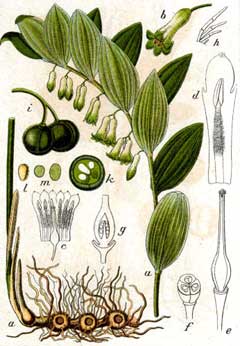
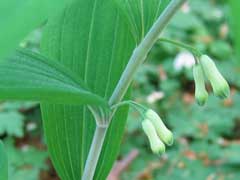
 Polygonatum multiflorum is a PERENNIAL growing to 1.2 m (4ft) by 0.3 m (1ft in).
See above for USDA hardiness. It is hardy to UK zone 4. It is in flower in June, and the seeds ripen in October. The species is hermaphrodite (has both male and female organs) and is pollinated by Bees. The plant is self-fertile.
Suitable for: light (sandy), medium (loamy) and heavy (clay) soils, prefers well-drained soil and can grow in heavy clay soil. Suitable pH: mildly acid, neutral and basic (mildly alkaline) soils. It can grow in full shade (deep woodland) or semi-shade (light woodland). It prefers dry or moist soil and can tolerate drought.
UK Hardiness Map
US Hardiness Map
Synonyms
Convallaria ambigua. Convallaria bracteata. Convallaria broteroi. Polygonatum salamonis.
Plant Habitats
Woodland Garden Dappled Shade; Shady Edge; not Deep Shade; Ground Cover;
Edible Uses
Edible Parts: Leaves Root Shoots
Edible Uses:
Young shoots - cooked. Boiled and used as an asparagus substitute, they make an excellent vegetable[2, 4, 115] and are widely used in Turkey[244]. Root - cooked[177, 179]. Rich in starch[115]. The root should be macerated for some time in water in order to remove bitter substances[4]. Normally only used in times of famine, the root was powdered and then made into a bread by the North American Indians[244].
References More on Edible Uses
Medicinal Uses
Plants For A Future can not take any responsibility for any adverse effects from the use of plants. Always seek advice from a professional before using a plant medicinally.
Astringent Demulcent Dysentery Emetic Poultice Tonic
Solomon's seal has been used for thousands of years in herbal medicine. It is used mainly in the form of a poultice and is believed to prevent excessive bruising and to stimulate tissue repair[254]. The root is astringent, demulcent, emetic and tonic[4, 21, 61, 240]. An infusion is healing and restorative, it is good in the treatment of stomach inflammations, chronic dysentery etc[4]. It is used with other herbs in the treatment of pulmonary problems, including tuberculosis, and women's complaints[4, 254]. The powdered roots make an excellent poultice for bruises, piles, inflammation etc[4]. The root is harvested in the autumn and dried for later use[4]. The plant should not be used internally except under professional supervision[254]. A distilled water made from the whole plant has been used as a skin tonic and is an ingredient of expensive cosmetics[244]. The dried powdered roots and flowers have been used as a snuff to promote sneezing and thus clear the bronchial passages[244].
References More on Medicinal Uses
The Bookshop: Edible Plant Books
Our Latest books on Perennial Plants For Food Forests and Permaculture Gardens in paperback or digital formats.

Edible Tropical Plants
Food Forest Plants for Hotter Conditions: 250+ Plants For Tropical Food Forests & Permaculture Gardens.
More

Edible Temperate Plants
Plants for Your Food Forest: 500 Plants for Temperate Food Forests & Permaculture Gardens.
More

More Books
PFAF have eight books available in paperback and digital formats. Browse the shop for more information.
Shop Now
Other Uses
Cosmetic
Plants can be grown for ground cover when spaced about 30cm apart each way[208]. A distilled water made from the whole plant is used as a cosmetic to improve the complexion[244].
Special Uses
Food Forest Ground cover
References More on Other Uses
Cultivation details
Prefers a fertile humus rich moisture retentive well-drained soil in cool shade or semi-shade[200]. Succeeds in dry shade if the soil is rich in humus[190]. Grows well in heavy clay soils. Plants are intolerant of heat and drought but tolerate most other conditions[200]. Another report suggests that they tolerate drought so long as the soil is rich in humus[190]. A very ornamental plant[1], growing well on the woodland edge[24]. There are some named forms[188]. Members of this genus are rarely if ever troubled by browsing deer or rabbits[233]. The young shoots of most members of this genus are very attractive to slugs[K]. Hybridizes with other members of this genus[200].
References Carbon Farming Information and Carbon Sequestration Information
Temperature Converter
Type a value in the Celsius field to convert the value to Fahrenheit:
Fahrenheit:
The PFAF Bookshop
Plants For A Future have a number of books available in paperback and digital form. Book titles include Edible Plants, Edible Perennials, Edible Trees,Edible Shrubs, Woodland Gardening, and Temperate Food Forest Plants. Our new book is Food Forest Plants For Hotter Conditions (Tropical and Sub-Tropical).
Shop Now
Plant Propagation
Seed - best sown as soon as it is ripe in early autumn in a shady part of a cold greenhouse[200]. Sow stored seed as early in the year as possible. Germination can be slow, they may not come true to type[200] and it takes a few years for them to reach a good size. When they are large enough to handle, prick the seedlings out into individual pots and grow them on in a shady position in the greenhouse for at least their first winter. Plant them out into their permanent positions in late spring or early summer, after the last expected frosts. Division in March or October. Larger divisions can be planted out direct into their permanent positions. We have found that it is better to pot up the smaller divisions and grow them on in light shade in a cold frame until they are well established before planting them out in late spring or early summer.
Other Names
If available other names are mentioned here
Native Range
TEMPERATE ASIA: Turkey, Russian Federation-Ciscaucasia (Ciscaucasia) TROPICAL ASIA: Nepal EUROPE: Denmark, Finland, United Kingdom, Norway, Czechoslovakia, Austria, Belgium, Switzerland, Germany, Hungary, Netherlands, Poland, Russian Federation (European part), Belarus, Russian Federation (Saratov, Volgogradskaja oblast), Ukraine, Former Yugoslavia, Albania, Bulgaria, Greece, Italy, Romania, Spain, France
Weed Potential
Right plant wrong place. We are currently updating this section.
Please note that a plant may be invasive in one area but may not in your area so it's worth checking.
Conservation Status
IUCN Red List of Threatened Plants Status :

Growth: S = slow M = medium F = fast. Soil: L = light (sandy) M = medium H = heavy (clay). pH: A = acid N = neutral B = basic (alkaline). Shade: F = full shade S = semi-shade N = no shade. Moisture: D = dry M = Moist We = wet Wa = water.
Now available:
Food Forest Plants for Mediterranean Conditions
350+ Perennial Plants For Mediterranean and Drier Food Forests and Permaculture Gardens.
[Paperback and eBook]
This is the third in Plants For A Future's series of plant guides for food forests tailored to
specific climate zones. Following volumes on temperate and tropical ecosystems, this book focuses
on species suited to Mediterranean conditions—regions with hot, dry summers and cool, wet winters,
often facing the added challenge of climate change.
Read More
Expert comment
Author
(L.)All.
Botanical References
17200
Links / References
For a list of references used on this page please go here
Readers comment
| Add a comment |
|
If you have important information about this plant that may help other users please add a comment or link below. Only comments or links that are felt to be directly relevant to a plant will be included. If you think a comment/link or information contained on this page is inaccurate or misleading we would welcome your feedback at [email protected]. If you have questions about a plant please use the Forum on this website as we do not have the resources to answer questions ourselves.
* Please note: the comments by website users are not necessarily those held by PFAF and may give misleading or inaccurate information.
|
Subject : Polygonatum multiflorum
|
|
|
|