 |
|
http://nl.wikipedia.org/wiki/Gebruiker:Roepers |
 |
| http://commons.wikimedia.org/wiki/User:Fabelfroh |
Translate this page:
Summary
Form: Spreading or horizontal, Upright or erect.
Physical Characteristics

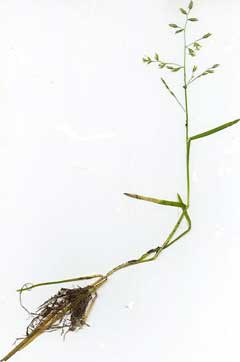
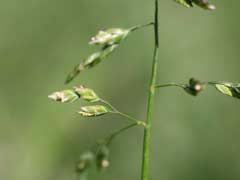
 Poa annua is a ANNUAL growing to 0.3 m (1ft) by 0.2 m (0ft 8in).
See above for USDA hardiness. It is hardy to UK zone 5 and is not frost tender. It is in leaf all year, in flower from February to November, and the seeds ripen from April to November. The species is hermaphrodite (has both male and female organs) and is pollinated by Wind, Cleistogomy (self-pollinating without flowers ever opening). The plant is self-fertile.
It is noted for attracting wildlife.
Suitable for: light (sandy), medium (loamy) and heavy (clay) soils and prefers well-drained soil. Suitable pH: mildly acid, neutral and basic (mildly alkaline) soils and can grow in very acid soils.
It cannot grow in the shade. It prefers moist soil.
UK Hardiness Map
US Hardiness Map
Synonyms
Plant Habitats
Lawn; Meadow;
Edible Uses
References More on Edible Uses
Medicinal Uses
Plants For A Future can not take any responsibility for any adverse effects from the use of plants. Always seek advice from a professional before using a plant medicinally.
None known
References More on Medicinal Uses
The Bookshop: Edible Plant Books
Our Latest books on Perennial Plants For Food Forests and Permaculture Gardens in paperback or digital formats.
Edible Tropical Plants
Food Forest Plants for Hotter Conditions: 250+ Plants For Tropical Food Forests & Permaculture Gardens.
More
Edible Temperate Plants
Plants for Your Food Forest: 500 Plants for Temperate Food Forests & Permaculture Gardens.
More
More Books
PFAF have eight books available in paperback and digital formats. Browse the shop for more information.
Shop Now
Other Uses
References More on Other Uses
Cultivation details
A very easily grown plant, it succeeds in any well-drained moderately fertile soil in a sunny position[1]. Tolerates very acid soils[1]. This plant is a very common garden weed and will not usually require cultivation. An important food plant for the caterpillars of many species of butterfly[30]. It is often found growing in close cut lawns[1]. The seed drops very readily from the plant so it is difficult to harvest[1]. This also means that the seed is spread very easily, making the plant even more difficult to eradicate[K]. Special Features:North American native.
References Carbon Farming Information and Carbon Sequestration Information
Temperature Converter
Type a value in the Celsius field to convert the value to Fahrenheit:
Fahrenheit:
The PFAF Bookshop
Plants For A Future have a number of books available in paperback and digital form. Book titles include Edible Plants, Edible Perennials, Edible Trees,Edible Shrubs, Woodland Gardening, and Temperate Food Forest Plants. Our new book is Food Forest Plants For Hotter Conditions (Tropical and Sub-Tropical).
Shop Now
Plant Propagation
Seed - there should be no problem with having to sow this plant since it does the job very effectively without our help.
Other Names
If available other names are mentioned here
Native Range
EUROPE: Russian Federation (Saratov, Volgogradskaja oblast)
Weed Potential
Right plant wrong place. We are currently updating this section.
Please note that a plant may be invasive in one area but may not in your area so it's worth checking.
Conservation Status
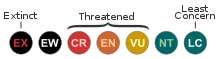
IUCN Red List of Threatened Plants Status :
| Related Plants
|
| Latin Name | Common Name | Habit | Height | Hardiness | Growth | Soil | Shade | Moisture | Edible | Medicinal | Other |
| Achnatherum hymenoides | Indian Millet, Indian ricegrass | Perennial | 0.6 |
7-10
| | LMH | N | M | 4 | 0 | 3 |
| Aegilops speltoides | Goatgrass | Annual | 0.6 |
0-0
| | LMH | SN | DM | 1 | 0 | |
| Aegilops triuncialis | Barbed goatgrass, Barb goatgrass | Annual | 0.3 |
8-10
| | LMH | N | DM | 1 | 0 | 0 |
| Agropyron elongatum | Tall Wheatgrass | Perennial | 1.8 |
5-9
| | LMH | N | DM | 0 | 0 | 3 |
| Agrostis capillaris | Browntop Bent Grass | Perennial | 0.4 |
3-10
| F | LM | SN | WeM | 0 | 0 | 4 |
| Agrostis perennans | Upland Bent, Upland bentgrass | Perennial | 0.9 |
0-0
| | LMH | SN | DM | 1 | 0 | 2 |
| Alopecurus aequalis | Shortawn Foxtail, Sonoma shortawn foxtail | Annual/Perennial | 0.3 |
0-0
| | LMH | SN | MWe | 2 | 1 | 0 |
| Ammophila arenaria | Marram Grass, European beachgrass | Perennial | 1.2 |
4-8
| | LM | N | DM | 1 | 0 | 4 |
| Ammophila breviligulata | Beach Grass, American beachgrass | Perennial | 1.3 |
4-8
| | LM | N | DM | 0 | 0 | |
| Ampelodesmos mauritanicus | Mauritanian grass | Perennial | 3.0 |
7-10
| | LM | N | DM | 0 | 0 | |
| Andropogon gerardii | Big Bluestem | Perennial | 2.0 |
4-8
| | L | N | DM | 0 | 1 | 2 |
| Andropogon virginicus | Broomsedge Bluestem | Perennial | 1.2 |
5-9
| | L | N | DM | 0 | 1 | 1 |
| Anthoxanthum odoratum | Sweet Vernal Grass | Perennial | 0.5 |
0-0
| | LMH | N | DM | 2 | 2 | 2 |
| Arundinaria gigantea | Canebrake bamboo, Cane Reed, Giant cane | Bamboo | 9.0 |
5-9
| | LMH | SN | M | 3 | 1 | 4 |
| Arundinaria spp | Running Bamboo | Bamboo | 10.0 |
4-10
| F | LMH | FSN | M | 3 | 1 | 4 |
| Arundinella hookeri | | Perennial | 6.0 |
6-9
| | LMH | N | M | 0 | 0 | 1 |
| Arundinella nepalensis | | Perennial | 2.0 |
6-9
| | LMH | N | M | 0 | 0 | 3 |
| Arundo donax | Giant Reed, Giant Reed Grass | Perennial | 6.0 |
6-10
| F | LMH | N | MWe | 3 | 2 | 4 |
| Astrebla pectinata | Barley Mitchell Grass | Perennial | 1.0 |
-
| | LMH | SN | M | 1 | 0 | |
| Astrebla squarrosa | Bull Mitchell grass | Perennial | 1.5 |
4-12
| F | LMH | N | DM | 4 | 0 | 1 |
| Avena abyssinica | Abyssinian Oat | Annual | 0.0 |
-
| | LMH | N | DM | 2 | 0 | 2 |
| Avena barbata | Slender Oat | Annual | 0.0 |
4-8
| F | LM | N | DM | 2 | 0 | 2 |
| Avena brevis | | Annual | 0.0 |
-
| | LMH | N | DM | 2 | 0 | 2 |
| Avena byzantina | Red Oat | Annual | 0.0 |
-
| | LMH | N | DM | 2 | 0 | 2 |
| Avena fatua | Wild Oats | Annual | 1.2 |
3-10
| | LMH | N | DM | 3 | 1 | 3 |
| Avena ludoviciana | Oats | Annual | 0.0 |
-
| | LMH | N | DM | 2 | 0 | 2 |
| Avena nuda | Naked Oat | Annual | 0.9 |
-
| | LMH | N | DM | 4 | 0 | 2 |
| Avena nudibrevis | | Annual | 0.0 |
-
| | LMH | N | DM | 2 | 0 | 2 |
| Avena orientalis | Hungarian Oat | Annual | 0.0 |
-
| | LMH | N | DM | 3 | 1 | 2 |
| Avena sativa | Oats, Common oat | Annual | 0.9 |
3-10
| | LMH | N | DM | 3 | 3 | 4 |
|
|
Growth: S = slow M = medium F = fast. Soil: L = light (sandy) M = medium H = heavy (clay). pH: A = acid N = neutral B = basic (alkaline). Shade: F = full shade S = semi-shade N = no shade. Moisture: D = dry M = Moist We = wet Wa = water.
Now available:
Food Forest Plants for Mediterranean Conditions
350+ Perennial Plants For Mediterranean and Drier Food Forests and Permaculture Gardens.
[Paperback and eBook]
This is the third in Plants For A Future's series of plant guides for food forests tailored to
specific climate zones. Following volumes on temperate and tropical ecosystems, this book focuses
on species suited to Mediterranean conditions—regions with hot, dry summers and cool, wet winters,
often facing the added challenge of climate change.
Read More
Expert comment
Author
L.
Botanical References
17
Links / References
For a list of references used on this page please go here
Readers comment
© 2010, Plants For A Future. Plants For A Future is a charitable company limited by guarantee, registered in England and Wales. Charity No. 1057719, Company No. 3204567.