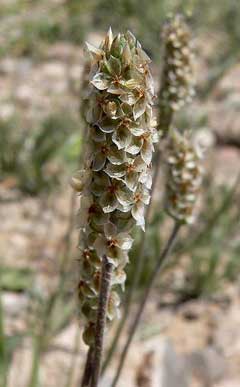
 |
|
http://commons.wikimedia.org/wiki/User:Stan_Shebs |
 |
| http://commons.wikimedia.org/wiki/User:Stan_Shebs |
Translate this page:
Summary
Physical Characteristics
![]()
![]() Plantago ovata is a ANNUAL. The species is hermaphrodite (has both male and female organs) and is pollinated by Wind. The plant is self-fertile.
Plantago ovata is a ANNUAL. The species is hermaphrodite (has both male and female organs) and is pollinated by Wind. The plant is self-fertile.
Suitable for: light (sandy), medium (loamy) and heavy (clay) soils and prefers well-drained soil. Suitable pH: mildly acid, neutral and basic (mildly alkaline) soils. It cannot grow in the shade. It prefers dry or moist soil.
UK Hardiness Map
US Hardiness Map
Synonyms
P. decumbens. P. ispaghula.
Plant Habitats
Cultivated Beds;
Edible Uses
Edible Parts: Leaves Seed
Edible Uses: Stabilizer
Young leaves - raw or cooked. The mucilage contained in the seedcoat is used as a stabilizer in ice cream, chocolate etc[105, 177, 183]. Seed - sprouted and eaten in salads[183].
References More on Edible Uses
Medicinal Uses
Plants For A Future can not take any responsibility for any adverse effects from the use of plants. Always seek advice from a professional before using a plant medicinally.
Anticholesterolemic Antidiarrhoeal Demulcent Dysentery Laxative Urinary
Psyllium has been used as a safe and effective laxative for thousands of years in Western herbal medicine[254]. Both the dried seeds and the seed husks are demulcent, emollient and laxative[4, 9, 46, 254]. They are used in the treatment of dysentery, catarrhal conditions of the genito-urinary tract, inflamed membranes of the intestinal canal etc[4, 46, 165, 171]. The seeds have a mucilaginous coat and swell to several times their volume when in water[9]. The seeds and the husks contain high levels of fibre, they expand and become highly gelatinous when soaked in water. By maintaining a high water content within the large bowel they increase the bulk of the stool, easing its passage[254]. They are used as a demulcent and as a bulk laxative in the treatment of constipation, dysentery and other intestinal complaints, having a soothing and regulatory effect upon the system[4, 9]. Their regulatory effect on the digestive system means that they can also be used in the treatment of diarrhoea and by helping to soften the stool they reduce the irritation of haemorrhoids[254]. The jelly-like mucilage produced when psyllium is soaked in water has the ability to absorb toxins within the large bowel. Thus it helps to remove toxins from the body and can be used to reduce auto-toxicity[254]. The oil in the seed embryo contains 50% linoleic acid and has been used as a preventative of atherosclerosis[240]. It is also effective in reducing cholesterol levels in the blood[240].
References More on Medicinal Uses
The Bookshop: Edible Plant Books
Our Latest books on Perennial Plants For Food Forests and Permaculture Gardens in paperback or digital formats.

Edible Tropical Plants
Food Forest Plants for Hotter Conditions: 250+ Plants For Tropical Food Forests & Permaculture Gardens.
More

Edible Temperate Plants
Plants for Your Food Forest: 500 Plants for Temperate Food Forests & Permaculture Gardens.
More

More Books
PFAF have eight books available in paperback and digital formats. Browse the shop for more information.
Shop Now
Other Uses
Starch
A mucilage found in the seed coat is sometimes used as a starch to stiffen linen[4].
Special Uses
References More on Other Uses
Cultivation details
We have very little information on this species and do not know if it will be hardy in Britain, though judging by its native habitat it should succeed outdoors in most parts of the country. This plant is cultivated for its seed in India[46, 61]. The following notes are based on the general needs of the genus. Succeeds in any moderately fertile soil in a sunny position[200].
References Carbon Farming Information and Carbon Sequestration Information
Temperature Converter
Type a value in the Celsius field to convert the value to Fahrenheit:
Fahrenheit:
The PFAF Bookshop
Plants For A Future have a number of books available in paperback and digital form. Book titles include Edible Plants, Edible Perennials, Edible Trees,Edible Shrubs, Woodland Gardening, and Temperate Food Forest Plants. Our new book is Food Forest Plants For Hotter Conditions (Tropical and Sub-Tropical).
Shop Now
Plant Propagation
Seed - sow spring in a cold frame. When they are large enough to handle, prick the seedlings out into individual pots and plant them out in early summer. A sowing can be made outdoors in situ in mid to late spring if you have enough seeds.
Other Names
If available other names are mentioned here
Native Range
TEMPERATE ASIA: Kuwait, Oman, Saudi Arabia, Yemen, Afghanistan, Cyprus, Egypt (Sinai), Iran, Iraq, Israel, Jordan, Syria, Azerbaijan, Turkmenistan TROPICAL ASIA: Pakistan EUROPE: Spain (south) AFRICA: Spain (Canarias), Portugal (Madeira Islands), Algeria, Egypt, Libya, Morocco, Tunisia
Weed Potential
Right plant wrong place. We are currently updating this section.
Please note that a plant may be invasive in one area but may not in your area so it's worth checking.
Conservation Status
IUCN Red List of Threatened Plants Status :
| Related Plants
|
| Latin Name | Common Name | Habit | Height | Hardiness | Growth | Soil | Shade | Moisture | Edible | Medicinal | Other |
| Alisma plantago-aquatica | Great Water Plantain, ZE-XIE, European water plantain, American water plantain, Northern water plan | Perennial | 0.9 |
5-9
| | LMH | N | WeWa | 1 | 3 | |
| Plantago affra | Psyllium | Annual | 0.6 |
-
| | LMH | N | DM | 1 | 3 | |
| Plantago amplexicaulis | | Annual | 0.1 |
-
| | LMH | N | DM | 1 | 2 | |
| Plantago arenaria | French Psyllium | Annual | 0.3 |
-
| | LMH | N | DM | 1 | 3 | |
| Plantago asiatica | Che Qian Zi | Perennial | 0.5 |
5-9
| | LMH | SN | M | 1 | 3 | 2 |
| Plantago australis | Mexican Plantain | Perennial | 0.2 |
-
| | LMH | N | M | 1 | 2 | |
| Plantago camtschatica | | Perennial | 0.3 |
-
| | LM | N | DM | 1 | 2 | |
| Plantago coronopus | Buck's-Horn Plantain | Annual/Perennial | 0.3 |
5-9
| | LM | N | DM | 3 | 2 | 2 |
| Plantago crassifolia | | Perennial | 0.2 |
-
| | LMH | N | M | 1 | 2 | |
| Plantago cunninghamii | | | 0.0 |
-
| | LMH | SN | M | 0 | 0 | |
| Plantago debilis | | Perennial | 0.4 |
-
| | LMH | SN | M | 0 | 0 | |
| Plantago decipiens | | Perennial | 0.2 |
-
| | LMH | N | DM | 1 | 2 | |
| Plantago depressa | | Perennial | 0.0 |
-
| | LMH | SN | M | 1 | 2 | |
| Plantago hakusanensis | | Perennial | 0.1 |
-
| | LMH | N | M | 1 | 2 | |
| Plantago juncoides | | Perennial | 0.0 |
-
| | LMH | N | DM | 1 | 2 | |
| Plantago lanceolata | Ribwort Plantain, Narrowleaf plantain | Perennial | 0.5 |
5-9
| | LMH | N | DM | 2 | 3 | 3 |
| Plantago major | Common Plantain, Cart Track Plant,White Man's Foot ,Plantain | Perennial | 0.1 |
3-12
| F | LMH | N | M | 2 | 3 | 3 |
| Plantago maritima | Sea Plantain, Goose tongue, California goose tongue | Perennial | 0.2 |
5-9
| | LMH | N | M | 3 | 2 | 2 |
| Plantago media | Hoary Plantain | Perennial | 0.1 |
5-9
| | LMH | N | DM | 2 | 2 | 2 |
| Plantago oliganthus | | Perennial | 0.2 |
-
| | LMH | N | M | 1 | 2 | |
| Plantago psyllium | Fleawort | Annual | 0.6 |
-
| | LMH | N | DM | 2 | 3 | 1 |
| Plantago rugelii | Blackseed Plantain | Annual/Perennial | 0.1 |
0-0
| | LMH | N | DM | 1 | 2 | 0 |
|
Growth: S = slow M = medium F = fast. Soil: L = light (sandy) M = medium H = heavy (clay). pH: A = acid N = neutral B = basic (alkaline). Shade: F = full shade S = semi-shade N = no shade. Moisture: D = dry M = Moist We = wet Wa = water.
Now available:
Food Forest Plants for Mediterranean Conditions
350+ Perennial Plants For Mediterranean and Drier Food Forests and Permaculture Gardens.
[Paperback and eBook]
This is the third in Plants For A Future's series of plant guides for food forests tailored to
specific climate zones. Following volumes on temperate and tropical ecosystems, this book focuses
on species suited to Mediterranean conditions—regions with hot, dry summers and cool, wet winters,
often facing the added challenge of climate change.
Read More
Expert comment
Author
Forssk.
Botanical References
50
Links / References
For a list of references used on this page please go here
Readers comment