 |
|
|
 |
| http://hu.wikipedia.org/wiki/Szerkeszt%C5%91:H3ini |
Translate this page:
Summary
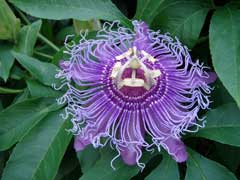
Bloom Color: Lavender, Pink, Purple. Main Bloom Time: Early summer, Early fall, Late summer, Mid summer. Form: Spreading or horizontal, Variable height, Variable spread.
Physical Characteristics

 Passiflora incarnata is an evergreen Climber growing to 6 m (19ft 8in) at a fast rate.
See above for USDA hardiness. It is hardy to UK zone 6 and is not frost tender. It is in leaf all year, in flower from June to July, and the seeds ripen from September to November. The species is hermaphrodite (has both male and female organs) and is pollinated by Bees.
Suitable for: light (sandy), medium (loamy) and heavy (clay) soils and prefers well-drained soil. Suitable pH: mildly acid, neutral and basic (mildly alkaline) soils. It cannot grow in the shade. It prefers moist soil.
UK Hardiness Map
US Hardiness Map
Synonyms
Plant Habitats
Woodland Garden Sunny Edge; Dappled Shade; South Wall. By. West Wall. By.
Edible Uses
Edible Parts: Flowers Fruit Leaves
Edible Uses:
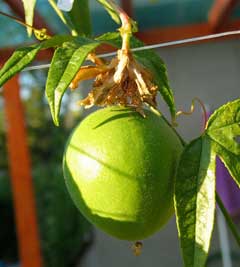
Fruit - raw or cooked in jellies, jams etc[2, 3, 21, 46, 61]183]. A sweet flavour[4], it is best when used as a jelly[95]. High in niacin[160]. Fairly large, the fruit is up to 5cm in diameter[200] though it contains relatively little edible pulp and a lot of seeds[K]. Leaves - raw or cooked. Said to be delicious as a cooked vegetable or when eaten in salads[183]. Flowers - cooked as a vegetable or made into syrup[183].
References More on Edible Uses
Medicinal Uses
Plants For A Future can not take any responsibility for any adverse effects from the use of plants. Always seek advice from a professional before using a plant medicinally.
Antidepressant Antispasmodic Astringent Diaphoretic Epilepsy Homeopathy Hypnotic Narcotic
Sedative Vasodilator Women's complaints
Maypops is a valuable sedative and tranquillising herb with a long history of use in North America[254]. It is frequently used in the treatment of insomnia, epilepsy, hysteria etc[254]. The leaves and stems are antispasmodic, astringent, diaphoretic, hypnotic, narcotic, sedative, vasodilator and are also used in the treatment of women's complaints[4, 7, 21, 46, 61, 165, 192, 207, 238]. The plant is harvested after some of the berries have matured and is then dried for later use[4]. It is used in the treatment of insomnia, nervous tension, irritability, neuralgia, irritable bowel syndrome, pre-menstrual tension and vaginal discharges[4, 21, 165, 192, 207]. An extract of the plant depresses the motor nerves of the spinal cord[213], it is also slightly sedative, slightly reduces blood pressure and increases respiratory rate[222]. The plant contains alkaloids and flavonoids that are an effective non-addictive sedative that does not cause drowsiness[238]. The plant is not recommended for use during pregnancy[238]. A poultice of the roots is applied to boils, cuts, earaches, inflammation etc[222]. The dried plant is exported from America to Europe for medicinal usage[207]. A homeopathic remedy is made from the plant[4]. The German Commission E Monographs, a therapeutic guide to herbal medicine, approve Passiflora incarnata for nervousness & insomnia (see [302] for critics of commission E).
References More on Medicinal Uses
The Bookshop: Edible Plant Books
Our Latest books on Perennial Plants For Food Forests and Permaculture Gardens in paperback or digital formats.
Edible Tropical Plants
Food Forest Plants for Hotter Conditions: 250+ Plants For Tropical Food Forests & Permaculture Gardens.
More
Edible Temperate Plants
Plants for Your Food Forest: 500 Plants for Temperate Food Forests & Permaculture Gardens.
More
More Books
PFAF have eight books available in paperback and digital formats. Browse the shop for more information.
Shop Now
Other Uses
References More on Other Uses
Cultivation details
Landscape Uses:Arbor, Container, Seashore. Requires a well-drained soil with plenty of moisture in the growing season, otherwise it is not fussy[1]. Another report says that it prefers a well-drained sandy slightly acid soil in full sun[238]. In a well-drained soil the roots are hardy to about -20°c, although top growth is killed back by frost[160, 200]. The top growth is cut back almost to the ground each year by some people and the plant treated as a herbaceous perennial[88]. The roots should be mulched in winter to prevent them from freezing. Plants thrive in a short growing season[160]. A climbing plant, supporting itself by means of tendrils[222]. Resistant to pests and diseases[160]. Plants in this genus are notably resistant to honey fungus[200]. Cultivated for its edible fruit by the North American Indians[2, 46]. Plants yield from 5 to 20 fruits annually in the wild[160]. Outdoor grown plants should have their roots restricted in order to encourage fruit production instead of excessive vegetative growth[1]. Hand pollinate using pollen from a flower that has been open for 12 hours to pollinate a newly opened flower before midday[88]. Special Features:
North American native, Attracts butterflies, Attractive flowers or blooms. For polyculture design as well as the above-ground architecture (form - tree, shrub etc. and size shown above) information on the habit and root pattern is also useful and given here if available. Herbaceous. A suckering vine sending up suckers some distance main plant [1-2]. The root pattern is stoloniferous rooting from creeping stems above the ground [1-2].
References Carbon Farming Information and Carbon Sequestration Information
Temperature Converter
Type a value in the Celsius field to convert the value to Fahrenheit:
Fahrenheit:
The PFAF Bookshop
Plants For A Future have a number of books available in paperback and digital form. Book titles include Edible Plants, Edible Perennials, Edible Trees,Edible Shrubs, Woodland Gardening, and Temperate Food Forest Plants. Our new book is Food Forest Plants For Hotter Conditions (Tropical and Sub-Tropical).
Shop Now
Plant Propagation
Pre-soak the seed for 12 hours in warm water and then sow late winter or early spring in a warm greenhouse. If sown in January and grown on fast it can flower and fruit in its first year[88]. The seed germinates in 1 - 12 months at 20°c. Prick out the seedlings into individual pots when they are large enough to handle. It you are intending to grow the plants outdoors, it is probably best to keep them in the greenhouse for their first winter and plant them out into their permanent positions in late spring or early summer, after the last expected frosts. Mulch the roots well in late autumn to protect them from the cold. Cuttings of young shoots, 15cm with a heel, in spring[1]. Leaf bud cuttings in spring. Cuttings of fully mature wood in early summer. Takes 3 months. High percentage[3].
Other Names
If available other names are mentioned here
Native Range
NORTHERN AMERICA: United States, Alabama, Arkansas, Bermuda, Florida, Georgia, Illinois, Indiana, Kansas, Kentucky, Louisiana, Mississippi, Missouri, North Carolina, Ohio, Oklahoma, Pennsylvania, South Carolina, Tennessee, Texas, Virginia, West Virginia,
Weed Potential
Right plant wrong place. We are currently updating this section.
Please note that a plant may be invasive in one area but may not in your area so it's worth checking.
Conservation Status
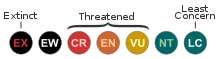
IUCN Red List of Threatened Plants Status :
Growth: S = slow M = medium F = fast. Soil: L = light (sandy) M = medium H = heavy (clay). pH: A = acid N = neutral B = basic (alkaline). Shade: F = full shade S = semi-shade N = no shade. Moisture: D = dry M = Moist We = wet Wa = water.
Now available:
Food Forest Plants for Mediterranean Conditions
350+ Perennial Plants For Mediterranean and Drier Food Forests and Permaculture Gardens.
[Paperback and eBook]
This is the third in Plants For A Future's series of plant guides for food forests tailored to
specific climate zones. Following volumes on temperate and tropical ecosystems, this book focuses
on species suited to Mediterranean conditions—regions with hot, dry summers and cool, wet winters,
often facing the added challenge of climate change.
Read More
Expert comment
Author
L.
Botanical References
43200
Links / References
For a list of references used on this page please go here
Readers comment