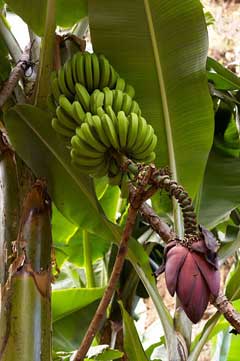
 |
|
http://commons.wikimedia.org/wiki/User:MichaD |
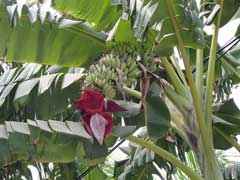 |
| http://commons.wikimedia.org/wiki/User:Miya.m |
Translate this page:
Summary
Physical Characteristics

 Musa acuminata is a PERENNIAL growing to 3 m (9ft 10in).
See above for USDA hardiness. It is hardy to UK zone 9 and is frost tender. The species is hermaphrodite (has both male and female organs).
Suitable for: light (sandy), medium (loamy) and heavy (clay) soils and prefers well-drained soil. Suitable pH: mildly acid, neutral and basic (mildly alkaline) soils. It can grow in semi-shade (light woodland) or no shade. It prefers moist soil.
UK Hardiness Map
US Hardiness Map
Synonyms
Plant Habitats
South Wall. By. West Wall. By.
Edible Uses
Edible Parts: Fruit Shoots Shoots
Edible Uses:
Fruit - raw or dried for later use[177
]. A sweet flavour[46
, 166
]. The fruit is up to 12cm long and 2.5cm wide[200
].
The male flowers are eaten raw or roasted and eaten like artichokes[301
, 362
].
Young shoots - cut finely and added to sauces[301
].
The tender core of the stem is eaten as a vegetable, in a similar manner to bamboo shoots[362
].
The leaves are occasionally used for wrapping foods[301
].
References More on Edible Uses
Medicinal Uses
Plants For A Future can not take any responsibility for any adverse effects from the use of plants. Always seek advice from a professional before using a plant medicinally.
Antibiotic Antidiarrhoeal Antifungal Antihaemorrhoidal Antitussive Astringent Digestive Dysentery
Epilepsy Hypoglycaemic Leprosy Poultice Skin Stings
Unripe fruits are astringent and are eaten as a treatment for diarrhoea[254
].
The peel and pulp of ripe bananas contain antifungal, antibiotic and dopamine factors[362
]. The ripe banana peel is abortive, and is also used as a salve to ease insect stings and bites[362
]. Ashes of the unripe peel and leaves are used as a treatment of dysentery, diarrhea and malignant ulcers[362
].
The leaves, dried and made into a syrup, are used in Cuba to treat coughs and chest conditions such as bronchitis[254
]. A decoction of the leaves is drunk to treat consumption[311
]. Painful urination is treated with juice from the leaves, and dysentery is treated with the leaves[311
].
A poultice of the leaves is used to treat burns and other skin ailments[362
].
The flowers are cooked as a remedy for bronchitis, dysentery, diabetics and ulcers[362
].
The root is strongly astringent and has been used to arrest the coughing up of blood[254
]. The roots are used to treat convulsions[311
].
A poultice of the roots has been used to treat carbuncles, swellings, digestive disorders and dysentery[362
]..
The pith of the suckers is used to treat burns[311
].
The stem is used to treat swellings of the armpit and groin and to treat haemorrhoids[311
]. An infusion of the stem pulp is used to treat dysentery[362
].
The sap is used as a treatment for epilepsy, leprosy, dysentery, diarrhea, and is applied on insect stings and bites[362
].
References More on Medicinal Uses
The Bookshop: Edible Plant Books
Our Latest books on Perennial Plants For Food Forests and Permaculture Gardens in paperback or digital formats.
Edible Tropical Plants
Food Forest Plants for Hotter Conditions: 250+ Plants For Tropical Food Forests & Permaculture Gardens.
More
Edible Temperate Plants
Plants for Your Food Forest: 500 Plants for Temperate Food Forests & Permaculture Gardens.
More
More Books
PFAF have eight books available in paperback and digital formats. Browse the shop for more information.
Shop Now
Other Uses
Containers Fibre Packing Paper Weaving
The leaves are used for packing, wrapping and decorative purposes[320
].
The leaves and shoots yield a fibre that can be used for making a high-quality cloth[362
].
Fibres from the stem are used for making rugs with a silk-like texture[362
]
Fibres from the bark are used for making paper[362
].
Special Uses
Carbon Farming Food Forest
References More on Other Uses
Cultivation details
Agroforestry Services: Crop shade Global Crop Industrial Crop: Fiber Management: Managed Multistem Other Systems: Dyke-pond Other Systems: Homegarden Other Systems: Multistrata Staple Crop: Basic Starch
A plant of the moist to humid tropics and subtropics, where it is found at elevations up to 2,400 metres. It grows best in areas where annual daytime temperatures are within the range 23 - 33°c, but can tolerate 12 - 42°c[418
]. The optimal temperature for fruit production is about 27°c, and night time temperatures should not fall much below 18°c when the fruit is ripening or flavour can be impaired[200
]. It is not frost tolerant and can be killed by temperatures of 1°c or lower[418
]. It prefers a mean annual rainfall in the range 1,200 - 3,600mm, but tolerates 650 - 5,000mm[418
].
Requires a sunny sheltered position in a well-drained fertile soil with a pH between 6 and 7.5[200
]. Prefers a pH in the range 5.5 - 7.5, tolerating 4 - 8.4[418
].
Wild plants are diploid (2n = 22) and bear fruits containing numerous seeds making them inedible. Cultivated plants are triploid (2n = 33) and bear seedless, edible fruits; such plants have been called M. acuminata ‘Dwarf Cavendish’ (M. cavendishii Lambert ex Paxton; M. chinensis Sweet; M. nana Loureiro)[266].
Carbon Farming
-
Agroforestry Services: Crop shade
Plants providing crop shade especially trees.
-
Global Crop
These crops are already grown or traded around the world. The annual value of each is more than $1 billion US Examples include coconuts, almonds, and bananas.
-
Industrial Crop: Fiber
Clothing, rugs, sheets, blankets etc. Currently, almost none of our fiber are produced from perennial crops but could be!
-
Management: Managed Multistem
Regularly removing some multiple stems. A non-A non-destructive management systems maintaining the soil organic carbon.
-
Other Systems: Dyke-pond
Aquaforestry integrating, fish, livestock and crops.
-
Other Systems: Homegarden
Tropical multistrata agroforestry (multi-story combinations of trees, crops, domestic animals in the homestead).
-
Other Systems: Multistrata
Multistrata agroforests feature multiple layers of trees often with herbaceous perennials, annual crops, and livestock.
-
Staple Crop: Basic Starch
The Carbon Farming Solution. Eric Toensmeier.
References Carbon Farming Information and Carbon Sequestration Information
Temperature Converter
Type a value in the Celsius field to convert the value to Fahrenheit:
Fahrenheit:
The PFAF Bookshop
Plants For A Future have a number of books available in paperback and digital form. Book titles include Edible Plants, Edible Perennials, Edible Trees,Edible Shrubs, Woodland Gardening, and Temperate Food Forest Plants. Our new book is Food Forest Plants For Hotter Conditions (Tropical and Sub-Tropical).
Shop Now
Plant Propagation
Seed - sow the large seed in individual pots in the spring in a warm greenhouse at about 20°c[200]. Grow the seedlings on in a rich soil, giving occasional liquid feeds. Keep the plants in the greenhouse for at least three years before trying them outdoors. Division of suckers in late spring. Dig up the suckers with care, trying to cause the least disturbance to the main plant. Pot them up and grow them on in a lightly shaded position in a greenhouse until they are well established.
Other Names
If available other names are mentioned here
Dwarf Banana, Apala, Guiteng, banana, bananas, banane, bananier du paradis, banano.
Native Range
TEMPERATE ASIA: Guangxi Zhuangzu Zizhiqu (west), Yunnan Sheng (southeast),China. TROPICAL ASIA: India (south), Sri Lanka, Indochina, Myanmar, Thailand, Indonesia, Malaysia, Philippines,
Weed Potential
Right plant wrong place. We are currently updating this section.
Please note that a plant may be invasive in one area but may not in your area so it's worth checking.
Conservation Status
IUCN Red List of Threatened Plants Status : Cultivated, Ornamental
Growth: S = slow M = medium F = fast. Soil: L = light (sandy) M = medium H = heavy (clay). pH: A = acid N = neutral B = basic (alkaline). Shade: F = full shade S = semi-shade N = no shade. Moisture: D = dry M = Moist We = wet Wa = water.
Now available:
Food Forest Plants for Mediterranean Conditions
350+ Perennial Plants For Mediterranean and Drier Food Forests and Permaculture Gardens.
[Paperback and eBook]
This is the third in Plants For A Future's series of plant guides for food forests tailored to
specific climate zones. Following volumes on temperate and tropical ecosystems, this book focuses
on species suited to Mediterranean conditions—regions with hot, dry summers and cool, wet winters,
often facing the added challenge of climate change.
Read More
Expert comment
Author
Colla.
Botanical References
200266
Links / References
For a list of references used on this page please go here
A special thanks to Ken Fern for some of the information used on this page.
Readers comment
| Add a comment |
|
If you have important information about this plant that may help other users please add a comment or link below. Only comments or links that are felt to be directly relevant to a plant will be included. If you think a comment/link or information contained on this page is inaccurate or misleading we would welcome your feedback at [email protected]. If you have questions about a plant please use the Forum on this website as we do not have the resources to answer questions ourselves.
* Please note: the comments by website users are not necessarily those held by PFAF and may give misleading or inaccurate information.
|
|