 |
|
|
 |
| http://commons.wikimedia.org/wiki/User:JMSchneid |
Translate this page:
Summary
Bloom Color: Lavender, Pink, Purple, Red, White. Main Bloom Time: Early summer, Early fall, Late summer, Mid summer. Form: Upright or erect.
Physical Characteristics

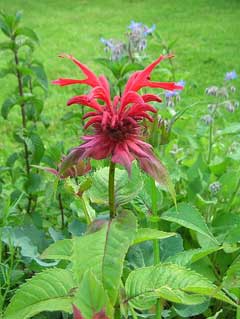
 Monarda didyma is a PERENNIAL growing to 0.9 m (3ft) by 0.5 m (1ft 8in) at a medium rate.
See above for USDA hardiness. It is hardy to UK zone 4 and is not frost tender. It is in leaf from April to October, in flower from June to September, and the seeds ripen from August to October. The species is hermaphrodite (has both male and female organs) and is pollinated by Bees. The plant is self-fertile.
It is noted for attracting wildlife.
Suitable for: light (sandy), medium (loamy) and heavy (clay) soils and can grow in heavy clay soil. Suitable pH: mildly acid, neutral and basic (mildly alkaline) soils. It can grow in semi-shade (light woodland) or no shade. It prefers moist soil.
UK Hardiness Map
US Hardiness Map
Synonyms
Plant Habitats
Woodland Garden Sunny Edge; Dappled Shade; Cultivated Beds;
Edible Uses
Edible Parts: Flowers Leaves Shoots
Edible Uses: Condiment Tea
Leaves and young shoot tips - raw or cooked. They are used as a flavouring in salads, fruit salads, drinks etc[46, 61, 105, 183]. Flowers - raw. They are added as an attractive garnish to salads[183, 238, 244]. An excellent aromatic tea is made from the fresh or dried leaves and flower heads[21, 46, 105, 183]. The leaves give an Earl Grey flavour to China tea[238].
References More on Edible Uses
Medicinal Uses
Plants For A Future can not take any responsibility for any adverse effects from the use of plants. Always seek advice from a professional before using a plant medicinally.
Anthelmintic Carminative Diuretic Expectorant Febrifuge Rubefacient Stimulant Urinary
Bergamot is often used as a domestic medicine, being particularly useful in the treatment of digestive disorders. The leaves and flowering stems are anthelmintic, carminative, diuretic, expectorant, febrifuge, rubefacient and stimulant[4, 222]. An infusion is used in the treatment of flatulent colic and sickness, it is also used as a diuretic to treat urinary disorders[4, 238]. The leaves can be harvested before the plant flowers, or they can be harvested with the flowering stems. They can be used fresh or dried[238]. An essential oil from the herb is mainly used externally as a rubefacient in the treatment of rheumatism etc[4].
References More on Medicinal Uses
The Bookshop: Edible Plant Books
Our Latest books on Perennial Plants For Food Forests and Permaculture Gardens in paperback or digital formats.
Edible Tropical Plants
Food Forest Plants for Hotter Conditions: 250+ Plants For Tropical Food Forests & Permaculture Gardens.
More
Edible Temperate Plants
Plants for Your Food Forest: 500 Plants for Temperate Food Forests & Permaculture Gardens.
More
More Books
PFAF have eight books available in paperback and digital formats. Browse the shop for more information.
Shop Now
Other Uses
Companion Essential Pot-pourri
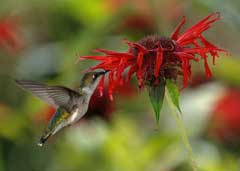
Landscape Uses: Border, Container, Massing, Rock garden, Specimen. Attracts birds, North American native, Edible, Fragrant foliage, Invasive, Naturalizing, Attracts butterflies, Suitable for cut flowers, Suitable for dried flowers, Fragrant flowers. Yields an essential oil, used in perfumery, as a hair tonic etc[46, 61]. The dried leaves and flowers are used to scent and add colour to pot-pourri[238]. Brings hummingbirds.
Special Uses
Attracts Wildlife Food Forest Scented Plants
References More on Other Uses
Cultivation details
Easily grown in ordinary garden soil so long as it is not too dry[1, 200]. Grows well in heavy clay soils. Requires a moist soil and a sunny position[4, 200]. Prefers some shade[4] but succeeds in a sunny position so long as the soil does not dry out. Provide light shade in hotter zones. Plants are hardy to at least -25°c[187]. The flowers are rich in nectar and are very attractive to bees[4, 55, 244]. A good companion plant, it grows well with tomatoes[14, 20]. Bergamot is a very ornamental and aromatic plant, it is often grown in the herb garden, there are some named varieties[183, 233]. The leaves, stems and roots carry a delicious aromatic orange-like perfume when crushed[245]. Plants are subject to mildew in dry summers[200]. Special Features:
The plant is heat tolerant in zones 10 through 1. (Plant Hardiness Zones show how well plants withstand cold winter temperatures.
Plant Heat Zones show when plants would start suffering from the heat.
The Plant Heat Zone map is based on the number of "heat days" experienced in a given area where the temperature climbs to over 86 degrees F (30°C).
At this temperature, many plants begin to suffer physiological damage. Heat Zones range from 1 (no heat days) to 12 (210 or more heat days).
For example Heat Zone. 11-1 indicates that the plant is heat tolerant in zones 11 through 1.) For polyculture design as well as the above-ground architecture (form - tree, shrub etc. and size shown above) information on the habit and root pattern is also useful and given here if available. The plant growth habit is a runner spreading indefinitely by rhizomes or stolons [1-2]. The root pattern is rhizomatous with underground stems sending roots and shoots along their length [1-2].
References Carbon Farming Information and Carbon Sequestration Information
Temperature Converter
Type a value in the Celsius field to convert the value to Fahrenheit:
Fahrenheit:
The PFAF Bookshop
Plants For A Future have a number of books available in paperback and digital form. Book titles include Edible Plants, Edible Perennials, Edible Trees,Edible Shrubs, Woodland Gardening, and Temperate Food Forest Plants. Our new book is Food Forest Plants For Hotter Conditions (Tropical and Sub-Tropical).
Shop Now
Plant Propagation
Seed - sow mid to late spring in a cold frame. Germination usually takes place within 10 - 40 days at 20°c. When large enough to handle, prick the seedlings out into individual pots and plant them out into their permanent positions in early summer. The seed can also be sown in situ in late summer in areas where the winters are not too severe and will produce larger plants. Cuttings of soft basal shoots in spring. Harvest the shoots with plenty of underground stem when they are about 8 - 10cm above the ground. Pot them up into individual pots and keep them in light shade in a cold frame or greenhouse until they are rooting well. Plant them out in the summer. Division in spring or autumn. Very easy, large divisions can be planted out direct into their permanent positions. We have found that it is better to pot up the smaller divisions and grow them on in light shade in a cold frame until they are well established before planting them out in late spring or early summer.
Other Names
If available other names are mentioned here
Sweet Bergamot. Bee Balm
Native Range
NORTHERN AMERICA: United States, Connecticut, Maine, Massachusetts, New Hampshire, New Jersey, New York, Ohio, Pennsylvania, Vermont, West Virginia, Georgia (north), Kentucky (northeast), North Carolina (west), Tennessee, Virginia,
Weed Potential
Right plant wrong place. We are currently updating this section.
Please note that a plant may be invasive in one area but may not in your area so it's worth checking.
Conservation Status
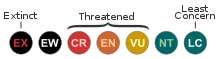
IUCN Red List of Threatened Plants Status :
Growth: S = slow M = medium F = fast. Soil: L = light (sandy) M = medium H = heavy (clay). pH: A = acid N = neutral B = basic (alkaline). Shade: F = full shade S = semi-shade N = no shade. Moisture: D = dry M = Moist We = wet Wa = water.
Now available:
Food Forest Plants for Mediterranean Conditions
350+ Perennial Plants For Mediterranean and Drier Food Forests and Permaculture Gardens.
[Paperback and eBook]
This is the third in Plants For A Future's series of plant guides for food forests tailored to
specific climate zones. Following volumes on temperate and tropical ecosystems, this book focuses
on species suited to Mediterranean conditions—regions with hot, dry summers and cool, wet winters,
often facing the added challenge of climate change.
Read More
Expert comment
Author
L.
Botanical References
43200
Links / References
For a list of references used on this page please go here
Readers comment