 |
|
|
 |
| http://commons.wikimedia.org/wiki/User:Rasbak |
Translate this page:
Summary
Physical Characteristics

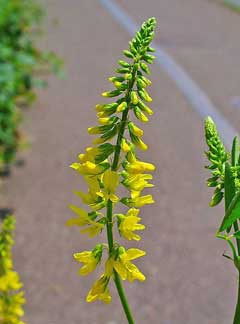
 Melilotus officinalis is a ANNUAL/BIENNIAL growing to 1.2 m (4ft) by 0.7 m (2ft 4in).
It is not frost tender. It is in flower from July to September. The species is hermaphrodite (has both male and female organs) and is pollinated by Bees.
It can fix Nitrogen.
Suitable for: light (sandy), medium (loamy) and heavy (clay) soils, prefers well-drained soil and can grow in heavy clay soil. Suitable pH: neutral and basic (mildly alkaline) soils and can grow in saline soils.
It cannot grow in the shade. It prefers dry or moist soil and can tolerate drought.
UK Hardiness Map
US Hardiness Map
Synonyms
M. arvensis.
Plant Habitats
Cultivated Beds;
Edible Uses
Edible Parts: Flowers Leaves Root Seedpod Shoots
Edible Uses: Condiment
Root[46, 105, 172]. Consumed as a food by the Kalmuks[183]. Young shoots - cooked. Used like asparagus[183]. Young leaves are eaten in salads[13]. The leaves and seedpods are cooked as a vegetable[8, 55, 172]. They are used as a flavouring[46]. Only fresh leaves should be used, see the notes above on toxicity[62]. The crushed dried leaves can be used as a vanilla flavouring in puddings, pastries etc[177, 183, 238]. Caution is advised, see the notes above on toxicity. Flowers - raw or cooked[172]. The flowers and seeds are used as a flavouring[2]. The flowers also give an aromatic quality to some tisanes[7].
References More on Edible Uses
Medicinal Uses
Plants For A Future can not take any responsibility for any adverse effects from the use of plants. Always seek advice from a professional before using a plant medicinally.
Antispasmodic Aromatic Carminative Diuretic Emollient Expectorant Ophthalmic Vulnerary
Melilot, used either externally or internally, can help treat varicose veins and haemorrhoids though it requires a long-term treatment for the effect to be realised[254]. Use of the plant also helps to reduce the risk of phlebitis and thrombosis[254]. Melilot contains coumarins and, as the plant dries or spoils, these become converted to dicoumarol, a powerful anticoagulant[254]. Thus the plant should be used with some caution, it should not be prescribed to patients with a history of poor blood clotting or who are taking warfarin medication[238]. See also the notes above on toxicity[21]. The flowering plant is antispasmodic, aromatic, carminative, diuretic, emollient, mildly expectorant, mildly sedative and vulnerary[4, 7, 9, 13, 21, 238, 240]. An infusion is used in the treatment of sleeplessness, nervous tension, neuralgia, palpitations, varicose veins, painful congestive menstruation, in the prevention of thrombosis, flatulence and intestinal disorders[7, 238]. Externally, it is used to treat eye inflammations, rheumatic pains, swollen joints, severe bruising, boils and erysipelas, whilst a decoction is added to the bath-water[9, 238]. The flowering plant is harvested in the summer and can be dried for later use[7]. A distilled water obtained from the flowering tops is an effective treatment for conjunctivitis[7].
References More on Medicinal Uses
The Bookshop: Edible Plant Books
Our Latest books on Perennial Plants For Food Forests and Permaculture Gardens in paperback or digital formats.
Edible Tropical Plants
Food Forest Plants for Hotter Conditions: 250+ Plants For Tropical Food Forests & Permaculture Gardens.
More
Edible Temperate Plants
Plants for Your Food Forest: 500 Plants for Temperate Food Forests & Permaculture Gardens.
More
More Books
PFAF have eight books available in paperback and digital formats. Browse the shop for more information.
Shop Now
Other Uses
Green manure Repellent
The leaves contain coumarin and they release the pleasant smell of newly mown hay when they are drying[238]. The leaves are dried and used as an insect repellent[169, 172], especially in order to repel moths from clothing[13, 100, 238]. They can be put in pillows, mattresses etc[178]. Poorly dried or fermented leaves produce a substance called dicoumarol. This is a potent anti-coagulant which is extremely poisonous in excess, it prevents the blood from coagulating and so it is possible to bleed to death from very small wounds. Dicoumarol is used in rat poisons[238]. The plant can be used as a green manure, enriching the soil with nitrogen as well a providing organic matter[238].
Special Uses
Nitrogen Fixer Scented Plants
References More on Other Uses
Cultivation details
Prefers a well-drained to dry neutral to alkaline soil in a sunny position[238]. Prefers a clay or a saline soil[13]. Dislikes shade. Established plants are drought tolerant[238]. The flowers are rich in pollen making this a good bee plant[4, 7, 8, 13]. If they are cut back before flowering, the plants will grow on for at least another year before dying[115]. The dried plant has a sweet aromatic fragrance like newly mown hay[245]. This species has a symbiotic relationship with certain soil bacteria, these bacteria form nodules on the roots and fix atmospheric nitrogen. Some of this nitrogen is utilized by the growing plant but some can also be used by other plants growing nearby[200].
References Carbon Farming Information and Carbon Sequestration Information
Temperature Converter
Type a value in the Celsius field to convert the value to Fahrenheit:
Fahrenheit:
The PFAF Bookshop
Plants For A Future have a number of books available in paperback and digital form. Book titles include Edible Plants, Edible Perennials, Edible Trees,Edible Shrubs, Woodland Gardening, and Temperate Food Forest Plants. Our new book is Food Forest Plants For Hotter Conditions (Tropical and Sub-Tropical).
Shop Now
Plant Propagation
Seed - sow spring to mid-summer in situ[87]. Pre-soaking the seed for 12 hours in warm water will speed up the germination process, particularly in dry weather[K]. Germination will usually take place within 2 weeks.
Other Names
If available other names are mentioned here
Native Range
TEMPERATE ASIA: Afghanistan, Iran, Iraq (northeast), Turkey, Russian Federation-Ciscaucasia (Ciscaucasia), Armenia, Azerbaijan, Georgia, Russian Federation (Dagestan), Russian Federation-Western Siberia (Western Siberia), Russian Federation-Eastern Siberia (Eastern Siberia), Kazakhstan, Kyrgyzstan, Tajikistan, Turkmenistan, Uzbekistan, China (west) TROPICAL ASIA: India (Himachal Pradesh, Jammu and Kashmir), Pakistan (north) EUROPE: Czechoslovakia, Austria, Belgium, Switzerland, Germany, Hungary, Netherlands, Poland, Russian Federation (European part), Belarus, Estonia, Lithuania, Latvia, Moldova, Former Yugoslavia, Albania, Bulgaria, Greece, Italy (incl. Sardinia), Romania, Spain (incl. Baleares), France
Weed Potential
Right plant wrong place. We are currently updating this section.
Please note that a plant may be invasive in one area but may not in your area so it's worth checking.
Conservation Status
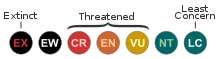
IUCN Red List of Threatened Plants Status :
Growth: S = slow M = medium F = fast. Soil: L = light (sandy) M = medium H = heavy (clay). pH: A = acid N = neutral B = basic (alkaline). Shade: F = full shade S = semi-shade N = no shade. Moisture: D = dry M = Moist We = wet Wa = water.
Now available:
Food Forest Plants for Mediterranean Conditions
350+ Perennial Plants For Mediterranean and Drier Food Forests and Permaculture Gardens.
[Paperback and eBook]
This is the third in Plants For A Future's series of plant guides for food forests tailored to
specific climate zones. Following volumes on temperate and tropical ecosystems, this book focuses
on species suited to Mediterranean conditions—regions with hot, dry summers and cool, wet winters,
often facing the added challenge of climate change.
Read More
Expert comment
Author
Lam.
Botanical References
17
Links / References
For a list of references used on this page please go here
Readers comment