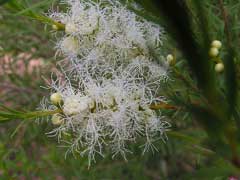
 |
|
www.flickr.com/photos/arthur_chapman |
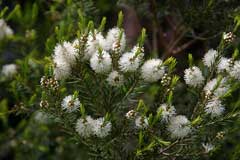 |
| www.flickr.com/photos/ericinsf |
Translate this page:
Summary
Physical Characteristics

 Melaleuca alternifolia is an evergreen Shrub growing to 6 m (19ft) by 4 m (13ft).
See above for USDA hardiness. It is hardy to UK zone 9. It is in leaf all year, in flower in June. The species is hermaphrodite (has both male and female organs) and is pollinated by Insects.
Suitable for: light (sandy), medium (loamy) and heavy (clay) soils and prefers well-drained soil. Suitable pH: mildly acid and neutral soils. It cannot grow in the shade. It prefers moist soil.
UK Hardiness Map
US Hardiness Map
Synonyms
Melaleuca linariifolia var. alternifolia Maiden & Betche
Plant Habitats
Woodland Garden Sunny Edge;
Edible Uses
References More on Edible Uses
Medicinal Uses
Plants For A Future can not take any responsibility for any adverse effects from the use of plants. Always seek advice from a professional before using a plant medicinally.
Alterative Antibacterial Antiseptic Aromatherapy Diaphoretic Expectorant
Tea tree, and in particular its essential oil, is one of the most important natural antiseptics and it merits a place in every medicine chest[254]. It is useful for treating stings, burns, wounds and skin infections of all kinds[254]. An essential oil obtained from the leaves and twigs is strongly antiseptic, diaphoretic and expectorant[156, 157, 238]. It stimulates the immune system and is effective against a broad range of bacterial and fungal infections[238]. Internally, it is used in the treatment of chronic and some acute infections, notably cystitis, glandular fever and chronic fatigue syndrome[254]. It is used externally in the treatment of thrush, vaginal infections, acne, athlete's foot, verrucae, warts, insect bites, cold sores and nits[238]. It is applied neat to verrucae, warts and nits, but is diluted with a carrier oil such as almond for other uses[238]. The oil is non-irritant[238]. Another report says that high quality oils contain about 40% terpinen-4-ol, which is well tolerated by the skin and 5% cineol which is irritant. However, in poor quality oils the levels of cineol can exceed 10% and in some cases up to 65%[254]. The essential oil is used in aromatherapy. Its keyword is 'Antiseptic'[210].
References More on Medicinal Uses
The Bookshop: Edible Plant Books
Our Latest books on Perennial Plants For Food Forests and Permaculture Gardens in paperback or digital formats.

Edible Tropical Plants
Food Forest Plants for Hotter Conditions: 250+ Plants For Tropical Food Forests & Permaculture Gardens.
More

Edible Temperate Plants
Plants for Your Food Forest: 500 Plants for Temperate Food Forests & Permaculture Gardens.
More

More Books
PFAF have eight books available in paperback and digital formats. Browse the shop for more information.
Shop Now
Other Uses
Essential Wood
An essential oil is obtained from the leaves[156, 157]. It is strongly germicidal and is also used in dentistry, deodorants, soaps, mouthwashes etc[156, 238]. Wood - very durable in wet conditions and in damp ground[167].
Special Uses
Carbon Farming Food Forest
References More on Other Uses
Cultivation details
Industrial Crop: Medicinal Management: Coppice Management: Standard Regional Crop
Requires a fertile, well-drained moisture retentive lime-free soil in full sun[182]. Prefers a soil that does not contain much nitrogen[188]. Plants are shade tolerant and succeed in most soils and aspects except dry conditions when they are grown in Australian gardens[157]. This species is not very cold hardy and is only likely to succeed outdoors in the very mildest parts of Britain. It tolerates temperatures down to at least -7°c in Australian gardens[157] but this cannot be translated directly to British gardens because of our cooler summers and longer colder and wetter winters. Seed takes about 12 months to develop on the plant, the woody seed capsules persist for 3 or more years[200]. Any pruning is best done after the plants have flowered with the intention of maintaining a compact habit[200]. Hybridizes freely with other members of this genus[200]. Plants in this genus are notably resistant to honey fungus[200].
Carbon Farming
-
Industrial Crop: Medicinal
Most pharmaceuticals are synthesized from petroleum but 25% of modern medicines are based on plants.
-
Management: Coppice
Cut to the ground repeatedly - resprouting vigorously. Non-destructive management systems maintaining the soil organic carbon.
-
Management: Standard
Plants grow to their standard height. Harvest fruit, seeds, or other products. Non-Destructive management systems.
-
Regional Crop
These crops have been domesticated and cultivated regionally but have not been adopted elsewhere and are typically not traded globally, Examples in this broad category include perennial cottons and many nuts and staple fruits.
References Carbon Farming Information and Carbon Sequestration Information
Temperature Converter
Type a value in the Celsius field to convert the value to Fahrenheit:
Fahrenheit:
The PFAF Bookshop
Plants For A Future have a number of books available in paperback and digital form. Book titles include Edible Plants, Edible Perennials, Edible Trees,Edible Shrubs, Woodland Gardening, and Temperate Food Forest Plants. Our new book is Food Forest Plants For Hotter Conditions (Tropical and Sub-Tropical).
Shop Now
Plant Propagation
Seed - surface sow in spring or autumn onto a pot of permanently moist soil in a warm greenhouse. Emmerse in 5cm of water and do not water from overhead. Grow on until the seedlings are 0.5cm tall then remove from the water and pot up a week later. Seedlings are liable to damp off when grown this way, sowing the seed thinly, good ventilation and hygiene are essential for success[200]. Grow the plants on for at least their first winter in a greenhouse and then plant them out in late spring or early summer, after the last expected frosts. Consider giving the plants some protection from the cold for their first few winters outdoors. Cuttings of half-ripe lateral shoots with a heel, July/August in a frame[200].
Other Names
If available other names are mentioned here
Native Range
AUSTRALASIA: Australia (New South Wales, Queensland)
Weed Potential
Right plant wrong place. We are currently updating this section.
Please note that a plant may be invasive in one area but may not in your area so it's worth checking.
Conservation Status
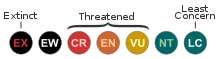
IUCN Red List of Threatened Plants Status :
Growth: S = slow M = medium F = fast. Soil: L = light (sandy) M = medium H = heavy (clay). pH: A = acid N = neutral B = basic (alkaline). Shade: F = full shade S = semi-shade N = no shade. Moisture: D = dry M = Moist We = wet Wa = water.
Now available:
Food Forest Plants for Mediterranean Conditions
350+ Perennial Plants For Mediterranean and Drier Food Forests and Permaculture Gardens.
[Paperback and eBook]
This is the third in Plants For A Future's series of plant guides for food forests tailored to
specific climate zones. Following volumes on temperate and tropical ecosystems, this book focuses
on species suited to Mediterranean conditions—regions with hot, dry summers and cool, wet winters,
often facing the added challenge of climate change.
Read More
Expert comment
Author
(Maiden.&Betche.)Cheel.
Botanical References
Links / References
For a list of references used on this page please go here
Readers comment