 |
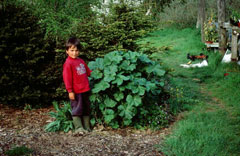
|
(c) 2010 Ken Fern & Plants For A Future |
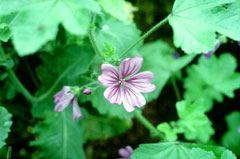 |
| (c) 2010 Ken Fern & Plants For A Future |
Translate this page:
Summary
Taxonomic Note: This genus was formerly classified in the family Tiliaceae. Modern classifications include it within the Malvaceae.
Bloom Color: Pink. Main Bloom Time: Early summer, Early fall, Late summer, Mid summer. Form: Upright or erect.
Physical Characteristics

 Malva sylvestris is a BIENNIAL/PERENNIAL growing to 0.5 m (1ft 8in) at a fast rate.
See above for USDA hardiness. It is hardy to UK zone 5 and is not frost tender. It is in flower from June to September, and the seeds ripen from July to October. The species is hermaphrodite (has both male and female organs) and is pollinated by Bees. The plant is self-fertile.
Suitable for: light (sandy), medium (loamy) and heavy (clay) soils and prefers well-drained soil. Suitable pH: mildly acid, neutral and basic (mildly alkaline) soils. It can grow in semi-shade (light woodland) or no shade. It prefers moist soil.
UK Hardiness Map
US Hardiness Map
Synonyms
Althaea godronii. Althaea mauritiana. Malva ambigua. Malva erecta. Malva mauritiana.
Plant Habitats
Woodland Garden Sunny Edge; Dappled Shade; Hedgerow;
Edible Uses
Edible Parts: Flowers Leaves Seed
Edible Uses: Tea
Leaves - raw or cooked[2, 4, 7, 9, 94, 183]. Mucilaginous with a mild pleasant flavour, they are nice in soups where they act as a thickener[5]. The young leaves also make a very acceptable substitute for lettuce in a salad[K]. Immature seed - raw[183]. Used as a nibble[183], the seeds have a nice nutty flavour[12] but are too fiddly for most people to want to gather in quantity[K]. Flowers - raw. Added to salads or used as a garnish[183]. A pleasant mild flavour, with a similar texture to the leaves, they make a pleasant and pretty addition to the salad bowl[K]. The leaves are a tea substitute[46, 183].
References More on Edible Uses
Medicinal Uses
Plants For A Future can not take any responsibility for any adverse effects from the use of plants. Always seek advice from a professional before using a plant medicinally.
Antiphlogistic Astringent Demulcent Diuretic Emollient Expectorant Laxative Salve
All parts of the plant are antiphlogistic, astringent, demulcent, diuretic, emollient, expectorant, laxative, salve[4, 7, 9, 21, 46, 222, 238]. The leaves and flowers can be eaten as part of the diet, or a tea can be made from the leaves, flowers or roots[222]. The leaves and flowers are the main part used, their demulcent properties making them valuable as a poultice for bruise, inflammations, insect bites etc, or they can be taken internally in the treatment of respiratory system diseases and problems with the digestive tract[4, 238, 254]. When combined with eucalyptus it makes a god remedy for coughs and other chest ailments[254]. Mallow has similar properties, but is considered to be inferior to the marsh mallow (Althaea officinalis) and are seldom used internally[4]. The plant is an excellent laxative for young children[7]. The leaves can be used fresh whenever they are available or can be harvested in the spring and dried for later use[254]. The flowers are harvested in the summer and can be dried for later use[254]. The German Commission E Monographs, a therapeutic guide to herbal medicine, approve Malva sylvestris for cough, bronchitis, inflammation of the mouth and pharynx (see [302] for critics of commission E).
References More on Medicinal Uses
The Bookshop: Edible Plant Books
Our Latest books on Perennial Plants For Food Forests and Permaculture Gardens in paperback or digital formats.
Edible Tropical Plants
Food Forest Plants for Hotter Conditions: 250+ Plants For Tropical Food Forests & Permaculture Gardens.
More
Edible Temperate Plants
Plants for Your Food Forest: 500 Plants for Temperate Food Forests & Permaculture Gardens.
More
More Books
PFAF have eight books available in paperback and digital formats. Browse the shop for more information.
Shop Now
Other Uses
Dye Fibre Litmus
Cream, yellow and green dyes can be obtained from the plant and the seed heads[168]. A tincture of the flowers forms a very delicate test for alkalis[4, 115]. The leaves are used to relieve insect bites and stings[53]. A fibre obtained from the stems is useful for cordage, textiles and paper making[115].
Special Uses
Dynamic accumulator Food Forest
References More on Other Uses
Cultivation details
Landscape Uses:Border, Massing. A very easily grown plant, succeeding in ordinary garden soil[1] and in poor soils[238]. It prefers a reasonably well-drained and moderately fertile soil in a sunny position[200], where it will produce a better crop of salad leaves[K]. Plants are hardy to about -20°c[187]. There are some named forms, selected for their ornamental value[187]. 'Mauritiana' is larger than the type with much more ornamental flowers[187]. The flavour of the leaves and flowers is considered by many to be superior to the type species[183]. Plants seem to be immune to the predations of rabbits[233]. Prone to infestation by rust fungus[200]. Special Features:
Not North American native, Naturalizing, Attractive flowers or blooms.
References Carbon Farming Information and Carbon Sequestration Information
Temperature Converter
Type a value in the Celsius field to convert the value to Fahrenheit:
Fahrenheit:
The PFAF Bookshop
Plants For A Future have a number of books available in paperback and digital form. Book titles include Edible Plants, Edible Perennials, Edible Trees,Edible Shrubs, Woodland Gardening, and Temperate Food Forest Plants. Our new book is Food Forest Plants For Hotter Conditions (Tropical and Sub-Tropical).
Shop Now
Plant Propagation
Seed - sow early spring in situ. Germination should take place within 2 weeks.
Other Names
If available other names are mentioned here
Native Range
TEMPERATE ASIA: Afghanistan, Cyprus, Egypt (Sinai), Iran, Israel, Jordan, Lebanon, Syria, Turkey, Russian Federation-Ciscaucasia (Ciscaucasia), Armenia, Azerbaijan, Georgia, Russian Federation (Dagestan), Kyrgyzstan, Tajikistan, Turkmenistan, Uzbekistan TROPICAL ASIA: Bhutan, India, Nepal EUROPE: Denmark, Finland, United Kingdom, Ireland, Norway, Sweden, Austria, Belgium, Switzerland, Czech Republic, Germany, Hungary, Netherlands, Poland, Slovakia, Russian Federation (European part), Ukraine (incl. Krym), Albania, Bulgaria, Bosnia and Herzegovina, Greece (incl. Crete), Croatia, Italy (incl. Sardinia, Sicily), North Macedonia, Montenegro, Romania, Serbia, Slovenia, Spain (incl. Baleares), France (incl. Corsica), Portugal AFRICA: Portugal (Madeira Islands), Algeria, Egypt, Libya, Morocco, Tunisia
Weed Potential
Right plant wrong place. We are currently updating this section.
Please note that a plant may be invasive in one area but may not in your area so it's worth checking.
Conservation Status
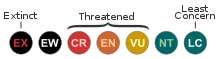
IUCN Red List of Threatened Plants Status :
| Related Plants
|
| Latin Name | Common Name | Habit | Height | Hardiness | Growth | Soil | Shade | Moisture | Edible | Medicinal | Other |
| Abelmoschus esculentus | Okra | Annual | 1.0 |
5-11
| | LMH | N | M | 4 | 3 | 2 |
| Abelmoschus manihot | Aibika | Perennial | 3.0 |
8-11
| F | LMH | N | M | 4 | 1 | 2 |
| Abelmoschus moschatus | Musk Mallow,Musk Okra | Perennial | 2.0 |
8-11
| F | LMH | N | M | 2 | 3 | 3 |
| Abroma augusta | Cotton Abroma. Perennial Indian Hemp. | Shrub | 3.0 |
10-12
| F | LMH | N | M | 0 | 3 | 4 |
| Abutilon megapotamicum | Trailing Abutilon | Shrub | 2.0 |
7-10
| F | LMH | SN | M | 4 | 0 | 0 |
| Abutilon ochsenii | | Shrub | 4.0 |
7-10
| | LMH | SN | M | 3 | 0 | |
| Abutilon pictum | Abutilon, Parlour Maple, Flowering Maple, Spotted | Shrub | 5.0 |
8-10
| M | LMH | SN | M | 3 | 0 | |
| Abutilon purpurascens | | Shrub | 2.4 |
8-11
| | LMH | SN | DM | 2 | 0 | |
| Abutilon species | | Shrub | 3.0 |
7-10
| | LMH | SN | M | 3 | 0 | |
| Abutilon theophrasti | China Jute, Velvetleaf, Butterprint Buttonweed Jute, China Mallow, Indian Velvet Leaf | Annual | 1.0 |
0-0
| | LMH | SN | DM | 3 | 2 | 4 |
| Abutilon vitifolium | | Shrub | 8.0 |
7-10
| | LMH | SN | M | 3 | 0 | |
| Abutilon x hybridum | Chinese Lantern, Flowering Maple | Shrub | 3.0 |
9-11
| F | LMH | SN | M | 3 | 0 | 0 |
| Abutilon x milleri | Trailing Abutilon | Shrub | 3.0 |
7-10
| | LMH | SN | M | 3 | 0 | 0 |
| Abutilon x suntense | | Shrub | 8.0 |
7-10
| F | LMH | SN | M | 3 | 0 | 0 |
| Adansonia digitata | Baobab, Judas Fruit, Monkey Bread Tree | Tree | 20.0 |
10-12
| S | LMH | N | DM | 3 | 3 | 4 |
| Alcea rosea | Hollyhock | Perennial | 2.4 |
5-9
| F | LMH | N | DM | 3 | 2 | 3 |
| Althaea cannabina | Palm-leaf marshmallow | Perennial | 1.8 |
4-8
| | LMH | N | DM | 0 | 0 | 1 |
| Althaea officinalis | Marsh Mallow, Common marshmallow | Perennial | 1.2 |
3-7
| M | LMH | N | DM | 5 | 5 | 3 |
| Anoda cristata | Crested Anoda | Annual | 0.8 |
8-11
| F | LMH | N | DM | 2 | 0 | 0 |
| Bombax ceiba | Red Silk Cotton Tree, Kapok Tree | Tree | 25.0 |
10-12
| M | LMH | N | DM | 2 | 2 | 4 |
| Burretiodendron hsienmu | Hsienmu wood | Tree | 35.0 |
10-12
| S | LMH | N | M | 0 | 0 | 4 |
| Callirhoe digitata | Finger Poppy Mallow, Winecup | Perennial | 0.9 |
4-8
| | L | N | DM | 2 | 0 | |
| Callirhoe involucrata | Poppy Mallow, Purple poppymallow, Winecup, Finger Poppy Mallow | Perennial | 0.2 |
4-8
| M | L | N | DM | 3 | 2 | 0 |
| Callirhoe leiocarpa | Tall Poppy-Mallow | Annual | 0.9 |
5-9
| | L | N | DM | 2 | 0 | |
| Ceiba aesculifolia | Pochote | Tree | 25.0 |
10-12
| M | LMH | N | DM | 2 | 1 | 4 |
| Ceiba pentandra | Kapok Tree, Cotton Tree, Suma'ma | Tree | 50.0 |
10-12
| F | MH | N | DM | 3 | 3 | 5 |
| Clappertonia ficifolia | Bolo Bolo | Shrub | 2.5 |
10-12
| F | LM | N | MWe | 0 | 1 | 4 |
| Cola acuminata | Cola Nut, Kola, Bissy Nut | Tree | 20.0 |
10-12
| M | LMH | N | M | 3 | 4 | 2 |
| Cola nitida | Cola Nut, Kola, Bissy Nuts | Tree | 20.0 |
10-12
| S | LMH | SN | DM | 3 | 4 | 2 |
| Corchorus capsularis | Jute | Annual/Perennial | 3.5 |
9-11
| F | LMH | N | M | 3 | 2 | 2 |
|
|
Growth: S = slow M = medium F = fast. Soil: L = light (sandy) M = medium H = heavy (clay). pH: A = acid N = neutral B = basic (alkaline). Shade: F = full shade S = semi-shade N = no shade. Moisture: D = dry M = Moist We = wet Wa = water.
Now available:
Food Forest Plants for Mediterranean Conditions
350+ Perennial Plants For Mediterranean and Drier Food Forests and Permaculture Gardens.
[Paperback and eBook]
This is the third in Plants For A Future's series of plant guides for food forests tailored to
specific climate zones. Following volumes on temperate and tropical ecosystems, this book focuses
on species suited to Mediterranean conditions—regions with hot, dry summers and cool, wet winters,
often facing the added challenge of climate change.
Read More
Expert comment
Author
L.
Botanical References
17200
Links / References
For a list of references used on this page please go here
Readers comment