 |
|
|
 |
| http://fr.wikipedia.org/wiki/Utilisateur:Jeffdelonge |
Translate this page:
Summary
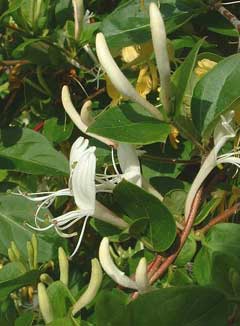
Bloom Color: White, Yellow. Main Bloom Time: Early summer, Early spring, Late summer, Late spring, Mid summer, Mid spring. Form: Irregular or sprawling, Spreading or horizontal, Variable height, Variable spread.
Physical Characteristics

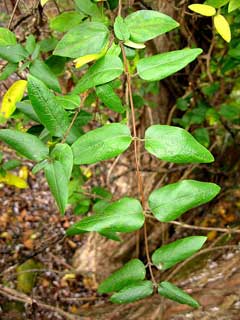
 Lonicera japonica is an evergreen Climber growing to 5 m (16ft) by 5 m (16ft) at a fast rate.
See above for USDA hardiness. It is hardy to UK zone 4. It is in leaf all year, in flower from June to July. The species is hermaphrodite (has both male and female organs) and is pollinated by Moths.
Suitable for: light (sandy), medium (loamy) and heavy (clay) soils. Suitable pH: mildly acid, neutral and basic (mildly alkaline) soils. It can grow in semi-shade (light woodland) or no shade. It prefers dry or moist soil.
UK Hardiness Map
US Hardiness Map
Synonyms
Nintooa japonica. (Thunb.)Sweet.
Plant Habitats
Woodland Garden Dappled Shade; Shady Edge; Ground Cover;
Edible Uses
Edible Parts: Flowers Leaves
Edible Uses: Tea
Leaves - cooked. The parboiled leaves are used as a vegetable[183]. Some caution is advised, see notes above on toxicity. Flowers - sucked for their sweet nectar[183], used as a vegetable or made into a syrup and puddings[183]. A tea is made from the leaves, buds and flowers[177, 183].
References More on Edible Uses
Medicinal Uses
Plants For A Future can not take any responsibility for any adverse effects from the use of plants. Always seek advice from a professional before using a plant medicinally.
Antibacterial Antiinflammatory Antispasmodic Antiviral Depurative Diuretic Dysentery Febrifuge
Skin TB VD
The stems and flower buds are alterative, antibacterial, anti-inflammatory, antispasmodic, depurative, diuretic, febrifuge[147, 174, 176, 178, 238]. The plant is also used to reduce blood pressure[174, 176, 238]. The stems are used internally in the treatment of acute rheumatoid arthritis, mumps and hepatitis[238]. The stems are harvested in the autumn and winter, and are dried for later use[238]. The stems and flowers are used together as an infusion in the treatment of upper respiratory tract infections (including pneumonia) and dysentery[238]. An infusion of the flower buds is used in the treatment of a wide range of ailments including syphilitic skin diseases and tumours, bacterial dysentery, colds, enteritis, pain, swellings etc[174, 176, 218, 222, 238, 279]. Experimentally, the flower extracts have been shown to lower blood cholesterol levels and are antibacterial, antiviral and tuberculostatic[222, 279]. Externally, the flowers are applied as a wash to skin inflammations, infectious rashes and sores[238]. The flowers are harvested in early morning before they open and are dried for later use[238]. The plant has a similar action to Forsythia suspensa and is usually used in combination with that species to achieve a stronger action[176]. This plant has become a serious weed in many areas of N. America, it might have the potential to be utilized for proven medical purposes[222].
References More on Medicinal Uses
The Bookshop: Edible Plant Books
Our Latest books on Perennial Plants For Food Forests and Permaculture Gardens in paperback or digital formats.
Edible Tropical Plants
Food Forest Plants for Hotter Conditions: 250+ Plants For Tropical Food Forests & Permaculture Gardens.
More
Edible Temperate Plants
Plants for Your Food Forest: 500 Plants for Temperate Food Forests & Permaculture Gardens.
More
More Books
PFAF have eight books available in paperback and digital formats. Browse the shop for more information.
Shop Now
Other Uses
Basketry Insecticide
A very vigorous climbing plant, it makes a good dense ground cover plant where it has the space to run over the ground but it will swamp smaller plants[197, 200]. The sub-species L. japonica repens is especially used for this purpose on the continent[182]. The cultivar 'Halliana' has also been recommended[188, 197]. This cultivar should be clipped back severely in the spring if it gets untidy, it responds well to such conditions[208]. Plants should be spaced about 1 metre apart each way[208]. The plant is said to be insecticidal[218]. The stems have been used in making baskets[257].
Special Uses
Ground cover Scented Plants
References More on Other Uses
Cultivation details
Prefers a good moist soil with its roots in the shade and its top climbing into the light[200]. Succeeds in any soil in part shade[184]. Established plants are drought tolerant[190]. They succeed in dry shade, the cultivar 'Halliana' is especially recommended for such a situation[188]. Plants are hardy to about -20°c[184]. The foliage can be damaged in severe wind-chill conditions but the plant usually recovers in the spring[202]. Fruit is only formed after a hot summer[202]. A rampantly growing plant[190], it climbs by twining around other plants[182] and makes an excellent screen for a north or east facing fence or an unsightly object[190]. This species has the potential to become a rampant weed, it has escaped from cultivation in N. America whre it can outcompete native species[274]. The plant has powerfully scented flowers. The white-flowered cultivar 'Halliana' has a pronounced lemon-like perfume[245]. There are several named varieties, developed for their ornamental value[182, 200]. Special Features:Not North American native, Invasive, Naturalizing, Fragrant flowers, Attractive flowers or blooms.
References Carbon Farming Information and Carbon Sequestration Information
Temperature Converter
Type a value in the Celsius field to convert the value to Fahrenheit:
Fahrenheit:
The PFAF Bookshop
Plants For A Future have a number of books available in paperback and digital form. Book titles include Edible Plants, Edible Perennials, Edible Trees,Edible Shrubs, Woodland Gardening, and Temperate Food Forest Plants. Our new book is Food Forest Plants For Hotter Conditions (Tropical and Sub-Tropical).
Shop Now
Plant Propagation
Seed - best sown as soon as it is ripe in a cold frame. Stored seed requires 2 months cold stratification[113] and should be sown as soon as possible in a cold frame. When they are large enough to handle, prick the seedlings out into individual pots and grow them on in the greenhouse for at least their first winter. Plant them out into their permanent positions in late spring or early summer, after the last expected frosts. Cuttings of half-ripe wood, 7 - 10cm with or without a heel, July/August in a frame. Good percentage[78]. Cuttings of mature wood of the current season's growth, 15 - 20cm with or without a heel, November in a cold frame. Good percentage[78]. Layering in autumn[200].
Other Names
If available other names are mentioned here
Native Range
TEMPERATE ASIA: China (Anhui Sheng, Fujian Sheng, Gansu Sheng, Guangdong Sheng, Guangxi Zhuangzu Zizhiqu, Guizhou Sheng, Hebei Sheng, Henan Sheng, Hubei Sheng, Hunan Sheng, Jiangsu Sheng, Jiangxi Sheng, Jilin Sheng, Liaoning Sheng, Shaanxi Sheng, Shandong Sheng, Shanxi Sheng, Sichuan Sheng, Yunnan Sheng, Zhejiang Sheng), Korea, Japan (Hokkaidô (south), Honshu, Kyushu, Shikoku), Taiwan
Weed Potential
Right plant wrong place. We are currently updating this section.
Please note that a plant may be invasive in one area but may not
in your area so it's worth checking.
Conservation Status
IUCN Red List of Threatened Plants Status :

IUCN Red List
Growth: S = slow M = medium F = fast. Soil: L = light (sandy) M = medium H = heavy (clay). pH: A = acid N = neutral B = basic (alkaline). Shade: F = full shade S = semi-shade N = no shade. Moisture: D = dry M = Moist We = wet Wa = water.
Now available:
Food Forest Plants for Mediterranean Conditions
350+ Perennial Plants For Mediterranean and Drier Food Forests and Permaculture Gardens.
[Paperback and eBook]
This is the third in Plants For A Future's series of plant guides for food forests tailored to
specific climate zones. Following volumes on temperate and tropical ecosystems, this book focuses
on species suited to Mediterranean conditions—regions with hot, dry summers and cool, wet winters,
often facing the added challenge of climate change.
Read More
Expert comment
Author
Thunb.
Botanical References
1158200
Links / References
For a list of references used on this page please go here
Readers comment