 |
|
http://www.flickr.com/photos/stonebird/ |
 |
| http://www.flickr.com/photos/stonebird/ |
Translate this page:
Summary
Beardless wildrye is a native perennial grass of western North America that spreads by extensive rhizomes and forms dense colonies in moist meadows, floodplains, streambanks, and valley bottoms. Although less common than basin wildrye (Leymus cinereus), it produces edible grains that were available to Indigenous peoples wherever reliable seed crops developed. One drawback is that this species frequently produces poor or inconsistent seed crops, making it a less dependable food plant than many other native grasses. Like all wildryes, the grains must be carefully inspected for ergot fungus before consumption.
Physical Characteristics

 Leymus triticoides is a PERENNIAL growing to 1.2 m (4ft) by 0.3 m (1ft in) at a fast rate.
See above for USDA hardiness. It is hardy to UK zone 5. It is in flower from May to July, and the seeds ripen from September to October. The species is hermaphrodite (has both male and female organs) and is pollinated by Wind.
Suitable for: light (sandy) and medium (loamy) soils, prefers well-drained soil and can grow in nutritionally poor soil. Suitable pH: mildly acid, neutral and basic (mildly alkaline) soils and can grow in saline soils.
It cannot grow in the shade. It prefers moist or wet soil. The plant can tolerate maritime exposure.
UK Hardiness Map
US Hardiness Map
Synonyms
Elymus condensatus var. triticoides (Buckley) Thurb. Elymus triticoides Buckley
Plant Habitats
Cultivated Beds;
Edible Uses
Edible Parts: Seed
Edible Uses:
Beardless wildrye is a useful native grain, but one that requires realistic expectations. Its tendency to produce inconsistent seed crops means it is less dependable than basin wildrye or many other native grasses. Nevertheless, where healthy grain heads are abundant and carefully screened for ergot, it provides another nutritious wild cereal that reflects the remarkable diversity of edible grasses found throughout western North America [2-3]. The grains are edible [2-3]. Like other Leymus species, the grains provide a nutritious wild cereal when mature. However, check every seed head carefully for ergot (Claviceps purpurea), a toxic fungus that can replace healthy grains. Any infected seed heads should be discarded [2-3]. Edibility Rating: 3 out of 5 – A nutritious native grain, but unreliable seed production and the potential presence of ergot reduce its overall value. Taste and Preparation: Although the grains of beardless wildrye were not personally sampled during the original fieldwork, they are expected to resemble those of other native wildryes and cereal grasses. The mature grains can be boiled as a whole grain, ground into flour, or roasted before milling. Their flavor is likely to be mild, nutty, and comparable to wheat or rye, making them suitable for porridges, flatbreads, soups, and other traditional grain preparations. Before any preparation, thoroughly clean and carefully inspect the grains to ensure they are free of ergot infection. Seasonality (Phenology): Beardless wildrye flowers from June through August. Mature grains normally develop during late summer into early autumn, although many populations produce relatively few viable seeds in some years [2-3]. Nutritional Value: Like other cereal grasses, the grains are rich in complex carbohydrates with moderate amounts of protein, dietary fiber, minerals, and B vitamins, providing a valuable source of seasonal energy [2-3]. Traditional Uses: Native peoples throughout western North America harvested wildrye grains where they were abundant. Although beardless wildrye appears to have been used less frequently than basin wildrye because of its inconsistent seed production, it nevertheless contributed to traditional seasonal food resources. The grains are edible only if free from ergot fungus (Claviceps purpurea). Ergot replaces healthy grains with dark, elongated fungal structures containing toxic alkaloids that are not destroyed by cooking. Inspect every seed head carefully before harvesting, and discard any infected plants. Seed - cooked[22, 46, 61, 95, 161]. Used as a piñole[213]. The seed can be ground into a flour and used to make bread, cakes, porridge or as a cereal[183, 257]. The seed is rather small and fiddly to harvest. The hairs on the seed must be removed before consumption. The N. American Indians would singe the seed in order to remove these hairs[183].
References More on Edible Uses
Medicinal Uses
Plants For A Future can not take any responsibility for any adverse effects from the use of plants. Always seek advice from a professional before using a plant medicinally.
None known
References More on Medicinal Uses
The Bookshop: Edible Plant Books
Our Latest books on Perennial Plants For Food Forests and Permaculture Gardens in paperback or digital formats.
Edible Tropical Plants
Food Forest Plants for Hotter Conditions: 250+ Plants For Tropical Food Forests & Permaculture Gardens.
More
Edible Temperate Plants
Plants for Your Food Forest: 500 Plants for Temperate Food Forests & Permaculture Gardens.
More
More Books
PFAF have eight books available in paperback and digital formats. Browse the shop for more information.
Shop Now
Other Uses
Basketry
The leaves are used in basket making and for making mats, rope, paper etc[99, 257]. Beardless wildrye is widely cultivated for erosion control, streambank stabilization, habitat restoration, and forage production. Wildlife Value: The dense rhizomatous growth provides valuable cover for birds, small mammals, and insects. Granivorous birds eat the seeds, while the foliage provides forage for wildlife and livestock.
Special Uses
References More on Other Uses
Cultivation details
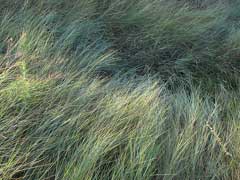
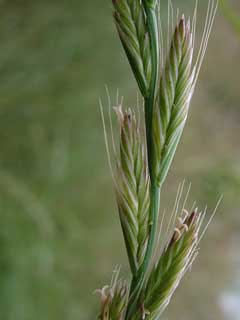
Beardless wildrye grows best in full sun with moist to seasonally wet soils. It commonly occurs on floodplains, streambanks, wet meadows, alkaline flats, and other areas where moisture remains available during much of the growing season. Habitat: Occurs throughout western North America in moist meadows, riparian areas, valley bottoms, floodplains, wetlands, and seasonally moist grasslands. USDA Hardiness Zones: USDA Zones 4–9. Growth Rate: Moderate to fast. The plant spreads vigorously by creeping rhizomes and can form extensive colonies under favorable conditions. Mature Size: Typically 60–150 cm (2–5 ft) tall, occasionally taller in moist, fertile habitats. Cultivation: Beardless wildrye is widely cultivated for erosion control, streambank stabilization, habitat restoration, and forage production. It performs best in sunny sites with moist soils and tolerates seasonal flooding better than many native grasses. Pollinators: Like nearly all grasses, beardless wildrye is wind-pollinated. Identification: Beardless wildrye is a perennial, rhizomatous grass that forms dense colonies rather than isolated bunches. It bears upright flowering spikes resembling cultivated rye but lacks the conspicuous long awns found on many other grasses. Its creeping rhizomes distinguish it from the bunch-forming basin wildrye. Similar Species: Beardless wildrye closely resembles basin wildrye (Leymus cinereus), but basin wildrye forms large bunches and generally produces more dependable grain crops. Other species of Leymus and Elymus can look similar, but precise identification matters little for foraging because their grains are edible when healthy and free of ergot. The plant has extensively creeping rhizomes and often forms large clumps in the wild[236]. The following notes are based on the general needs of the genus. Succeeds in most soils, preferring a sandy soil and a sunny position[1, 162].
References Carbon Farming Information and Carbon Sequestration Information
Temperature Converter
Type a value in the Celsius field to convert the value to Fahrenheit:
Fahrenheit:
The PFAF Bookshop
Plants For A Future have a number of books available in paperback and digital form. Book titles include Edible Plants, Edible Perennials, Edible Trees,Edible Shrubs, Woodland Gardening, and Temperate Food Forest Plants. Our new book is Food Forest Plants For Hotter Conditions (Tropical and Sub-Tropical).
Shop Now
Plant Propagation
Seed - sow mid spring in situ and only just cover the seed[162]. Germination should take place within 2 weeks. If the supply of seed is limited, it can also be sown in mid spring in a cold frame. Only just cover the seed. When large enough to handle, prick the seedlings out into individual pots and plant them out in summer[K] Division in spring or summer[162]. Very easy, larger clumps can be replanted direct into their permanent positions, though it is best to pot up smaller clumps and grow them on in a cold frame until they are rooting well. Plant them out in the spring.
Other Names
If available other names are mentioned here
Beardless wildrye, creeping wildrye
Native Range
NORTHERN AMERICA: Canada (British Columbia (south)), United States (Colorado (west), Idaho, Montana (w.?), Oregon, Washington, Wyoming (west), New Mexico (west), Texas, Arizona, California, Nevada, Utah), Mexico (Baja California (Norte) (north))
Weed Potential
Right plant wrong place. We are currently updating this section.
Please note that a plant may be invasive in one area but may not in your area so it's worth checking.
Low. Although it spreads by rhizomes, beardless wildrye is a native species and is generally beneficial in natural habitats. It is not considered invasive.
Conservation Status
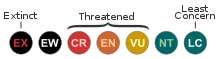
IUCN Red List of Threatened Plants Status : Not Listed.
Growth: S = slow M = medium F = fast. Soil: L = light (sandy) M = medium H = heavy (clay). pH: A = acid N = neutral B = basic (alkaline). Shade: F = full shade S = semi-shade N = no shade. Moisture: D = dry M = Moist We = wet Wa = water.
Now available:
Food Forest Plants for Mediterranean Conditions
350+ Perennial Plants For Mediterranean and Drier Food Forests and Permaculture Gardens.
[Paperback and eBook]
This is the third in Plants For A Future's series of plant guides for food forests tailored to
specific climate zones. Following volumes on temperate and tropical ecosystems, this book focuses
on species suited to Mediterranean conditions—regions with hot, dry summers and cool, wet winters,
often facing the added challenge of climate change.
Read More
Expert comment
Author
(Buckley)Pilg.
Botanical References
60235
Links / References
For a list of references used on this page please go here
Readers comment
| Add a comment |
|
If you have important information about this plant that may help other users please add a comment or link below. Only comments or links that are felt to be directly relevant to a plant will be included. If you think a comment/link or information contained on this page is inaccurate or misleading we would welcome your feedback at [email protected]. If you have questions about a plant please use the Forum on this website as we do not have the resources to answer questions ourselves.
* Please note: the comments by website users are not necessarily those held by PFAF and may give misleading or inaccurate information.
|
Subject : Leymus triticoides
|
|
|
|