 |
|
http://commons.wikimedia.org/wiki/User:Bor%C3%A9al |
 |
| http://commons.wikimedia.org/wiki/User:Dlanglois |
Translate this page:
Summary
Physical Characteristics

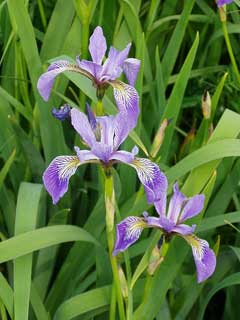
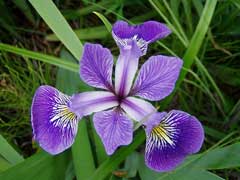
 Iris versicolor is a PERENNIAL growing to 0.6 m (2ft) by 1 m (3ft 3in).
See above for USDA hardiness. It is hardy to UK zone 5. It is in flower from May to June. The species is hermaphrodite (has both male and female organs) and is pollinated by Insects. The plant is self-fertile.
Suitable for: light (sandy) and medium (loamy) soils. Suitable pH: mildly acid, neutral and basic (mildly alkaline) soils. It can grow in semi-shade (light woodland) or no shade. It prefers moist or wet soil.
UK Hardiness Map
US Hardiness Map
Synonyms
Iris boltoniana, Iris caurina, Iris dierinckii, Limniris versicolor.
Plant Habitats
Bog Garden;
Edible Uses
References More on Edible Uses
Medicinal Uses
Plants For A Future can not take any responsibility for any adverse effects from the use of plants. Always seek advice from a professional before using a plant medicinally.
Alterative Antiinflammatory Cathartic Cholagogue Diuretic Emetic Sialagogue Stimulant
Blue flag was one of the most popular medicinal plants amongst various native North American Indian tribes[213]. In modern herbalism it is mainly employed to detoxify the body - it increases urination and bile production and has a mild laxative effect[254]. Some caution should be exercised in its use, however, since there are reports that it is poisonous[222]. The fresh root is quite acrid and when taken internally causes nausea, vomiting, colic and purging[4, 238]. The dried root is much less acrid[4]. This remedy should not be prescribed for pregnant women[238]. The root is alterative, anti-inflammatory, cathartic, cholagogue, diaphoretic, diuretic, emetic and sialagogue[21, 46, 165, 238]. Taken internally as a tea, the root has been used as a strong laxative or emetic that also acts strongly on the liver and promotes the excretion of excess body fluids[4, 213]. It is also stimulant for the circulatory and lymphatic system[165]. Its detoxifying effect make it useful in the treatment of psoriasis, acne, herpes, arthritis, swollen glands, pelvic inflammatory disease etc[238, 254]. Externally, it is applied to skin diseases, wounds and rheumatic joints[238]. The roots are harvested in late summer and early autumn and are usually dried for later use[4, 238]. The roots were boiled in water and then mashed to make a poultice which was used to relieve the pain and swelling associated with sores and bruises[213].
References More on Medicinal Uses
The Bookshop: Edible Plant Books
Our Latest books on Perennial Plants For Food Forests and Permaculture Gardens in paperback or digital formats.

Edible Tropical Plants
Food Forest Plants for Hotter Conditions: 250+ Plants For Tropical Food Forests & Permaculture Gardens.
More

Edible Temperate Plants
Plants for Your Food Forest: 500 Plants for Temperate Food Forests & Permaculture Gardens.
More

More Books
PFAF have eight books available in paperback and digital formats. Browse the shop for more information.
Shop Now
Other Uses
Litmus Repellent Weaving
A fine blue infusion is obtained from the flowers and this can be used as a litmus substitute to test for acids and alkalis[4]. The leaves have been used to weave baskets and mats[257]. Some native North American Indian tribes used the root as a protection against rattlesnakes. It was believed that, so long as the root was handled occasionally to ensure the scent permeated the person and their clothes, rattlesnakes would not bite them. Some tribes even used to chew the root and then hold rattlesnakes with their teeth and were not bitten so long as the scent persisted[257].
Special Uses
References More on Other Uses
Cultivation details
Prefers growing in marshy conditions[1]. Very easily grown in any damp soil[42]. Prefers a heavy rich moist soil[4] and partial shade[188]. Prefers a sunny position[233]. Plants are hardy to about -25°c[187]. This species has been cultivated by the N. American Indians as a medicinal plant[207, 213]. Members of this genus are rarely if ever troubled by browsing deer or rabbits[233].
References Carbon Farming Information and Carbon Sequestration Information
Temperature Converter
Type a value in the Celsius field to convert the value to Fahrenheit:
Fahrenheit:
The PFAF Bookshop
Plants For A Future have a number of books available in paperback and digital form. Book titles include Edible Plants, Edible Perennials, Edible Trees,Edible Shrubs, Woodland Gardening, and Temperate Food Forest Plants. Our new book is Food Forest Plants For Hotter Conditions (Tropical and Sub-Tropical).
Shop Now
Plant Propagation
Seed - best sown as soon as it is ripe in a cold frame. Stored seed should be sown as early in the year as possible in a cold frame. Prick out the seedlings into individual pots when they are large enough to handle and grow them on in the greenhouse or cold frame for their first year. Plant out into their permanent positions in late spring or early summer. Division, best done in early autumn after flowering, but can also be done in mid-spring. Very easy, larger clumps can be replanted direct into their permanent positions, though it is best to pot up smaller clumps and grow them on in a cold frame until they are rooting well. Plant them out in the spring.
Other Names
If available other names are mentioned here
Native Range
NORTHERN AMERICA: Canada (Québec, Nova Scotia, Ontario, Prince Edward Island, New Brunswick, Newfoundland and Labrador (incl. Labrador), Manitoba (south)), United States (Connecticut, Maine, Massachusetts, Michigan, New Hampshire, New Jersey, New York, Ohio, Pennsylvania, Rhode Island, Vermont, Minnesota, Wisconsin, Maryland, Virginia)
Weed Potential
Right plant wrong place. We are currently updating this section.
Please note that a plant may be invasive in one area but may not in your area so it's worth checking.
Conservation Status
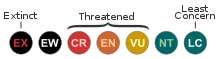
IUCN Red List of Threatened Plants Status :
| Related Plants
|
| Latin Name | Common Name | Habit | Height | Hardiness | Growth | Soil | Shade | Moisture | Edible | Medicinal | Other |
| Albizia lebbeck | Siris Tree, Woman's Tongue, East Indian Walnut | Tree | 15.0 |
10-11
| F | LMH | N | DM | 1 | 2 | 4 |
| Albizia lucidior | Potka siris tree | Tree | 15.0 |
10-12
| F | LMH | SN | M | 0 | 0 | 3 |
| Albizia procera | White Siris, Tall Albizia, Forest Siris | Tree | 25.0 |
10-12
| F | LMH | N | M | 1 | 2 | 4 |
| Bobartia indica | Rush Iris | Perennial | 0.6 |
7-10
| S | L | N | DM | 0 | 0 | 1 |
| Gynandriris sisyrinchium | Spanish Nut | Perennial | 0.2 |
7-10
| | MH | SN | DM | 1 | 0 | |
| Iris cristata | Crested Iris, Dwarf crested iris | Perennial | 0.2 |
5-9
| M | LM | SN | M | 1 | 1 | |
| Iris decora | | Perennial | 0.3 |
-
| | LM | N | DM | 0 | 1 | |
| Iris douglasiana | Mountain Iris, Douglas iris | Perennial | 0.3 |
6-9
| | LM | SN | DMWe | 0 | 0 | 1 |
| Iris ensata | Japanese Water Iris | Perennial | 0.6 |
5-8
| M | LM | N | MWe | 1 | 1 | 2 |
| Iris filifolia | | Bulb | 0.5 |
-
| | LM | N | DM | 1 | 0 | |
| Iris foetidissima | Stinking Gladwin, Stinking iris, Gladwin Iris | Perennial | 1.0 |
7-10
| M | LMH | FSN | DMWe | 0 | 2 | 3 |
| Iris germanica | Purple Flag, German iris, Orris-root, Tall Bearded German Iris, Bearded Iris | Perennial | 1.0 |
4-10
| M | LM | SN | DM | 1 | 3 | 2 |
| Iris germanica florentina | Orris, Orris-root | Perennial | 0.9 |
5-10
| M | LM | SN | M | 1 | 3 | 3 |
| Iris japonica | | Perennial | 0.6 |
-
| | LM | SN | DM | 1 | 2 | 3 |
| Iris kemaonensis | | Perennial | 0.5 |
-
| | LM | SN | DM | 0 | 2 | |
| Iris macrosiphon | Bowltube Iris | Perennial | 0.2 |
-
| | LM | SN | M | 0 | 1 | 1 |
| Iris missouriensis | Rocky Mountain Iris | Perennial | 0.8 |
0-0
| | LM | SN | MWe | 1 | 2 | 1 |
| Iris pallida | Dalmation Iris, Sweet iris, Fragrant Iris, Zebra Iris | Perennial | 1.0 |
4-10
| M | LM | SN | DM | 2 | 1 | 3 |
| Iris pseudacorus | Yellow Flag, Paleyellow iris | Perennial | 1.5 |
5-8
| M | LM | SN | MWeWa | 1 | 2 | 2 |
| Iris purdyi | Purdy's Iris | Perennial | 0.4 |
-
| | LM | SN | DM | 0 | 0 | 1 |
| Iris sanguinea | Blood iris | Perennial | 0.8 |
5-9
| | LM | SN | MWe | 0 | 1 | 1 |
| Iris setosa | Beachhead Iris, Canada beachhead iris, Wild flag | Perennial | 0.6 |
4-8
| M | LM | SN | MWe | 1 | 1 | 1 |
| Iris sibirica | Siberian Iris | Perennial | 0.6 |
4-9
| F | LM | SN | MWe | 1 | 1 | 1 |
| Iris tectorum | Roof Iris, Wall iris, Japanese Roof, White Root Iris | Perennial | 0.3 |
5-9
| M | LM | SN | DM | 1 | 0 | |
| Iris tenax | Tough-Leaf Iris, Klamath iris | Perennial | 0.3 |
0-0
| | LM | SN | DM | 0 | 1 | 2 |
| Solanum tuberosum | Potato, Irish potato | Perennial | 1.0 |
7-10
| | LMH | N | M | 5 | 2 | 3 |
| Tagetes filifolia | Irish Lace | Annual | 0.4 |
8-11
| F | LMH | N | DM | 1 | 0 | 2 |
|
Growth: S = slow M = medium F = fast. Soil: L = light (sandy) M = medium H = heavy (clay). pH: A = acid N = neutral B = basic (alkaline). Shade: F = full shade S = semi-shade N = no shade. Moisture: D = dry M = Moist We = wet Wa = water.
Now available:
Food Forest Plants for Mediterranean Conditions
350+ Perennial Plants For Mediterranean and Drier Food Forests and Permaculture Gardens.
[Paperback and eBook]
This is the third in Plants For A Future's series of plant guides for food forests tailored to
specific climate zones. Following volumes on temperate and tropical ecosystems, this book focuses
on species suited to Mediterranean conditions—regions with hot, dry summers and cool, wet winters,
often facing the added challenge of climate change.
Read More
Expert comment
Author
L.
Botanical References
200270
Links / References
For a list of references used on this page please go here
Readers comment
© 2010, Plants For A Future. Plants For A Future is a charitable company limited by guarantee, registered in England and Wales. Charity No. 1057719, Company No. 3204567.