 |
|
http://en.wikipedia.org/wiki/User:Ram-Man |
 |
| http://commons.wikimedia.org/wiki/User:Dysmachus |
Translate this page:
Summary
Physical Characteristics

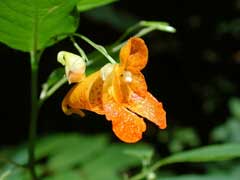
 Impatiens capensis is a ANNUAL growing to 1.2 m (4ft) at a fast rate.
See above for USDA hardiness. It is hardy to UK zone 2. It is in flower from July to October. The species is hermaphrodite (has both male and female organs) and is pollinated by Bees. The plant is self-fertile.
Suitable for: light (sandy), medium (loamy) and heavy (clay) soils and can grow in heavy clay soil. Suitable pH: mildly acid, neutral and basic (mildly alkaline) soils. It can grow in semi-shade (light woodland) or no shade. It prefers moist soil.
UK Hardiness Map
US Hardiness Map
Synonyms
I. biflora. I. fulva.
Plant Habitats
Woodland Garden Sunny Edge; Dappled Shade; Bog Garden;
Edible Uses
Edible Parts: Leaves Seed Shoots Stem
Edible Uses:
The succulent stems, whilst still young and tender, can be cut up and cooked like green beans[183]. Young leaves and shoots - cooked. They contain calcium oxalate crystals[62]. Calcium oxalate is usually destroyed by thorough cooking[K]. Large quantities of the leaves are purgative[55]. See also the notes above on toxicity.
References More on Edible Uses
Medicinal Uses
Plants For A Future can not take any responsibility for any adverse effects from the use of plants. Always seek advice from a professional before using a plant medicinally.
Antidote Poultice Stings Warts
Jewelweed was commonly used as a medicinal herb by a number of native North American Indian tribes[257], and has been widely used in domestic medicine. Its main value lies in its external application for wounds and a range of skin complaints. However, it is little used in modern herbalism and is considered to be dangerous and 'wholly questionable' when used internally[4]. The herb is antidote, cathartic, diuretic and emetic[4, 172, 207, 213]. An infusion has been used in the treatment of fevers, difficult urination, measles, stomach cramps, jaundice etc[257]. The juice of the leaves is used externally in the treatment of piles, fungal dermatitis, nettle stings, poison ivy rash, burns etc[4, 172, 207, 213, 257]. The sap is used to remove warts[207]. A poultice of the leaves is applied to bruises, burns, cuts etc[222].
References More on Medicinal Uses
The Bookshop: Edible Plant Books
Our Latest books on Perennial Plants For Food Forests and Permaculture Gardens in paperback or digital formats.
Edible Tropical Plants
Food Forest Plants for Hotter Conditions: 250+ Plants For Tropical Food Forests & Permaculture Gardens.
More
Edible Temperate Plants
Plants for Your Food Forest: 500 Plants for Temperate Food Forests & Permaculture Gardens.
More
More Books
PFAF have eight books available in paperback and digital formats. Browse the shop for more information.
Shop Now
Other Uses
Dye Fungicide
The fresh juice obtained from the plant is a fungicide. This juice can be concentrated by boiling it[62]. A yellow dye has been made from the flowers[4]. It can be made from the whole plant[257].
Special Uses
References More on Other Uses
Cultivation details
Succeeds in any reasonably good soil[1]. Grows well in heavy clay soils. Prefers a moist well-drained humus rich soil in a cool shady site[1, 200]. Plants self-sow in areas where minimum winter temperatures go no lower than -15°c[200]. This plant has seed capsules that spring open forcibly as the seed ripens to eject the seed a considerable distance. The capsules are sensitive to touch even before the seed is ripe, making seed collection difficult but fun[K].
References Carbon Farming Information and Carbon Sequestration Information
Temperature Converter
Type a value in the Celsius field to convert the value to Fahrenheit:
Fahrenheit:
The PFAF Bookshop
Plants For A Future have a number of books available in paperback and digital form. Book titles include Edible Plants, Edible Perennials, Edible Trees,Edible Shrubs, Woodland Gardening, and Temperate Food Forest Plants. Our new book is Food Forest Plants For Hotter Conditions (Tropical and Sub-Tropical).
Shop Now
Plant Propagation
Seed - sow spring in a greenhouse. When they are large enough to handle, prick the seedlings out into individual pots and plant them out in the summer.
Other Names
If available other names are mentioned here
Native Range
NORTHERN AMERICA: Canada (Northwest Territories (southwest), Québec, Nova Scotia, Ontario, Prince Edward Island, New Brunswick, Newfoundland and Labrador, Saskatchewan, Alberta, Manitoba), United States (Connecticut, Indiana, Maine, Massachusetts, Michigan, New Hampshire, New Jersey, New York, Ohio, Pennsylvania, Rhode Island, Vermont, West Virginia, Illinois, Iowa, Kansas (east & north), Minnesota, Missouri, Nebraska, North Dakota (east), Oklahoma (east), South Dakota, Wisconsin, Alabama, Arkansas, Delaware, Florida, Georgia, Kentucky, Louisiana, Maryland, Mississippi, North Carolina, South Carolina, Tennessee, Virginia, Texas)
Weed Potential
Right plant wrong place. We are currently updating this section.
Please note that a plant may be invasive in one area but may not in your area so it's worth checking.
Conservation Status
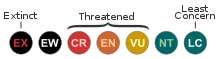
IUCN Red List of Threatened Plants Status :
Growth: S = slow M = medium F = fast. Soil: L = light (sandy) M = medium H = heavy (clay). pH: A = acid N = neutral B = basic (alkaline). Shade: F = full shade S = semi-shade N = no shade. Moisture: D = dry M = Moist We = wet Wa = water.
Now available:
Food Forest Plants for Mediterranean Conditions
350+ Perennial Plants For Mediterranean and Drier Food Forests and Permaculture Gardens.
[Paperback and eBook]
This is the third in Plants For A Future's series of plant guides for food forests tailored to
specific climate zones. Following volumes on temperate and tropical ecosystems, this book focuses
on species suited to Mediterranean conditions—regions with hot, dry summers and cool, wet winters,
often facing the added challenge of climate change.
Read More
Expert comment
Author
Meerb.
Botanical References
17200
Links / References
For a list of references used on this page please go here
Readers comment
© 2010, Plants For A Future. Plants For A Future is a charitable company limited by guarantee, registered in England and Wales. Charity No. 1057719, Company No. 3204567.