 |
|
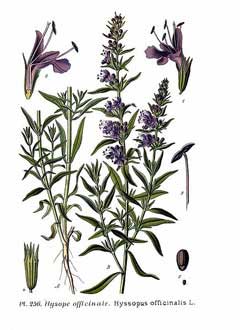
http://commons.wikimedia.org/wiki/File:256_Hyssopus_officinalis_L.jpg |
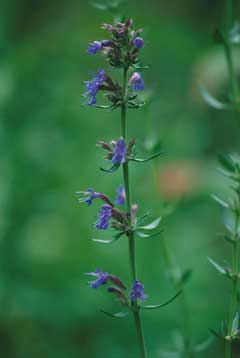 |
| http://commons.wikimedia.org/wiki/User:Llez |
Translate this page:
Summary
Hyssopus officinalis,
Hyssop is a small evergreen shrub in the mint family growing to 0.6m (2ft) and native to Southern Europe and the Middle East. The leaves, young shoot tips and flowers have an intensely aromatic flavour, like a cross between sage and mint. Eat them raw in salads or as a flavouring in soups. Hyssop is commonly grown in the herb garden as an edging plant or as a ground cover. It is a good companion plant to grow with grapes. The attractive blooms are suitable for cut or dried flowers. The root pattern is fibrous, dividing into many fine roots.
Harvesting: Leaves at any time after the plant is established. Flower tips are available in summer when the flowers are in full bloom. Bloom Color: Blue, Pink, Purple, White. Main Bloom Time: Early summer, Early fall, Late summer, Mid summer, Mid fall. Form: Upright or erect
Physical Characteristics

 Hyssopus officinalis is an evergreen Shrub growing to 0.6 m (2ft) by 0.6 m (2ft in) at a fast rate.
See above for USDA hardiness. It is hardy to UK zone 7. It is in leaf all year, in flower from July to September, and the seeds ripen from August to October. The species is hermaphrodite (has both male and female organs) and is pollinated by Bees. The plant is self-fertile.
It is noted for attracting wildlife.
Suitable for: light (sandy) and medium (loamy) soils and prefers well-drained soil. Suitable pH: neutral and basic (mildly alkaline) soils. It cannot grow in the shade. It prefers dry or moist soil.
UK Hardiness Map
US Hardiness Map
Synonyms
Thymus hyssopus
Plant Habitats
Ground Cover; Hedge; Cultivated Beds; East Wall. In. South Wall. In. West Wall. In.
Edible Uses
Edible Parts: Flowers Leaves Oil Shoots
Edible Uses: Condiment Oil
Leaves and young shoot tips - raw or used as a flavouring in soups, salads etc[4, 14, 183]. A strongly aromatic flavour, somewhat like a cross between sage and mint, it has fallen out of favour in recent years[4, 238]. It can be used fresh or dried[21]. Flowers - raw. Added to salads[183]. An essential oil from the plant is used as a food flavouring[183].
References More on Edible Uses
Medicinal Uses
Plants For A Future can not take any responsibility for any adverse effects from the use of plants. Always seek advice from a professional before using a plant medicinally.
Antiseptic Aromatherapy Astringent Carminative Diaphoretic Emmenagogue Expectorant Pectoral
Stimulant Stomachic Tonic Vasodilator
Hyssop has a long history of medicinal use and was so highly esteemed in the past that it was considered to be a virtual cure-all[254]. Currently an undervalued herb, it is often used as a household remedy, particularly as an expectorant and stomach tonic[4, 254]. It has a positive effect when used to treat bronchitis and respiratory infections, especially where there is excessive mucous production[254]. Hyssop can irritate the mucous membranes, so it is best given after an infection has peaked, when the herb's tonic action encourages a general recovery[254]. The plant should not be used by pregnant women, however, since in large quantities it can induce a miscarriage[7]. The leaves and flowering tops are antiseptic, antitussive, astringent, carminative, diaphoretic, emmenagogue, expectorant, pectoral, sedative, stimulant, stomachic, tonic and vasodilator[4, 7, 9, 21, 165, 238]. The plant can be harvested when in full flower and dried for later use[4]. A tea made from the leaves is used in the treatment of flatulence, stomach-aches, upper respiratory tract infections, coughs in children etc[222, 238]. A poultice made from the fresh herb is used to heal wounds[4, 238]. The essential oil is used in aromatherapy. Its keyword is 'Stability'[210]. This oil should not be used on people who are highly strung as it can cause epileptic symptoms[7, 254]. The essential oil should not be used internally except under professional supervision[254].
References More on Medicinal Uses
The Bookshop: Edible Plant Books
Our Latest books on Perennial Plants For Food Forests and Permaculture Gardens in paperback or digital formats.

Edible Tropical Plants
Food Forest Plants for Hotter Conditions: 250+ Plants For Tropical Food Forests & Permaculture Gardens.
More

Edible Temperate Plants
Plants for Your Food Forest: 500 Plants for Temperate Food Forests & Permaculture Gardens.
More

More Books
PFAF have eight books available in paperback and digital formats. Browse the shop for more information.
Shop Now
Other Uses
Essential Fungicide Hedge Hedge Oil Pot-pourri Repellent Strewing
Agroforestry uses:
Hyssop can be used as a companion plant in gardens, attracting pollinators and beneficial insects. It can also be utilized for erosion control and as a ground cover.
Hyssop can be grown as a dwarf hedge, it responds well to trimming in the spring[14, 52, 182]. The growing plant attracts cabbage white butterflies away from brassicas[14, 18, 20]. Another report says that hyssop attracts cabbage white butterflies and should not be grown near cabbages[201]. An essential oil from the leaves is antiseptic and also used in perfumery and as a food flavouring[200, 201]. It has a particularly fine odour and is much valued by perfumers[4]. Average yields of the oil are about 0.6%[7]. Yields from the blue-flowered variety are 1 - 1.5% essential oil, the red-flowered variety yields about 0.8%, whilst the white-flowered form yields 0.5% essential oil[240]. The plant was formerly used as a strewing herb[4, 200] and is also used in pot-pourri[245]. A tea made from the leaves is useful for controlling bacterial plant diseases[201]. Plants can be grown for ground cover when spaced about 45cm apart each way[208]. 1. Nectary - Flowers rich in nectar and pollen:
Yes – Hyssop produces flowers that are highly attractive to bees, butterflies, and other pollinators, providing both nectar and pollen.
2. Wildlife - Food (Fruit, Seeds, Leaf litter, Shelter, Nesting, Roosting):
Yes – While the seeds may be a food source for small birds, the plant’s structure offers some shelter, especially for insects, though it may not provide as much nesting or roosting for larger wildlife like birds.
3. Invertebrate Shelter (Overwintering sites, Leaf litter, Groundcover):
Yes – Hyssop offers overwintering sites for insects within its woody stems and provides some groundcover, though it’s not as dense as other groundcovers.
4. Pest Confuser (Smell):
Yes – The strong aromatic scent of hyssop can help confuse or deter certain pests, making it a useful companion plant.
Special Uses
Attracts Wildlife Food Forest Ground cover Hedge Hedge Scented Plants
References More on Other Uses
Cultivation details
Landscape Uses:Border, Specimen. Prefers a light, dry calcareous soil and a sunny position[1, 14, 37, 52]. A very cold-hardy plant, when dormant it can tolerate temperatures down to about -25°c[187]. Hyssop has very aromatic leaves and is commonly grown in the herb garden where it makes a good edging plant to a border[4]. There are some named varieties[183]. The plant needs to be trimmed regularly to keep it in shape, untrimmed plants will soon degenerate. Spring is the best time to trim the plants[238]. It is probably best to replace the plants every few years. The flowers have a rich aromatic fragrance[245]. Hyssop is a very good plant for attracting bees and butterflies to the garden[4, 20]. It is a good companion plant to grow with grapes, but it grows badly with radishes[14, 18, 20]. Special Features:Edible, Fragrant foliage, Not North American native, Naturalizing, Attracts butterflies, Suitable for cut flowers, Suitable for dried flowers, Attractive flowers or blooms. In garden design, as well as the above-ground architecture of a plant, root structure considerations help in choosing plants that work together for their optimal soil requirements including nutrients and water. The root pattern is fibrous dividing into a large number of fine roots [2-1]. Hyssop is typically harvested in the summer when the flowers are in full bloom.
Hyssop flowers from mid-summer to early autumn producing spikes of small, tubular flowers.
Hyssop is considered a fast-growing herb, typically reaching full height (about 30 to 60 cm or 1 to 2 feet) within the first year of growth.
References Carbon Farming Information and Carbon Sequestration Information
Temperature Converter
Type a value in the Celsius field to convert the value to Fahrenheit:
Fahrenheit:
The PFAF Bookshop
Plants For A Future have a number of books available in paperback and digital form. Book titles include Edible Plants, Edible Perennials, Edible Trees,Edible Shrubs, Woodland Gardening, and Temperate Food Forest Plants. Our new book is Food Forest Plants For Hotter Conditions (Tropical and Sub-Tropical).
Shop Now
Plant Propagation
Seed - sow spring in a cold frame and only just cover the seed. Very easy, the seed germinates quickly. When they are large enough to handle, prick the seedlings out into individual pots and grow them on in the greenhouse for their first winter. Plant them out into their permanent positions in late spring or early summer, after the last expected frosts. Cuttings of half-ripe wood, 5 - 7 cm with a heel, June/July in a frame[11, 78]. Fairly easy, the cuttings root quite quickly. Grow on the plants in the greenhouse for their first winter and plant out in late spring. Cuttings of greenwood, 5 - 7 cm with a heel, April/May in a frame[1]. Plant out in the summer. Division in spring or autumn[1, 4].
Other Names
If available other names are mentioned here
Native Range
TEMPERATE ASIA: Armenia, Azerbaijan, Dagestan, Russian Federation, Turkey,Iran (north). EUROPE: Czechoslovakia (Czech Republic and Slovakia), Austria, Switzerland, Hungary, Ukraine (incl. Krym), Former Yugoslavia, Albania, Bulgaria, Italy, Spain, France, AFRICA: Algeria (north), Morocco.
Weed Potential
Right plant wrong place. We are currently updating this section.
Please note that a plant may be invasive in one area but may not in your area so it's worth checking.
Conservation Status
IUCN Red List of Threatened Plants Status :

Growth: S = slow M = medium F = fast. Soil: L = light (sandy) M = medium H = heavy (clay). pH: A = acid N = neutral B = basic (alkaline). Shade: F = full shade S = semi-shade N = no shade. Moisture: D = dry M = Moist We = wet Wa = water.
Now available:
Food Forest Plants for Mediterranean Conditions
350+ Perennial Plants For Mediterranean and Drier Food Forests and Permaculture Gardens.
[Paperback and eBook]
This is the third in Plants For A Future's series of plant guides for food forests tailored to
specific climate zones. Following volumes on temperate and tropical ecosystems, this book focuses
on species suited to Mediterranean conditions—regions with hot, dry summers and cool, wet winters,
often facing the added challenge of climate change.
Read More
Expert comment
Author
L.
Botanical References
11200
Links / References
For a list of references used on this page please go here
Readers comment
| Add a comment |
|
If you have important information about this plant that may help other users please add a comment or link below. Only comments or links that are felt to be directly relevant to a plant will be included. If you think a comment/link or information contained on this page is inaccurate or misleading we would welcome your feedback at [email protected]. If you have questions about a plant please use the Forum on this website as we do not have the resources to answer questions ourselves.
* Please note: the comments by website users are not necessarily those held by PFAF and may give misleading or inaccurate information.
|
Subject : Hyssopus officinalis
|
|
|
|