 |
|
http://commons.wikimedia.org/wiki/User:Cillas |
 |
|
Translate this page:
Summary
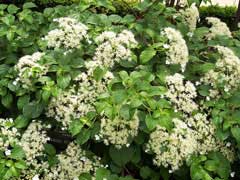
Bloom Color: Lavender, White. Main Bloom Time: Early summer, Early spring, Late summer, Late spring, Mid summer, Mid spring. Form: Rounded.
Physical Characteristics

 Hydrangea anomala is a deciduous Climber growing to 12 m (39ft 4in) at a fast rate.
See above for USDA hardiness. It is hardy to UK zone 5 and is not frost tender. It is in flower from June to July, and the seeds ripen from August to September. The species is hermaphrodite (has both male and female organs) and is pollinated by Bees.
Suitable for: light (sandy), medium (loamy) and heavy (clay) soils and prefers well-drained soil. Suitable pH: mildly acid, neutral and basic (mildly alkaline) soils and can grow in very acid soils.
It can grow in full shade (deep woodland) semi-shade (light woodland) or no shade. It prefers moist soil. The plant can tolerates strong winds but not maritime exposure.
UK Hardiness Map
US Hardiness Map
Synonyms
H. altissima. Wallich.
Plant Habitats
Woodland Garden Sunny Edge; Dappled Shade; Shady Edge; not Deep Shade; Ground Cover; East Wall. By.
Edible Uses
Edible Parts: Leaves Sap
Edible Uses: Condiment Sweetener
Leaves - cooked. A cucumber taste[183]. The Japanese crush the leaves and use them fresh with miso[177, 183]. A boiled concoction of the leaves is used to make a syrup[177, 183]. The sweet sap is used as a drink[183].
References More on Edible Uses
Medicinal Uses
Plants For A Future can not take any responsibility for any adverse effects from the use of plants. Always seek advice from a professional before using a plant medicinally.
The leaves are used medicinally[266]. No further information is given.
References More on Medicinal Uses
The Bookshop: Edible Plant Books
Our Latest books on Perennial Plants For Food Forests and Permaculture Gardens in paperback or digital formats.

Edible Tropical Plants
Food Forest Plants for Hotter Conditions: 250+ Plants For Tropical Food Forests & Permaculture Gardens.
More

Edible Temperate Plants
Plants for Your Food Forest: 500 Plants for Temperate Food Forests & Permaculture Gardens.
More

More Books
PFAF have eight books available in paperback and digital formats. Browse the shop for more information.
Shop Now
Other Uses
Paper
The bark is a paper substitute[146, 158]. The sub-species H. anomala petiolaris can be used as a ground cover plant in a shady position[188]. It is best spaced about 1.8 metres apart each way[208].
Special Uses
Espalier Ground cover
References More on Other Uses
Cultivation details
Landscape Uses:Arbor, Espalier. Tolerates most soils[200], thriving in a well-drained loamy soil[1], but resenting dryness at the roots[11, 200]. Succeeds in full sun or semi-shade[200], but if it is grown in a low rainfall area then it requires shade at the hottest part of the day[11]. Does well on very acid soils with a pH around 4.5[200]. The colour of the flowers reflects the pH of the soil the plant is growing in, the flowers are pink in a neutral to alkaline soil and blue in an acid soil. Although the dormant plant is quite hardy in Britain, the young growth in spring can be damaged by late frosts. A fast-growing self-clinging climbing plant[208], attaching itself by means of aerial roots[200], and growing up walls or tree trunks on any aspect. The plants may need initial support, however[200]. Plants are growing well on a wall at Kew[11]. Grows well on north walls but prefers a sunnier position[208]. Closely related to H. petiolaris[11]. H. petiolaris is normally treated as no more than a sub-species of this species[200]. This species is notably susceptible to honey fungus[200]. Special Features:
Not North American native, Blooms are very showy.
References Carbon Farming Information and Carbon Sequestration Information
Temperature Converter
Type a value in the Celsius field to convert the value to Fahrenheit:
Fahrenheit:
The PFAF Bookshop
Plants For A Future have a number of books available in paperback and digital form. Book titles include Edible Plants, Edible Perennials, Edible Trees,Edible Shrubs, Woodland Gardening, and Temperate Food Forest Plants. Our new book is Food Forest Plants For Hotter Conditions (Tropical and Sub-Tropical).
Shop Now
Plant Propagation
Seed - surface sow in a greenhouse in spring[113]. Cover the pot with paper until the seed germinates[78]. When they are large enough to handle, prick the seedlings out into individual pots and grow them on in the greenhouse for at least their first winter. Plant them out into their permanent positions in late spring or early summer, after the last expected frosts. Cuttings of half-ripe wood, 8cm long, July/August in a frame. Overwinter in a greenhouse and plant out in late spring[78]. Cuttings of mature wood in late autumn in a frame[200]. Mound layering in spring. Takes 12 months[78]. Basal softwood cuttings of non-flowering shoots[200]. Leaf-bud cuttings of the current seasons growth in a frame[200].
Other Names
If available other names are mentioned here
Native Range
TEMPERATE ASIA: China (Anhui Sheng, Fujian Sheng, Gansu Sheng, Guangdong Sheng, Guangxi Zhuangzu Zizhiqu, Guizhou Sheng, Henan Sheng, Hubei Sheng, Hunan Sheng, Jiangxi Sheng, Shaanxi Sheng, Sichuan Sheng, Xizang Zizhiqu, Yunnan Sheng, Zhejiang Sheng), Japan (Hokkaidô, Honshu), Taiwan TROPICAL ASIA: Bhutan, India (Sikkim, Assam (north), Himachal Pradesh, Punjab, Uttar Pradesh (north), West Bengal (north), Arunachal Pradesh), Nepal, Myanmar (north)
Weed Potential
Right plant wrong place. We are currently updating this section.
Please note that a plant may be invasive in one area but may not in your area so it's worth checking.
Conservation Status
IUCN Red List of Threatened Plants Status :
| Related Plants
|
| Latin Name | Common Name | Habit | Height | Hardiness | Growth | Soil | Shade | Moisture | Edible | Medicinal | Other |
| Clerodendrum bungei | Glory Flower, Rose glorybower, Cashmere Bouquet, Mexican Hydrangea, Glory Bower | Shrub | 2.0 |
7-9
| M | LMH | N | M | 0 | 1 | 0 |
| Deinanthe bifida | | Perennial | 0.4 |
6-9
| S | LM | FS | M | 1 | 0 | |
| Deutzia scabra | Fuzzy pride-of-rochester, Deutzia | Shrub | 3.0 |
5-8
| M | LMH | SN | M | 1 | 0 | 2 |
| Dichroa febrifuga | Chinese Quinine, Dichroa | Shrub | 2.0 |
8-11
| M | LMH | SN | M | 0 | 3 | 1 |
| Hydrangea arborescens | Seven Barks, Wild hydrangea, Ashy Hydrangea, Snowhill Hydrangea, Smooth Hydrangea | Shrub | 3.0 |
4-9
| M | LMH | SN | M | 1 | 3 | |
| Hydrangea aspera | Hydrangea | Shrub | 4.0 |
7-9
| M | LMH | SN | DM | 1 | 0 | |
| Hydrangea hirta | | Shrub | 1.0 |
6-9
| | LMH | SN | M | 1 | 0 | |
| Hydrangea macrophylla | French hydrangea , Florist's Hydrangea, Bigleaf Hydrangea | Shrub | 3.0 |
5-9
| M | LMH | SN | M | 3 | 2 | 3 |
| Hydrangea paniculata | Panicled hydrangea, Hybrid Hydrangea, PeeGee Hydrangea, Panicle Hydrangea | Shrub | 4.0 |
3-8
| F | LMH | SN | MWe | 1 | 2 | 2 |
| Hydrangea serrata | Hydrangea, Mountain Hydrangea, Sawtooth Hydrangea | Shrub | 2.0 |
5-9
| M | LMH | SN | M | 2 | 0 | 3 |
| Hydrangea serrata amagiana | | Shrub | 2.0 |
5-9
| | LMH | SN | M | 4 | 0 | 2 |
| Hydrangea serrata thunbergii | Tea of heaven, Ama-tsja, | Shrub | 1.5 |
5-9
| | LMH | SN | M | 3 | 0 | 2 |
| Philadelphus coronarius | Mock Orange, Sweet mock orange | Shrub | 4.0 |
4-8
| F | LMH | SN | M | 0 | 0 | 1 |
| Philadelphus delavayi | | Shrub | 4.0 |
5-9
| | LMH | SN | M | 0 | 0 | 1 |
| Philadelphus lewisii | Mock Orange, Lewis' mock orange | Shrub | 3.6 |
4-8
| | LMH | SN | M | 0 | 1 | 3 |
| Philadelphus microphyllus | Littleleaf Mock Orange | Shrub | 1.2 |
5-9
| | LMH | SN | DM | 1 | 0 | 1 |
| Philadelphus pubescens | Hoary mock orange | Shrub | 5.0 |
5-9
| | LMH | SN | M | 0 | 0 | 1 |
| Philadelphus purpurascens | | Shrub | 4.0 |
5-9
| | LMH | SN | DM | 0 | 0 | 1 |
| Philadelphus x virginalis | Mock Orange | Shrub | 3.0 |
5-8
| M | LMH | SN | M | 0 | 0 | 1 |
| Platycrater arguta | | Shrub | 1.0 |
7-10
| | LMH | S | M | 1 | 0 | 3 |
| Schizophragma hydrangeoides | Japanese Hydrangea Vine | Climber | 12.0 |
5-8
| S | LMH | FSN | M | 1 | 0 | 3 |
| Schizophragma integrifolium | | Climber | 12.0 |
6-9
| | LMH | FSN | M | 0 | 2 | 3 |
|
Growth: S = slow M = medium F = fast. Soil: L = light (sandy) M = medium H = heavy (clay). pH: A = acid N = neutral B = basic (alkaline). Shade: F = full shade S = semi-shade N = no shade. Moisture: D = dry M = Moist We = wet Wa = water.
Now available:
Food Forest Plants for Mediterranean Conditions
350+ Perennial Plants For Mediterranean and Drier Food Forests and Permaculture Gardens.
[Paperback and eBook]
This is the third in Plants For A Future's series of plant guides for food forests tailored to
specific climate zones. Following volumes on temperate and tropical ecosystems, this book focuses
on species suited to Mediterranean conditions—regions with hot, dry summers and cool, wet winters,
often facing the added challenge of climate change.
Read More
Expert comment
Author
D.Don.
Botanical References
11200266
Links / References
For a list of references used on this page please go here
Readers comment
© 2010, Plants For A Future. Plants For A Future is a charitable company limited by guarantee, registered in England and Wales. Charity No. 1057719, Company No. 3204567.