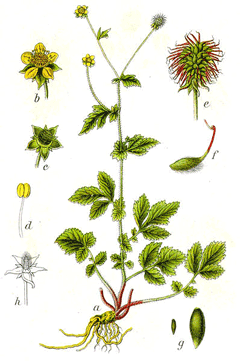
 |
|
http://commons.wikimedia.org/wiki/File:Geum_urbanum_Sturm44.jpg |
 |
| http://commons.wikimedia.org/wiki/User:Llez |
Translate this page:
Summary
Physical Characteristics

 Geum urbanum is a PERENNIAL growing to 0.5 m (1ft 8in) by 0.5 m (1ft 8in).
See above for USDA hardiness. It is hardy to UK zone 6 and is not frost tender. It is in flower from June to August. The species is hermaphrodite (has both male and female organs) and is pollinated by Bees. The plant is self-fertile.
Suitable for: light (sandy), medium (loamy) and heavy (clay) soils and prefers well-drained soil. Suitable pH: mildly acid, neutral and basic (mildly alkaline) soils. It can grow in semi-shade (light woodland) or no shade. It prefers moist soil.
UK Hardiness Map
US Hardiness Map
Synonyms
Geum rivale subsp. urbanum Á. Löve & D. Löve
Plant Habitats
Woodland Garden Sunny Edge; Dappled Shade; Shady Edge; Hedgerow; North Wall. In. East Wall. In. West Wall. In.
Edible Uses
Edible Parts: Leaves Root
Edible Uses: Condiment Drink
Young leaves - cooked. Root - cooked. Used as a spice in soups, stews etc, and also as a flavouring in ale[4, 5, 8, 13, 183]. It is a substitute for cloves with a hint of cinnamon in the flavour[12, 74, 183]. It is best used in spring[12]. The root is also boiled to make a beverage[161]. The root is up to 5cm long[4].
References More on Edible Uses
Medicinal Uses
Plants For A Future can not take any responsibility for any adverse effects from the use of plants. Always seek advice from a professional before using a plant medicinally.
Antidiarrhoeal Antiinflammatory Antiseptic Aromatic Astringent Diaphoretic Febrifuge Skin
Stomachic Styptic Tonic
Wood avens is an astringent herb, used principally to treat problems affecting the mouth, throat and gastro-intestinal tract. It tightens up soft gums, heals mouth ulcers, makes a good gargle for infections of the pharynx and larynx, and reduces irritation of the stomach and gut[254]. All parts of the plant, but especially the root, are anti-inflammatory, antiseptic, aromatic, astringent, diaphoretic, febrifuge, stomachic, styptic and tonic[4, 9, 21, 165, 238]. An infusion is taken internally in the treatment of diarrhoea, intestinal disorders, stomach upsets, irritable bowel syndrome and liver disorders, it is also applied externally as a wash to haemorrhoids, vaginal discharges etc[238, 254] and to treat various skin afflictions - it is said to remove spots, freckles and eruptions from the face[4, 9]. The root is best harvested in the spring, since at this time it is most fragrant[4]. Much of the fragrance can be lost on drying, so the root should be dried with great care then stored in a cool dry place in an airtight container, being sliced and powdered only when required for use[4]. The powdered root had a great reputation as a substitute for quinine in the treatment of intermittent fevers [301].
References More on Medicinal Uses
The Bookshop: Edible Plant Books
Our Latest books on Perennial Plants For Food Forests and Permaculture Gardens in paperback or digital formats.

Edible Tropical Plants
Food Forest Plants for Hotter Conditions: 250+ Plants For Tropical Food Forests & Permaculture Gardens.
More

Edible Temperate Plants
Plants for Your Food Forest: 500 Plants for Temperate Food Forests & Permaculture Gardens.
More

More Books
PFAF have eight books available in paperback and digital formats. Browse the shop for more information.
Shop Now
Other Uses
Repellent Tannin
The freshly dug root has a clove-like fragrance[4], when dried it is used in the linen cupboard to repel moths[4, 53]. The root contains about 9% tannin[4].
Special Uses
Food Forest Scented Plants
References More on Other Uses
Cultivation details
Easily grown in any moderately good garden soil that is well-drained[1]. Prefers shade[12, 21] and a soil rich in organic matter[200]. This species was widely cultivated as a pot-herb in the 16th century[5]. The bruised or dried root is pleasantly aromatic with a clove-like fragrance[245]. Plants self-sow freely when well-sited[238]. Hybridizes freely with other members of this genus[200]. For polyculture design as well as the above-ground architecture (form - tree, shrub etc. and size shown above) information on the habit and root pattern is also useful and given here if available. The plant growth habit is a clumper with limited spread [1-2]. The root pattern is rhizomatous with underground stems sending roots and shoots along their length [1-2].
References Carbon Farming Information and Carbon Sequestration Information
Temperature Converter
Type a value in the Celsius field to convert the value to Fahrenheit:
Fahrenheit:
The PFAF Bookshop
Plants For A Future have a number of books available in paperback and digital form. Book titles include Edible Plants, Edible Perennials, Edible Trees,Edible Shrubs, Woodland Gardening, and Temperate Food Forest Plants. Our new book is Food Forest Plants For Hotter Conditions (Tropical and Sub-Tropical).
Shop Now
Plant Propagation
Seed - sow spring or autumn in a cold frame[200]. When they are large enough to handle, prick the seedlings out into individual pots and plant them out in the summer' Division in spring or autumn. This should be done every 3 - 4 years in order to maintain the vigour of the plant[200]. Very easy, larger clumps can be replanted direct into their permanent positions, though it is best to pot up smaller clumps and grow them on in a cold frame until they are rooting well. Plant them out in the spring.
Other Names
If available other names are mentioned here
Native Range
TEMPERATE ASIA: Armenia, Azerbaijan, Ciscaucasia, Dagestan, Georgia, Iraq, Kazakhstan, Kyrgyzstan, Russian Federation, Russian Federation-Ciscaucasia, Russian Federation-Western Siberia, Tajikistan, Turkey, Turkmenistan, Western Siberia,Iran. EUROPE: Denmark, Finland (south), United Kingdom (U.K.), Ireland, Norway, Sweden (south), Austria, Belgium, Switzerland, Czech Republic, Germany, Hungary, Netherlands, Poland, Slovakia, Russian Federation-European part, European part, Belarus, Estonia, Lithuania, Latvia, Moldova, Ukraine (incl. Krym), Albania, Bulgaria, Bosnia and Herzegovina, Greece, Croatia, Italy (incl. Sardinia, Sicily), North Macedonia, Montenegro, Romania, Serbia, Slovenia, Spain, France (incl. Corsica), Portugal, AFRICA: Algeria, Morocco, Tunisia.
Weed Potential
Right plant wrong place. We are currently updating this section.
Please note that a plant may be invasive in one area but may not in your area so it's worth checking.
Conservation Status
IUCN Red List of Threatened Plants Status :
Growth: S = slow M = medium F = fast. Soil: L = light (sandy) M = medium H = heavy (clay). pH: A = acid N = neutral B = basic (alkaline). Shade: F = full shade S = semi-shade N = no shade. Moisture: D = dry M = Moist We = wet Wa = water.
Now available:
Food Forest Plants for Mediterranean Conditions
350+ Perennial Plants For Mediterranean and Drier Food Forests and Permaculture Gardens.
[Paperback and eBook]
This is the third in Plants For A Future's series of plant guides for food forests tailored to
specific climate zones. Following volumes on temperate and tropical ecosystems, this book focuses
on species suited to Mediterranean conditions—regions with hot, dry summers and cool, wet winters,
often facing the added challenge of climate change.
Read More
Expert comment
Author
L.
Botanical References
17200
Links / References
For a list of references used on this page please go here
Readers comment
© 2010, Plants For A Future. Plants For A Future is a charitable company limited by guarantee, registered in England and Wales. Charity No. 1057719, Company No. 3204567.