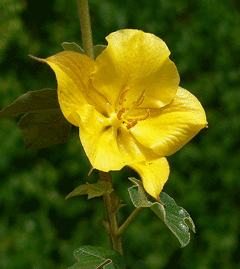
 |
|
http://commons.wikimedia.org/wiki/User:Stan_Shebs |
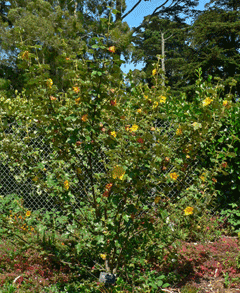 |
| http://commons.wikimedia.org/wiki/User:Stan_Shebs |
Translate this page:
Summary
Chiranthodendron californicum is a synonym of Fremontodendron californicum. Bloom Color: Yellow. Main Bloom Time: Early spring, Late spring, Mid spring. Form: Oval.
Physical Characteristics

 Fremontodendron californicum is an evergreen Shrub growing to 6 m (19ft) by 4 m (13ft) at a medium rate.
See above for USDA hardiness. It is hardy to UK zone 8 and is frost tender. It is in leaf all year, in flower from May to July. The species is hermaphrodite (has both male and female organs).
Suitable for: light (sandy) and medium (loamy) soils, prefers well-drained soil and can grow in nutritionally poor soil. Suitable pH: mildly acid, neutral and basic (mildly alkaline) soils and can grow in very alkaline soils.
It can grow in semi-shade (light woodland) or no shade. It prefers dry or moist soil and can tolerate drought.
UK Hardiness Map
US Hardiness Map
Synonyms
Chiranthodendron californicum. Fremontia californica.
Plant Habitats
Woodland Garden Sunny Edge; East Wall. By. South Wall. By.
Edible Uses
References More on Edible Uses
Medicinal Uses
Plants For A Future can not take any responsibility for any adverse effects from the use of plants. Always seek advice from a professional before using a plant medicinally.
Poultice Urinary
The inner bark is used as a poultice[4, 61]. One report says that the bark has similar properties to Ulmus rubra (Slippery Elm Bark)[4]. These properties are as follows:- Slippery elm bark is a widely used herbal remedy and is considered to be one of the most valuable of remedies in herbal practice[4]. In particular, it is a gentle and effective remedy for irritated states of the mucous membranes of the chest, urinary tubules, stomach and intestines[254]. The inner bark contains large quantities of a sticky slime that can be dried to a powder or made into a liquid[229]. The inner bark is harvested in the spring from the main trunk and from larger branches, it is then dried and powdered for use as required[4]. Ten year old bark is said to be best[4]. Fine grades of the powder are best for internal use, coarse grades are better suited to poultices[238]. The plant is also part of a North American formula called essiac which is a popular treatment for cancer. Its effectiveness has never been reliably proven or disproven since controlled studies have not been carried out. The other herbs included in the formula are Arctium lappa, Rumex acetosella and Rheum palmatum[254]. The inner bark is demulcent, diuretic, emollient, expectorant, nutritive[4, 21, 165, 213]. It has a soothing and healing effect on all parts of the body that it comes into contact with[4] and is used in the treatment of sore throats, indigestion, digestive irritation, stomach ulcers etc[222]. It used to be frequently used as a food that was a nutritive tonic for the old, young and convalescents[222]. It was also applied externally to fresh wounds, burns and scalds[222]. The bark has been used as an antioxidant to prevent fats going rancid[222]. The whole bark, including the outer bark, has been used as a mechanical irritant to abort foetuses[238]. Its use became so widespread that it is now banned in several countries[238].
References More on Medicinal Uses
The Bookshop: Edible Plant Books
Our Latest books on Perennial Plants For Food Forests and Permaculture Gardens in paperback or digital formats.

Edible Tropical Plants
Food Forest Plants for Hotter Conditions: 250+ Plants For Tropical Food Forests & Permaculture Gardens.
More

Edible Temperate Plants
Plants for Your Food Forest: 500 Plants for Temperate Food Forests & Permaculture Gardens.
More

More Books
PFAF have eight books available in paperback and digital formats. Browse the shop for more information.
Shop Now
Other Uses
Fibre Wood
Landscape Uses: Container, Espalier, Hedge, Specimen. The bark can be made into cordage then used in making nets etc[257]. Wood - fine-grained, hard to soft, heavy[82, 229]. It is not used commercially due to the small size of the tree[229].
Special Uses
Espalier
References More on Other Uses
Cultivation details
Requires a light well-drained poorish soil[11] in full sun in a position sheltered from cold drying winds[200]. Tolerates light shade[202]. Prefers a hot dry situation according to one report[166] whilst another says that it does best against a north, west or east wall, a southern exposure usually being too hot and dry[182]. Tolerates very chalky soils[200, 202]. Plants produce lush growth when growing in rich soils at the expense of flowering[200]. This species is not hardy in the open at Kew, though it succeeds in the open in milder areas of the country[11, 182]. Plants tolerate temperatures down to about -15°c, especially once they are more than 1.5 metres tall[202]. Plants are relatively fast growing[202]. Resents root disturbance and should be planted into its final position when quite young[1, 11]. Plants do not seem to be long lived in cultivation[182], about 20 years being considered old age[219]. They are subject to sudden collapse and death, even if they have been growing and flowering well[11]. This is probably the result of excessive wet or of the plant failing to fully ripen its wood. The stems die back if the bark is cracked by frost or abrasion[1]. Plants can be pruned in mid to late summer, generating new growth and more flowers[202]. This species is notably resistant to honey fungus[200]. Special Features: North American native, Attractive flowers or blooms. Landscape Uses Container, Espalier, Hedge, Specimen.
References Carbon Farming Information and Carbon Sequestration Information
Temperature Converter
Type a value in the Celsius field to convert the value to Fahrenheit:
Fahrenheit:
The PFAF Bookshop
Plants For A Future have a number of books available in paperback and digital form. Book titles include Edible Plants, Edible Perennials, Edible Trees,Edible Shrubs, Woodland Gardening, and Temperate Food Forest Plants. Our new book is Food Forest Plants For Hotter Conditions (Tropical and Sub-Tropical).
Shop Now
Plant Propagation
Seed - pre-soak for 48 hours in warm water and then sow singly in pots in a cold frame in late winter. Variable germination[78]. Grow the young plants on in the greenhouse for at least their first winter. Plant them out into their permanent positions in late spring or early summer, after the last expected frosts. Cuttings of half-ripe wood, July/August in sandy soil in a frame[200]. Cuttings of greenwood in spring in a frame[200].
Other Names
If available other names are mentioned here
Native Range
NORTHERN AMERICA: United States (Arizona, California), Mexico (Baja)
Weed Potential
Right plant wrong place. We are currently updating this section.
Please note that a plant may be invasive in one area but may not
in your area so it's worth checking.
Conservation Status
IUCN Red List of Threatened Plants Status :
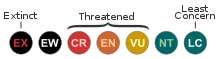
IUCN Red List
Growth: S = slow M = medium F = fast. Soil: L = light (sandy) M = medium H = heavy (clay). pH: A = acid N = neutral B = basic (alkaline). Shade: F = full shade S = semi-shade N = no shade. Moisture: D = dry M = Moist We = wet Wa = water.
Now available:
Food Forest Plants for Mediterranean Conditions
350+ Perennial Plants For Mediterranean and Drier Food Forests and Permaculture Gardens.
[Paperback and eBook]
This is the third in Plants For A Future's series of plant guides for food forests tailored to
specific climate zones. Following volumes on temperate and tropical ecosystems, this book focuses
on species suited to Mediterranean conditions—regions with hot, dry summers and cool, wet winters,
often facing the added challenge of climate change.
Read More
Expert comment
Author
(Torr.)Coville.
Botanical References
1171200
Links / References
For a list of references used on this page please go here
Readers comment
© 2010, Plants For A Future. Plants For A Future is a charitable company limited by guarantee, registered in England and Wales. Charity No. 1057719, Company No. 3204567.