 |
|
http://commons.wikimedia.org/wiki/File:Koeh-053.jpg |
 |
| http://commons.wikimedia.org/wiki/User:Llez |
Translate this page:
Summary
Bloom Color: Pink, Purple, White.
Main Bloom Time: Early summer, Late spring, Mid summer. Form: Upright or erect.
Physical Characteristics

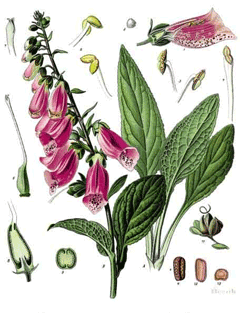
 Digitalis purpurea is a BIENNIAL growing to 1.2 m (4ft) by 0.6 m (2ft in) at a medium rate.
See above for USDA hardiness. It is hardy to UK zone 5 and is not frost tender. It is in flower from June to September, and the seeds ripen from August to October. The species is hermaphrodite (has both male and female organs) and is pollinated by Bees.
It is noted for attracting wildlife.
Suitable for: light (sandy), medium (loamy) and heavy (clay) soils. Suitable pH: mildly acid, neutral and basic (mildly alkaline) soils. It can grow in semi-shade (light woodland) or no shade. It prefers dry or moist soil.
UK Hardiness Map
US Hardiness Map
Synonyms
Digitalis alba. Digitalis campbelliana. Digitalis purpureolutea. Digitalis speciosa.
Plant Habitats
Woodland Garden Dappled Shade; Shady Edge;
Edible Uses
References More on Edible Uses
Medicinal Uses
Plants For A Future can not take any responsibility for any adverse effects from the use of plants. Always seek advice from a professional before using a plant medicinally.
Cardiac Diuretic Homeopathy Stimulant Tonic
The foxglove is a widely used herbal medicine with a recognised stimulatory effect upon the heart. It is also used in allopathic medicine in the treatment of heart complaints. It has a profound tonic effect upon a diseased heart, enabling the heart to beat more slowly, powerfully and regularly without requiring more oxygen[254]. At the same time it stimulates the flow of urine which lowers the volume of the blood and lessens the load on the heart[254]. The plant contains cardiac glycosides (including digoxin, digitoxin and lanatosides). Digitoxin rapidly strengthens the heartbeat but is excreted very slowly. Digoxin is therefore preferred as a long-term medication[254]. The leaves are cardiac, diuretic, stimulant and tonic[4, 9, 21, 46, 171]. The leaves should only be harvested from plants in their second year of growth, picked when the flowering spike has grown and about two thirds of the flowers have opened[4]. Harvested at other times, there is less of the medically active alkaloid present[4]. The seed has also been used in the past[4]. The leaves also have a very beneficial effect on the kidneys, they are strongly diuretic and are used with benefit in the treatment of dropsy[4]. Great care should be exercised in the use of this plant, the therapeutic dose is very close to the lethal dose[222]. See also the notes above on toxicity. A homeopathic remedy is made from the leaves[9]. It is used in the treatment of cardiac disorders[9].
References More on Medicinal Uses
The Bookshop: Edible Plant Books
Our Latest books on Perennial Plants For Food Forests and Permaculture Gardens in paperback or digital formats.

Edible Tropical Plants
Food Forest Plants for Hotter Conditions: 250+ Plants For Tropical Food Forests & Permaculture Gardens.
More

Edible Temperate Plants
Plants for Your Food Forest: 500 Plants for Temperate Food Forests & Permaculture Gardens.
More

More Books
PFAF have eight books available in paperback and digital formats. Browse the shop for more information.
Shop Now
Other Uses
Dye Preservative
An infusion of the plant prolongs the life of cut flowers[54]. Root crops growing near this plant store better[54]. An apple-green dye is obtained from the flowers[168]. Cut flower. Cultivars have gained the Royal Horticultural Society's Award of Garden Merit.
Special Uses
Attracts Wildlife Food Forest
References More on Other Uses
Cultivation details
Landscape Uses:Border, Container, Massing, Specimen, Woodland garden. Easily grown in ordinary garden soil, especially if it is rich in organic matter[1]. Prefers a light dry soil in semi-shade[17] but succeeds in full sun if the soil is moist[200]. Grows well in acid soils[17]. Plants are hardy to about -25°c[187]. The foxglove is a very ornamental plant that is easily naturalized in the semi-shade of a woodland[1]. It contains glycosides and forms the basis of an important heart medicine for which it is cultivated commercially[4]. This species is commonly used by herbalists, whereas D. lanata is more commonly grown for supplying the pharmaceutical industry[238]. The plant contains much greater concentrations of the medically active ingredients when it is grown in a sunny position[115]. The flowers are very attractive to bees[4, 24]. Individual plants can produce up to 2 million seeds[4]. Members of this genus are rarely if ever troubled by browsing deer or rabbits[233]. A good companion plant, it stimulates the growth of nearby plants, growing well with pine trees[18, 20, 54]. Special Features:Attractive foliage, Not North American native, Naturalizing, All or parts of this plant are poisonous, Suitable for cut flowers. In garden design, as well as the above-ground architecture of a plant, root structure considerations help in choosing plants that work together for their optimal soil requirements including nutrients and water. The root pattern is fibrous dividing into a large number of fine roots [2-1].
References Carbon Farming Information and Carbon Sequestration Information
Temperature Converter
Type a value in the Celsius field to convert the value to Fahrenheit:
Fahrenheit:
The PFAF Bookshop
Plants For A Future have a number of books available in paperback and digital form. Book titles include Edible Plants, Edible Perennials, Edible Trees,Edible Shrubs, Woodland Gardening, and Temperate Food Forest Plants. Our new book is Food Forest Plants For Hotter Conditions (Tropical and Sub-Tropical).
Shop Now
Plant Propagation
Seed - surface sow early spring in a cold frame. The seed usually germinates in 2 - 4 weeks at 20°c[175]. When they are large enough to handle, prick the seedlings out into individual pots and plant them out in the summer. If you have sufficient seed it can be sown outdoors in situ in the spring or autumn.
Other Names
If available other names are mentioned here
Foxglove, common foxglove, purple foxglove, lady's glove, Dedalera, Chupera.
Native Range
EUROPE: Finland, United Kingdom, Ireland, Norway, Sweden, Belgium, Germany, Albania, Italy (Sardegna), Spain (Baleares), France (incl. Corsica), Portugal AFRICA: Morocco
Weed Potential
Right plant wrong place. We are currently updating this section.
Please note that a plant may be invasive in one area but may not in your area so it's worth checking.
This plant can be weedy or invasive. Aggressive - Foxgloves self-seeds prolifically.
Conservation Status
IUCN Red List of Threatened Plants Status : This taxon has not yet been assessed.
Growth: S = slow M = medium F = fast. Soil: L = light (sandy) M = medium H = heavy (clay). pH: A = acid N = neutral B = basic (alkaline). Shade: F = full shade S = semi-shade N = no shade. Moisture: D = dry M = Moist We = wet Wa = water.
Now available:
Food Forest Plants for Mediterranean Conditions
350+ Perennial Plants For Mediterranean and Drier Food Forests and Permaculture Gardens.
[Paperback and eBook]
This is the third in Plants For A Future's series of plant guides for food forests tailored to
specific climate zones. Following volumes on temperate and tropical ecosystems, this book focuses
on species suited to Mediterranean conditions—regions with hot, dry summers and cool, wet winters,
often facing the added challenge of climate change.
Read More
Expert comment
Author
L.
Botanical References
17200
Links / References
For a list of references used on this page please go here
Readers comment
© 2010, Plants For A Future. Plants For A Future is a charitable company limited by guarantee, registered in England and Wales. Charity No. 1057719, Company No. 3204567.