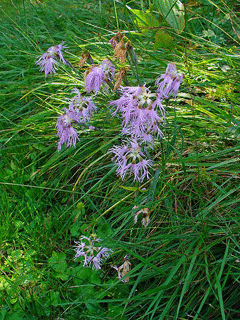
 |
|
http://commons.wikimedia.org/wiki/User:Llez |
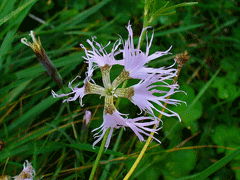 |
| http://commons.wikimedia.org/wiki/User:Llez |
Translate this page:
Summary
Physical Characteristics

 Dianthus superbus is a PERENNIAL growing to 0.6 m (2ft).
See above for USDA hardiness. It is hardy to UK zone 4 and is not frost tender. It is in flower from June to September. The species is hermaphrodite (has both male and female organs) and is pollinated by Insects.
Suitable for: light (sandy), medium (loamy) and heavy (clay) soils and prefers well-drained soil. Suitable pH: mildly acid, neutral and basic (mildly alkaline) soils and can grow in very alkaline soils.
It can grow in semi-shade (light woodland) or no shade. It prefers dry or moist soil.
UK Hardiness Map
US Hardiness Map
Synonyms
D. wimmeri.
Plant Habitats
Woodland Garden Sunny Edge; Dappled Shade; Shady Edge;
Edible Uses
Edible Parts: Flowers Leaves Nectar
Edible Uses:
The leaves, stems and tops are boiled, steeped in water and eaten as a potherb[105, 177, 179, 183]. Young plants are also eaten[183]. One report says that they contain saponins but that the leaves are apparently not toxic[179]. Probably this is because the content of saponins is too low to be harmful[K]. Children suck the flowers for their sweet edible nectar[105, 177, 183].
References More on Edible Uses
Medicinal Uses
Plants For A Future can not take any responsibility for any adverse effects from the use of plants. Always seek advice from a professional before using a plant medicinally.
Abortifacient Antibacterial Astringent Contraceptive Diuretic Emmenagogue Febrifuge Haemostatic
Ophthalmic Resolvent Tonic Urinary Vulnerary
The fringed pink, called Qu Mai in Chinese herbalism, has been used in Chinese herbal medicine for over 2,000 years. The whole plant is a bitter tonic herb that stimulates the digestive and urinary system, and also the bowels[238]. It also lowers blood pressure, reduces fevers and controls bacterial infections[218, 238]. Little used on its own, it is often taken with Dan Shen (Salvia multiorrhiza) to induce menstruation[254]. The closely related D. chinensis has the same uses as Qu Mai and is more commonly used[238]. The plant is abortifacient, contraceptive, diuretic, emmenagogue, ophthalmic, tonic and vulnerary[147, 176, 178, 218]. It is said to promote hair growth[147, 176, 178]. It is ranked 9th in a list of 250 potential antifertility Chinese plants[218]. The plant is taken internally in the treatment of acute urinary tract infections (especially cystitis), urinary stones, constipation and failure to menstruate[238]. Externally, it is applied to skin inflammations and swellings[238]. The leaves are used in the treatment of haemorrhoids, lumbricoid worms, venereal sores etc[218]. The flowers are astringent, diuretic, haemostatic, resolvent and vulnerary[218]. Research has shown that the flowers are the most markedly diuretic part of the plant[254].
References More on Medicinal Uses
The Bookshop: Edible Plant Books
Our Latest books on Perennial Plants For Food Forests and Permaculture Gardens in paperback or digital formats.

Edible Tropical Plants
Food Forest Plants for Hotter Conditions: 250+ Plants For Tropical Food Forests & Permaculture Gardens.
More

Edible Temperate Plants
Plants for Your Food Forest: 500 Plants for Temperate Food Forests & Permaculture Gardens.
More

More Books
PFAF have eight books available in paperback and digital formats. Browse the shop for more information.
Shop Now
Other Uses
References More on Other Uses
Cultivation details
Prefers an alkaline soil but tolerates slightly acid soils[200]. Succeeds in any well-drained peaty soil in sun or light shade[187]. Plants succeed when grown on the top of a broad or retaining wall[219]. A very hardy plant, tolerating temperatures down to about -20°c[187]. The flowers have a soft sweet perfume[245].
References Carbon Farming Information and Carbon Sequestration Information
Temperature Converter
Type a value in the Celsius field to convert the value to Fahrenheit:
Fahrenheit:
The PFAF Bookshop
Plants For A Future have a number of books available in paperback and digital form. Book titles include Edible Plants, Edible Perennials, Edible Trees,Edible Shrubs, Woodland Gardening, and Temperate Food Forest Plants. Our new book is Food Forest Plants For Hotter Conditions (Tropical and Sub-Tropical).
Shop Now
Plant Propagation
Seed - sow April/June in a greenhouse and only just cover the seed. Germination usually takes place within 1 - 3 weeks at 20°c. When they are large enough to handle, prick the seedlings out into individual pots and plant them out in the autumn.
Other Names
If available other names are mentioned here
Native Range
TEMPERATE ASIA: Russian Federation-Western Siberia (Western Siberia), Russian Federation-Eastern Siberia (Eastern Siberia), Kazakhstan, Kyrgyzstan, Tajikistan, Mongolia, Russian Federation-Far East (Far East), China (Anhui Sheng, Gansu Sheng, Guangxi Zhuangzu Zizhiqu, Guizhou Sheng, Hebei Sheng, Heilongjiang Sheng, Henan Sheng, Hubei Sheng, Hunan Sheng, Jiangsu Sheng, Jiangxi Sheng, Jilin Sheng, Nei Mongol Zizhiqu, Ningxia Huizi Zizhiqu, Qinghai Sheng, Shaanxi Sheng, Shandong Sheng, Shanxi Sheng, Sichuan Sheng, Xinjiang Uygur Zizhiqu, Zhejiang Sheng), Japan (Hokkaidô, Honshu, Kyushu, Shikoku) EUROPE: Denmark, Finland, Norway (northeast), Sweden, Austria, Switzerland, Czech Republic, Germany, Hungary, Netherlands (probably extinct), Poland, Slovakia, Russian Federation (European part), Belarus, Estonia, Lithuania, Latvia, Moldova, Ukraine, Bulgaria, Greece (Macedonia (east)), Croatia, Italy (north), North Macedonia, Romania, Serbia, Slovenia, France
Weed Potential
Right plant wrong place. We are currently updating this section.
Please note that a plant may be invasive in one area but may not in your area so it's worth checking.
Conservation Status
IUCN Red List of Threatened Plants Status :

Growth: S = slow M = medium F = fast. Soil: L = light (sandy) M = medium H = heavy (clay). pH: A = acid N = neutral B = basic (alkaline). Shade: F = full shade S = semi-shade N = no shade. Moisture: D = dry M = Moist We = wet Wa = water.
Now available:
Food Forest Plants for Mediterranean Conditions
350+ Perennial Plants For Mediterranean and Drier Food Forests and Permaculture Gardens.
[Paperback and eBook]
This is the third in Plants For A Future's series of plant guides for food forests tailored to
specific climate zones. Following volumes on temperate and tropical ecosystems, this book focuses
on species suited to Mediterranean conditions—regions with hot, dry summers and cool, wet winters,
often facing the added challenge of climate change.
Read More
Expert comment
Author
L.
Botanical References
50200
Links / References
For a list of references used on this page please go here
Readers comment
| Add a comment |
|
If you have important information about this plant that may help other users please add a comment or link below. Only comments or links that are felt to be directly relevant to a plant will be included. If you think a comment/link or information contained on this page is inaccurate or misleading we would welcome your feedback at [email protected]. If you have questions about a plant please use the Forum on this website as we do not have the resources to answer questions ourselves.
* Please note: the comments by website users are not necessarily those held by PFAF and may give misleading or inaccurate information.
|
Subject : Dianthus superbus
|
|
|
|