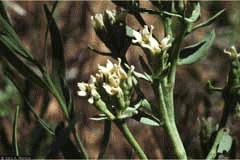
 |
|
Gary A. Monroe @ USDA-NRCS PLANTS Database |
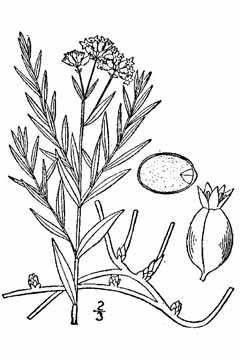 |
| USDA-NRCS PLANTS Database / Britton, N.L., and A. Brown. 1913. An illustrated flora of the northern United States, Canada and the British Possessions. Vol. 1: 640. |
Translate this page:
Summary
Taxonomic Note: This genus was formerly classified in the family Viscaceae. Modern classifications include it within the Santalaceae.
Comandra pallida A.DC. is a synonym of Comandra umbellata subsp. pallida. Pale bastard toadflax is one of those “high reward, high caution” wild foods. The fruits are widely described as edible, but they are typically thin-fleshed, often bitter and astringent, and frequently affected by fungi—making them a poor target for most foragers. The seeds inside, however, can be genuinely excellent: nut-like, oily, and calorically dense, with a flavor some people compare to hazelnut when roasted. The complication is selenium. This plant is known for accumulating selenium in some soils, and the difference between helpful and harmful selenium intake is narrow. In practice, that means the seeds may be delicious, but they are not a “regular snack” food, and they should be treated as an occasional, carefully sourced resource rather than a staple.
Physical Characteristics

 Comandra pallida is a PERENNIAL growing to 0.4 m (1ft 4in) by 0.2 m (0ft 8in).
See above for USDA hardiness. It is hardy to UK zone 4. It is in flower from May to June. The species is hermaphrodite (has both male and female organs).
Suitable for: light (sandy), medium (loamy) and heavy (clay) soils and prefers well-drained soil. Suitable pH: mildly acid soils and can grow in very acid soils.
It cannot grow in the shade. It prefers moist soil.
UK Hardiness Map
US Hardiness Map
Synonyms
C. umbellata pallida. (A.DC.)Piehl.
Plant Habitats
Cultivated Beds;
Edible Uses
Edible Parts: Fruit Seed
Edible Uses:
Edible fruits and seeds, but fruits are usually poor eating, and seeds—while excellent—carry a real safety question due to selenium accumulation that varies by site. Treat as a rare-use food, avoid diseased plants, and do not consume regularly or in large quantities [2-3]. Edible Uses & Rating: The fruits and seeds are edible in the basic sense, and flower nectar has been recorded as a sweet treat in some Indigenous use contexts. In practical foraging terms, the fruits rate low: thin-fleshed, often bitter, and commonly compromised by fungi. The seed rate is high for eating quality, but the overall food rating is moderated by safety uncertainty due to the potential for selenium accumulation and the variability of selenium levels across soil and sites. This is best treated as an occasional food, not a dependable daily edible [2-3]. Taste, Processing & Kitchen Notes: Flowers are bland and vegetal rather than floral, with little sweetness and only mild bitterness that cooking can reduce. They do not strongly signal “food value,” and they are commonly attacked by insects and disease, making them an unappealing harvest target. Fruits tend to be “all seed and little flesh.” The flesh can be thin, leathery, wrinkled, and notably astringent or bitter, sometimes approaching the mouth-drying effect people associate with acorns. Even fully colored fruits may never taste “ripe” in the sweet-fruit sense. Cooking does not reliably fix the bitterness, which is why many foragers end up focusing on the seed rather than the fruit pulp. Seeds are the standout. When extracted from the hard shell, they can be pearl-white, oily, and pleasantly nut-like, with roasting often intensifying the appeal. Ground seed meal can behave like a rich nut flour in cooking. The main practical barrier is shell removal: cracking and picking is slow but straightforward; pounding and using water to separate heavier shell fragments from lighter seed meal can be effective when done carefully. The big caveat remains selenium—excellent taste does not guarantee safe frequency [2-3]. Seasonality (Phenology): Flowering typically runs from spring into summer, often from April to August, depending on elevation and conditions. Fruits and seeds mature later, generally from late summer into late autumn. In many places, fruit availability can be surprisingly inconsistent: plants may be common while mature fruits are scarce, or fruits may drop or disappear quickly. If you are targeting seeds, timing matters, as missed windows often result in empty stalks or fruit lost to decay and dispersal. Safety & Cautions (Food Use): This is a caution plant. Pale bastard toadflax is known to absorb selenium, and selenium levels vary by soil and site. The safe margin is narrow: small amounts of selenium are essential, but chronic high intake can cause selenosis with symptoms that may begin with gastrointestinal upset and progress to more serious systemic effects. Because many selenium forms in plants are water-soluble, boiling and discarding the water can reduce exposure for plant tissues, but this does not magically make the plant “safe in unlimited quantity,” especially for seeds, which are exactly the part people may be tempted to eat more of because they taste so good. Avoid diseased plants, avoid repeated use from the same unknown site, and avoid making this a regular food. When in doubt, treat it as an occasional curiosity rather than a pantry staple. Harvest & Processing Workflow: Locate colonies during the flowering season, then revisit from late summer into autumn when fruits may mature. Harvest only clean-looking clusters and avoid plants showing vivid disease discoloration. If you try fruits, expect low payoff and likely bitterness; many foragers will skip straight to seed recovery. For seeds, either crack the shells by hand and pick out the kernels, or pound the fruits/seeds and use water separation so heavier shell fragments settle while the seed meal remains above, then pour off the usable fraction. If you choose to roast, do so gently to deepen flavor. Keep servings small and infrequent due to selenium uncertainty, and avoid building habits around this seed, even if you find it exceptionally tasty. Cultivar/Selection Notes: No cultivars are in common use for this plant. Practical “selection” in the field is really site selection: patches in selenium-poor soils are inherently safer than patches in selenium-rich soils, but without testing you cannot reliably know which is which. Visual plant vigor is helpful for avoiding diseased material, but it does not guarantee low selenium. Look-Alikes & Confusion Risks: Within its range, Comandra umbellata is fairly distinctive once you learn the overall look: dusty alternate leaves, small clustered bell-like flowers without true petals, and small crowned drupes. The bigger “confusion risk” is not a dangerous look-alike as much as a mistaken assumption that “edible” equals “safe as a regular food.” Selenium-accumulating behavior makes this plant a special case where site chemistry can matter as much as identification. Traditional / Indigenous Use Summary: Ethnobotanical records indicate the use of nectar as a sweet in at least one regional tradition, and seeds have been reported as a food by multiple groups in different areas. The presence of staple-like use in some records suggests that, in certain regions or conditions, the seeds were sufficiently abundant and acceptable to justify effort. At the same time, the scarcity of widespread “staple” framing in many accounts, plus the selenium issue, supports a modern foraging approach that emphasizes caution, moderation, and site awareness. Fruit[105, 161, 177]. A sweet flavour[274]. The fruit is about 10mm in diameter[200]. The small round seeds are eaten like nuts by children[257].
References More on Edible Uses
Medicinal Uses
Plants For A Future can not take any responsibility for any adverse effects from the use of plants. Always seek advice from a professional before using a plant medicinally.
Foot care Narcotic Ophthalmic Salve
The plant is narcotic[257]. A decoction has been used in the treatment of headaches and externally as a foot bath to treat corns[257]. The plant has been used to treat sore eyes and sores on the body and also as a mouth wash for canker sores[257].
References More on Medicinal Uses
The Bookshop: Edible Plant Books
Our Latest books on Perennial Plants For Food Forests and Permaculture Gardens in paperback or digital formats.

Edible Tropical Plants
Food Forest Plants for Hotter Conditions: 250+ Plants For Tropical Food Forests & Permaculture Gardens.
More

Edible Temperate Plants
Plants for Your Food Forest: 500 Plants for Temperate Food Forests & Permaculture Gardens.
More

More Books
PFAF have eight books available in paperback and digital formats. Browse the shop for more information.
Shop Now
Other Uses
Dye
A blue dye is obtained from the area next to the root bark[257]. As a flowering plant, it provides nectar and may support small pollinators, and its fruits can be taken by wildlife when available. The semi-parasitic habit can influence local plant interactions by tapping into neighbors, and the colony-forming nature creates small patches that may alter microhabitats for insects and ground-level species. In selenium-rich landscapes, selenium accumulation also becomes part of the ecological story, affecting how different organisms interact with the plant.
Special Uses
References More on Other Uses
Cultivation details
Pale bastard toadflax is a classic example of a plant that can be both impressive and problematic. The seed can be genuinely outstanding as a wild food in taste and richness, yet the plant’s selenium-accumulating tendencies and frequent disease issues mean it should be approached as an occasional, carefully considered harvest rather than a reliable everyday edible. Growing Conditions: This species tolerates a wide range of elevations and dry-to-mixed habitats, partly because semi-parasitism lets it “borrow” resources from neighbors. It often forms colonies in open, dry settings, but you may also see it where shrubs and grasses provide host opportunities. Soil chemistry is the critical wild-card: in selenium-rich soils, this plant can accumulate selenium to potentially problematic levels, which is the central reason it should not be treated as a routine edible. Habitat & Range: The Comandra umbellata complex is broadly distributed in North America, with ssp. pallida commonly referenced as the dominant southwestern form. It can occupy many habitat types across elevation gradients, often appearing in dry plant communities where it spreads into patches. Because it can form colonies, you may encounter it as a scattered plant one day and as a carpeted patch another day, depending on underground spread and site history. Size & Landscape Performance: Aboveground plants are modest in height, but colonies can cover meaningful ground. The plant’s “performance” is less about height and more about persistence: it can hold its place in dry systems and return year after year, especially where host plants are present. For foragers, this means revisitable patches are possible, but fruiting may still vary widely between seasons. Cultivation (Horticulture): This is not commonly cultivated as an edible, largely because its best edible part (the seed) raises concerns about selenium levels, and because semi-parasitic plants can be tricky to establish without appropriate hosts. It may appear in restoration or native plant settings, but it is not generally a garden crop. If someone did attempt cultivation, careful attention to soil selenium and host-plant relationships would be essential. Pests & Problems: Two recurring problems matter for foragers. Rust fungus and other diseases can cause severe discoloration and general plant decline, and unhealthy plants are a poor choice for harvest regardless of edibility. Fruits are also frequently affected by fungi and may drop or degrade before you ever see “nice” ripe clusters. Insects can infest flowers and fruiting structures, adding another reason to be selective and to process carefully. Pollination: Flowers are arranged in terminal clusters and are visited by insects that can navigate small, tubular floral structures. Pollination supports later drupe formation, but fruit set and fruit persistence can still vary widely, with many fruits dropping or succumbing to fungi before they become useful to a forager. Identification & Habit: Pale bastard toadflax is a low, often colony-forming plant in dry to mixed habitats across a wide elevation range. It is semi-parasitic, meaning it can photosynthesize but also taps into nearby plants via underground connections, which helps explain its ability to persist in lean sites and spread into patches. Leaves are alternate, sessile to short-stalked, and often look dusty or pale, with entire margins and a simple, streamlined shape ranging from linear to lanceolate or elliptic. The flowers are small and bell-shaped, arranged in terminal clusters; they lack true petals and instead present sepals on the rim of a tube-like structure. Later, the plant produces small, globe-shaped drupes about 7–9 mm across, often with a distinct crown at the top. Fruit color is variable as it matures and can show mixed tones on sun-exposed sides. Requires a well-drained moisture retentive lime-free soil[200]. A parasitic plant obtaining at least some of its nutrients from the roots of other plants[200, 235]. It is said to parasitize over 200 different species of plants in the wild[274].
References Carbon Farming Information and Carbon Sequestration Information
Temperature Converter
Type a value in the Celsius field to convert the value to Fahrenheit:
Fahrenheit:
The PFAF Bookshop
Plants For A Future have a number of books available in paperback and digital form. Book titles include Edible Plants, Edible Perennials, Edible Trees,Edible Shrubs, Woodland Gardening, and Temperate Food Forest Plants. Our new book is Food Forest Plants For Hotter Conditions (Tropical and Sub-Tropical).
Shop Now
Plant Propagation
Seed - stratify for 3 months at 5°c and then sow in the greenhouse in a pot with a suitable host. Plant out when it is well established close to a mature host plant[200].
Other Names
If available other names are mentioned here
Comandra umbellata subsp. pallida. Pale bastard toadflax, white bastard toadflax, dusty bastard toadflax
Native Range
NORTHERN AMERICA: Canada (Manitoba, British Columbia), United States (Minnesota, Colorado, Montana, Oregon, Washington, Wyoming, New Mexico, Texas, Arizona, Nevada)
Weed Potential
Right plant wrong place. We are currently updating this section.
Please note that a plant may be invasive in one area but may not
in your area so it's worth checking.
It is not typically a “weed” in the lawn-and-garden sense, but it can be locally abundant and colony-forming in suitable habitats. Because it is native in many areas and tied to natural plant communities, it is better viewed as a persistent wild component of dry systems than as an aggressive invader. Its patchiness is often a product of underground spread plus host availability.
Conservation Status
IUCN Red List of Threatened Plants Status : Not available.
IUCN Red List
Growth: S = slow M = medium F = fast. Soil: L = light (sandy) M = medium H = heavy (clay). pH: A = acid N = neutral B = basic (alkaline). Shade: F = full shade S = semi-shade N = no shade. Moisture: D = dry M = Moist We = wet Wa = water.
Now available:
Food Forest Plants for Mediterranean Conditions
350+ Perennial Plants For Mediterranean and Drier Food Forests and Permaculture Gardens.
[Paperback and eBook]
This is the third in Plants For A Future's series of plant guides for food forests tailored to
specific climate zones. Following volumes on temperate and tropical ecosystems, this book focuses
on species suited to Mediterranean conditions—regions with hot, dry summers and cool, wet winters,
often facing the added challenge of climate change.
Read More
Expert comment
Author
A.DC.
Botanical References
43200274
Links / References
For a list of references used on this page please go here
Readers comment
| Add a comment |
|
If you have important information about this plant that may help other users please add a comment or link below. Only comments or links that are felt to be directly relevant to a plant will be included. If you think a comment/link or information contained on this page is inaccurate or misleading we would welcome your feedback at [email protected]. If you have questions about a plant please use the Forum on this website as we do not have the resources to answer questions ourselves.
* Please note: the comments by website users are not necessarily those held by PFAF and may give misleading or inaccurate information.
|
Subject : Comandra pallida
|
|
|
|