 |
|
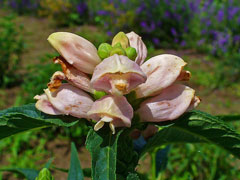
http://commons.wikimedia.org/wiki/File:Chelone_glabra_0003.JPG |
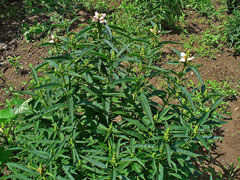 |
| http://commons.wikimedia.org/wiki/File:Chelone_glabra_0001.JPG |
Translate this page:
Summary
Physical Characteristics

 Chelone glabra is a PERENNIAL growing to 1 m (3ft 3in) by 0.5 m (1ft 8in).
See above for USDA hardiness. It is hardy to UK zone 3. It is in flower from July to September. The species is hermaphrodite (has both male and female organs).
Suitable for: light (sandy), medium (loamy) and heavy (clay) soils and can grow in heavy clay soil. Suitable pH: mildly acid, neutral and basic (mildly alkaline) soils. It can grow in semi-shade (light woodland) or no shade. It prefers moist or wet soil.
UK Hardiness Map
US Hardiness Map
Synonyms
C. obliqua alba.
Plant Habitats
Woodland Garden Sunny Edge; Dappled Shade; Shady Edge; Bog Garden;
Edible Uses
References More on Edible Uses
Medicinal Uses
Plants For A Future can not take any responsibility for any adverse effects from the use of plants. Always seek advice from a professional before using a plant medicinally.
Antibilious Aperient Appetizer Cathartic Cholagogue Detergent Tonic Vermifuge
Balmony is a very bitter herb with a tea-like flavour that acts mainly as a tonic for the liver and digestive system[238]. It has long been held in esteem in N. American folk medicine, though it has never been investigated scientifically[268]. The herb also has anti-depressant and laxative effects[238]. A decoction of the whole herb is antibilious, aperient, appetizer, cathartic, cholagogue, detergent, tonic, vermifuge[4, 21, 46, 61, 165, 207, 222]. It is used internally in the treatment of consumption, debility, diseases of the liver, gallbladder problems, gallstones etc[4, 254]. It is also used to relieve nausea and vomiting, intestinal colic and to expel worms[254]. Its tonic effect upon the digestive system has made it of benefit in the treatment of anorexia nervosa[268]. Externally, it is applied as a soothing ointment to piles, inflamed tumours, irritable ulcers, inflamed breasts etc[4, 268]. The plant is harvested when in flower and is dried for later use[238].
References More on Medicinal Uses
The Bookshop: Edible Plant Books
Our Latest books on Perennial Plants For Food Forests and Permaculture Gardens in paperback or digital formats.

Edible Tropical Plants
Food Forest Plants for Hotter Conditions: 250+ Plants For Tropical Food Forests & Permaculture Gardens.
More

Edible Temperate Plants
Plants for Your Food Forest: 500 Plants for Temperate Food Forests & Permaculture Gardens.
More

More Books
PFAF have eight books available in paperback and digital formats. Browse the shop for more information.
Shop Now
Other Uses
References More on Other Uses
Cultivation details
Easily grown in any ordinary soil, but it grows best in a light loam[1]. Tolerates heavy clays and light shade[1, 200]. Prefers growing in light shade[238]. Survives but does not thrive in dry conditions[200]. Prefers growing in a bog garden or in a soil that is unlikely to dry out[200]. Plants are very cold-hardy, tolerating temperatures down to about -20°c[187]. A polymorphic species, there are several named forms[43]. The plant spreads freely at the roots and so is best grown in a large pot[4].
References Carbon Farming Information and Carbon Sequestration Information
Temperature Converter
Type a value in the Celsius field to convert the value to Fahrenheit:
Fahrenheit:
The PFAF Bookshop
Plants For A Future have a number of books available in paperback and digital form. Book titles include Edible Plants, Edible Perennials, Edible Trees,Edible Shrubs, Woodland Gardening, and Temperate Food Forest Plants. Our new book is Food Forest Plants For Hotter Conditions (Tropical and Sub-Tropical).
Shop Now
Plant Propagation
Seed - sow spring in a cold frame and keep moist. The seed germinates in 2 - 6 weeks at 20°c[164]. Prick out the seedlings into individual pots when they are large enough to handle and grow them on in the cold frame. Plant them out into their permanent positions in the spring or early summer. Division in autumn[1]. Cuttings of soft tips in summer in a sandy soil in a frame[200].
Other Names
If available other names are mentioned here
Native Range
NORTHERN AMERICA: Canada (Newfoundland and Labrador, Nova Scotia, Ontario, Prince Edward Island, Québec, Manitoba), United States (Ohio, Pennsylvania, West Virginia, Illinois, Iowa, Kansas, Minnesota, Missouri, Wisconsin, Alabama, Arkansas, Georgia, Maryland, North Carolina, South Carolina, Tennessee, Virginia)
Weed Potential
Right plant wrong place. We are currently updating this section.
Please note that a plant may be invasive in one area but may not in your area so it's worth checking.
Conservation Status
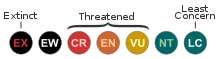
IUCN Red List of Threatened Plants Status :
Growth: S = slow M = medium F = fast. Soil: L = light (sandy) M = medium H = heavy (clay). pH: A = acid N = neutral B = basic (alkaline). Shade: F = full shade S = semi-shade N = no shade. Moisture: D = dry M = Moist We = wet Wa = water.
Now available:
Food Forest Plants for Mediterranean Conditions
350+ Perennial Plants For Mediterranean and Drier Food Forests and Permaculture Gardens.
[Paperback and eBook]
This is the third in Plants For A Future's series of plant guides for food forests tailored to
specific climate zones. Following volumes on temperate and tropical ecosystems, this book focuses
on species suited to Mediterranean conditions—regions with hot, dry summers and cool, wet winters,
often facing the added challenge of climate change.
Read More
Expert comment
Author
L.
Botanical References
43200
Links / References
For a list of references used on this page please go here
Readers comment