 |
|
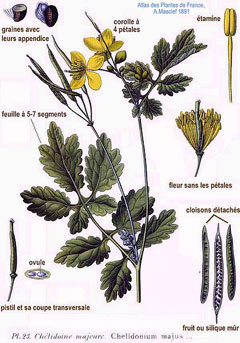
http://commons.wikimedia.org/wiki/File:23_Chelidonium_majus.jpg |
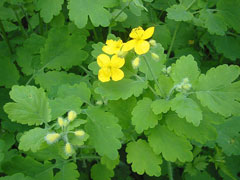 |
| http://commons.wikimedia.org/wiki/User:Bogdan |
Translate this page:
Summary
Bloom Color: Yellow.
Main Bloom Time: Late spring, Mid spring. Form: Upright or erect.
Physical Characteristics

 Chelidonium majus is a PERENNIAL growing to 0.5 m (1ft 8in) by 0.4 m (1ft 4in) at a fast rate.
See above for USDA hardiness. It is hardy to UK zone 6 and is not frost tender. It is in flower from May to August, and the seeds ripen from July to September. The species is hermaphrodite (has both male and female organs) and is pollinated by Bees, flies, beetles. The plant is self-fertile.
Suitable for: light (sandy), medium (loamy) and heavy (clay) soils. Suitable pH: mildly acid, neutral and basic (mildly alkaline) soils. It can grow in full shade (deep woodland) semi-shade (light woodland) or no shade. It prefers moist soil.
UK Hardiness Map
US Hardiness Map
Synonyms
Chelidonium haematodes. Chelidonium laciniatum. Chelidonium luteum. Chelidonium umbelliferum.
Plant Habitats
Woodland Garden Dappled Shade; Shady Edge; not Deep Shade; Ground Cover; Hedgerow; North Wall. In.
Edible Uses
Edible Parts: Leaves Oil
Edible Uses: Oil
Leaves - cooked in small quantities[177]. They contain small amounts of toxic alkaloids[179]. The leaves are boiled with clean earth, the mixture is left overnight and then thoroughly washed in several changes of water[179]. Very much a famine food, to be used when all else fails!![K].
References More on Edible Uses
Medicinal Uses
Plants For A Future can not take any responsibility for any adverse effects from the use of plants. Always seek advice from a professional before using a plant medicinally.
Acrid Alterative Anodyne Antispasmodic Cancer Cholagogue Diaphoretic Diuretic
Hydrogogue Narcotic Ophthalmic Purgative Stomachic Warts
Greater celandine has a long history of herbal use[4]. Traditionally it was employed as an ophthalmic to treat and clear the eyesight whilst in modern herbal medicine it is used more as a mild sedative, antispasmodic and detoxifying herb, relaxing the muscles of the bronchial tubes, intestines and other organs[254]. The latex is much used externally to treat warts. Caution should be employed, especially when the plant is used internally however, because it contains toxic alkaloids[7, 21]. The leaves and the sap are acrid, alterative, anodyne, antispasmodic, caustic, cholagogue, diaphoretic, diuretic, hydrogogue, narcotic, purgative[4, 7, 9, 21, 46, 165, 238]. They are used in the treatment of bronchitis, whooping cough, asthma, jaundice, gallstones and gallbladder pains[254]. The plant is harvested in the spring as it comes into flower, it is best used fresh[7], but can also be dried for later use[9]. The roots can also be used, these are harvested in the autumn and dried for later use[9]. The plant has anticancer properties and is analgesic[4, 218]. It is an important component of a stomach ulcer drug[218]. The plant has an abundant acrid bright-orange sap that stains the skin strongly and is powerfully irritant[4]. It is used as an external treatment to get rid of warts, ringworm and corns[13, 187, 222, 244] and has also been used to remove films from the cornea of the eye[4]. The plant contains the alkaloid chelidonine, which is similar to the alkaloid papaverine found in poppies. This alkaloid has antispasmodic and sedative effects on the bile ducts and bronchi. However, results have been inconsistent, especially if the preparation is not fresh[244]. The plant also contains the alkaloid sparteine, which restores normal rhythm to feeble arrhythmic myocardia[207]. The German Commission E Monographs, a therapeutic guide to herbal medicine, approve Chelidonium majus for liver and gallbladder complaints (see [302] for critics of commission E).
References More on Medicinal Uses
The Bookshop: Edible Plant Books
Our Latest books on Perennial Plants For Food Forests and Permaculture Gardens in paperback or digital formats.
Edible Tropical Plants
Food Forest Plants for Hotter Conditions: 250+ Plants For Tropical Food Forests & Permaculture Gardens.
More
Edible Temperate Plants
Plants for Your Food Forest: 500 Plants for Temperate Food Forests & Permaculture Gardens.
More
More Books
PFAF have eight books available in paperback and digital formats. Browse the shop for more information.
Shop Now
Other Uses
Oil
Plants rapidly form a ground cover, but should only be used in wild places because of their invasive nature[200]. Seed contains 50 - 66% of a fatty oil[74]. No more details given.
Special Uses
Ground cover
References More on Other Uses
Cultivation details
Landscape Uses:Woodland garden. Succeeds in any soil other than boggy conditions[1, 111, 233]. Prefers a rich soil of a woodland nature[1, 31]. Shade tolerant[31]. Plants grow well on walls if they are given a semi-shaded position and a pocket of soil into which to root[219]. A short-lived perennial[187], but it self-sows freely and can easily become a weed[200]. It quickly colonizes waste ground and thin woodland areas[233]. Once established, the plant is very difficult to eradicate. Special Features:
North American native, Naturalizing, Attractive flowers or blooms.
References Carbon Farming Information and Carbon Sequestration Information
Temperature Converter
Type a value in the Celsius field to convert the value to Fahrenheit:
Fahrenheit:
The PFAF Bookshop
Plants For A Future have a number of books available in paperback and digital form. Book titles include Edible Plants, Edible Perennials, Edible Trees,Edible Shrubs, Woodland Gardening, and Temperate Food Forest Plants. Our new book is Food Forest Plants For Hotter Conditions (Tropical and Sub-Tropical).
Shop Now
Plant Propagation
Seed - sow in situ February to May or August to November. Germination usually takes place within 1 - 12 months[164, 200]. The plant self-sows freely and should not need much encouragement. Division in March[111]. The plant bleeds profusely so this method is not recommended[200].
Other Names
If available other names are mentioned here
Native Range
TEMPERATE ASIA: Iran (north), Turkey, Russian Federation-Ciscaucasia (Ciscaucasia), Armenia, Azerbaijan, Georgia, Russian Federation (Dagestan), Russian Federation-Western Siberia (Western Siberia), Russian Federation-Eastern Siberia (Eastern Siberia), Kazakhstan (southeast), Mongolia EUROPE: Denmark, Finland (south), United Kingdom, Ireland, Norway (south), Sweden (south), Austria, Belgium, Switzerland, Czech Republic, Germany, Hungary, Netherlands, Poland, Slovakia, Russian Federation (European part), Belarus, Estonia, Lithuania, Latvia, Ukraine (incl. Krym), Albania, Bulgaria, Bosnia and Herzegovina, Greece (incl. Crete), Croatia, Italy (incl. Sardinia, Sicily), North Macedonia, Montenegro, Romania, Slovenia, Spain (incl. Baleares), France (incl. Corsica), Portugal AFRICA: Spain (Canarias), Portugal (Madeira Islands), Algeria (north), Morocco
Weed Potential
Right plant wrong place. We are currently updating this section.
Please note that a plant may be invasive in one area but may not
in your area so it's worth checking.
Conservation Status
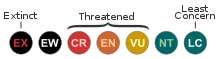
IUCN Red List of Threatened Plants Status :
IUCN Red List
Growth: S = slow M = medium F = fast. Soil: L = light (sandy) M = medium H = heavy (clay). pH: A = acid N = neutral B = basic (alkaline). Shade: F = full shade S = semi-shade N = no shade. Moisture: D = dry M = Moist We = wet Wa = water.
Now available:
Food Forest Plants for Mediterranean Conditions
350+ Perennial Plants For Mediterranean and Drier Food Forests and Permaculture Gardens.
[Paperback and eBook]
This is the third in Plants For A Future's series of plant guides for food forests tailored to
specific climate zones. Following volumes on temperate and tropical ecosystems, this book focuses
on species suited to Mediterranean conditions—regions with hot, dry summers and cool, wet winters,
often facing the added challenge of climate change.
Read More
Expert comment
Author
L.
Botanical References
17200
Links / References
For a list of references used on this page please go here
Readers comment