 |
|
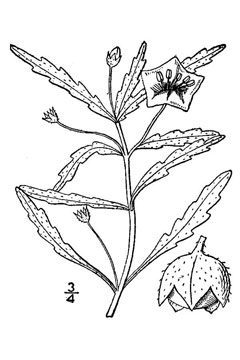
USDA-NRCS PLANTS Database / Britton, N.L., and A. Brown. 1913. An illustrated flora of the northern United States, Canada and the British Possessions. Vol. 3: 164. |
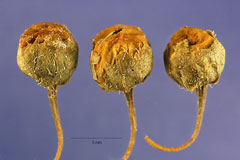 |
| Jose Hernandez @ USDA-NRCS PLANTS Database |
Translate this page:
Summary
Greenleaf five-eyes is a small, low-growing perennial native to the deserts and open landscapes of the American Southwest. Although it belongs to the nightshade family and produces berry-like fruits superficially resembling miniature groundcherries, its edibility is questionable at best and potentially harmful at worst. The berries are almost universally described as bitter, acrid, unpleasant, and lacking sweetness even when ripe, and they contain solanine-like toxins typical of many wild Solanaceae species. As a result, the fruits are not recommended for consumption. Despite its abundance in parts of Texas, New Mexico, and Arizona, greenleaf five-eyes has virtually no ethnobotanical history as a food. Instead, it holds value primarily as a distinctive desert plant and as an example of the many Solanaceae species that should be approached with caution in wild foraging.
Physical Characteristics

 Chamaesaracha coronopus is a PERENNIAL growing to 0.3 m (1ft) by 0.3 m (1ft in).
See above for USDA hardiness. It is hardy to UK zone 7. The species is hermaphrodite (has both male and female organs).
Suitable for: light (sandy), medium (loamy) and heavy (clay) soils. Suitable pH: mildly acid, neutral and basic (mildly alkaline) soils. It can grow in semi-shade (light woodland) or no shade. It prefers moist soil.
UK Hardiness Map
US Hardiness Map
Synonyms
Solanum coronopus
Plant Habitats
Cultivated Beds;
Edible Uses
The berries are extremely poor in flavour, dry, seed-dense, and potentially toxic. No part of the plant offers safe or worthwhile food value. Greenleaf five-eyes should be considered a non-edible species despite occasional outdated references suggesting otherwise [2-3]. Fruit[46, 161]. Edible Uses & Rating: Although sometimes listed as “edible” in older or superficial foraging references, the fruits of greenleaf five-eyes are overwhelmingly rated as unsafe or unpalatable. Their acrid and bitter flavor, combined with the near certainty of digestive upset in some individuals, makes them entirely unsuitable as a food source. The remainder of the plant is not edible. In practical terms, greenleaf five-eyes should be considered a non-food species for modern foragers, with an edibility rating near the lowest possible. Its value as a wild edible is effectively negligible [2-3]. Taste, Processing & Kitchen Notes: Ripe berries of greenleaf five-eyes are unpleasant from the first bite. Fresh fruits taste strongly acrid, bitter, and notably devoid of sweetness. Their texture is dry, with only a thin skin surrounding a mass of seeds. Cooking does nothing to reduce the bitterness or dryness; the unpleasant flavour simply becomes warm rather than raw. The calyx fits tightly around the berry, making preparation tedious even if the berries were somehow desirable. Because the fruit chemistry includes compounds similar to solanine and other nightshade glycoalkaloids, processing methods such as boiling or roasting are ineffective at neutralising toxins and do not produce a safe or palatable food. In short, there are no practical kitchen uses for this plant [2-3]. Seasonality (Phenology): Greenleaf five-eyes has an extended growing season in the desert Southwest, flowering and fruiting from April through October. Because rainfall patterns strongly influence growth cycles, plants in favourable conditions may bear fruit nearly year-round. The berries ripen gradually, often with earlier fruits exposed beyond the calyx and later fruits maturing deeper within it. As berries ripen, they become increasingly dry rather than sweeter, making “perfectly ripe” stages irrelevant in culinary contexts. Safety & Cautions (Food Use): Because greenleaf five-eyes belongs to the nightshade family and contains solanine-like compounds, all berries should be considered potentially toxic. Consumption may cause digestive upset or more serious symptoms in sensitive individuals. The berries’ unpleasant flavour provides a natural deterrent, but foragers should avoid experimenting with them. No traditional processing techniques are known that render the berries safe or palatable, and no part of the plant should be considered reliable food. Harvest & Processing Workflow: For ethical and safety reasons, harvesting is not recommended. If berries are collected for documentation or botanical study, the calyx must be peeled back to expose the fruit, a tedious process due to its tight fit. Because berries dry out quickly and provide almost no flesh, there is no practical workflow for food preparation. Foragers should avoid collecting them for consumption. Look-Alikes & Confusion Risks: Five-eyes species may superficially resemble small groundcherries (Physalis spp.), especially to inexperienced foragers. However, groundcherries possess inflated papery husks (true lantern-like calyces) that fully enclose the fruit, whereas greenleaf five-eyes has only a partially enclosing calyx that remains tight and does not form a lantern. Furthermore, groundcherries typically ripen to yellow or orange, with soft, sweet, aromatic fruits. In contrast, five-eyes fruits remain pale, dry, and unpalatable. Because misidentification could lead to consuming unsafe berries, foragers must pay close attention to the calyx structure, fruit appearance, and leaf form. Traditional / Indigenous Use Summary: There is no documented traditional food use of greenleaf five-eyes among Indigenous groups of the Southwest. Its poor flavour, minimal fruit pulp, and potential toxicity almost certainly excluded it from intentional harvest. Ethnobotanical literature is nearly silent on its cultural uses, suggesting that the plant held little practical value beyond being a common component of desert flora.
References More on Edible Uses
Medicinal Uses
Plants For A Future can not take any responsibility for any adverse effects from the use of plants. Always seek advice from a professional before using a plant medicinally.
The plant has been used to treat swellings[257].
References More on Medicinal Uses
The Bookshop: Edible Plant Books
Our Latest books on Perennial Plants For Food Forests and Permaculture Gardens in paperback or digital formats.
Edible Tropical Plants
Food Forest Plants for Hotter Conditions: 250+ Plants For Tropical Food Forests & Permaculture Gardens.
More
Edible Temperate Plants
Plants for Your Food Forest: 500 Plants for Temperate Food Forests & Permaculture Gardens.
More
More Books
PFAF have eight books available in paperback and digital formats. Browse the shop for more information.
Shop Now
Other Uses
Ecology & Wildlife: The flowers attract small generalist pollinators, particularly solitary bees and small flies adapted to desert climates. The plant provides limited ecological value beyond pollinator support; the berries appear to be minimally attractive to wildlife, likely due to their acrid flavour and low moisture content. The hairy foliage may also deter browsing mammals. Greenleaf five-eyes is rarely, if ever, cultivated intentionally. It may appear spontaneously in xeriscapes or native plant gardens if conditions mimic its natural habitat. It requires minimal water, thrives in nutrient-poor soils, and needs full sun. Because the plant has no edible or ornamental benefit, intentional cultivation is generally unnecessary.
Special Uses
References More on Other Uses
Cultivation details
Greenleaf five-eyes is a widespread but minor member of the desert flora, offering an interesting botanical presence but no meaningful edible use. Its unattractive flavour, potential toxicity, and seed-heavy fruits firmly place it in the category of plants that should be admired rather than eaten. Although easy to find in the Southwest, it serves primarily ecological and botanical roles rather than culinary ones. For foragers, it stands as a reminder of the importance of caution within the nightshade family. This species thrives in desert and semi-desert conditions, preferring sandy or gravelly soils with excellent drainage. It tolerates extreme heat, low rainfall, and significant temperature fluctuations, reflecting its adaptation to arid environments. Greenleaf five-eyes commonly appears in disturbed soils, open fields, alluvial fans, desert flats, and roadside margins. Full sun is essential for vigorous growth. Its tolerance of poor soils and harsh conditions makes it common across certain desert ranges, although individuals remain small and unobtrusive. Habitat & Range: Greenleaf five-eyes is native to the southwestern United States, occurring chiefly in Texas, New Mexico, and Arizona, with scattered occurrences in adjacent desert regions. It inhabits open, sandy, or rocky ground, desert washes, grasslands, roadside edges, and lightly vegetated slopes. Plants often occur in widely spaced clusters, particularly in areas receiving seasonal monsoon moisture. Its ecological niche overlaps loosely with that of various groundcherries (Physalis spp.), though it is not a culinary substitute and should never be treated as one.Size & Landscape Performance: Plants typically reach heights of 5 to 35 centimeters, with a loosely branching structure that gives a sparse, somewhat fragile appearance. In landscaping, it offers little aesthetic or horticultural value unless used in specialised desert restoration or native xeric plantings. Its muted colours, small size, and unremarkable bloom reduce ornamental appeal. It is, however, resilient and well suited to natural desert ecological communities. Cultivation (Horticulture): Greenleaf five-eyes is rarely, if ever, cultivated intentionally. It may appear spontaneously in xeriscapes or native plant gardens if conditions mimic its natural habitat. It requires minimal water, thrives in nutrient-poor soils, and needs full sun. Because the plant has no edible or ornamental benefit, intentional cultivation is generally unnecessary. In managed landscapes, it is easily removed if unwanted. Pests & Problems: This species rarely exhibits pest problems in the wild. Its tough, dry tissues and chemical defenses discourage most herbivory. Drought does not significantly affect it, as it is fully adapted to arid environments. Excessive moisture, however, can cause root stress or fungal issues, which is consistent with many desert-adapted plants. Cultivar/Selection Notes: No cultivars or horticultural selections exist for this species. All plants encountered in the wild represent natural populations. Pollination: Greenleaf five-eyes is pollinated primarily by small insects adapted to arid environments, including solitary bees, gnats, and small flies that visit its modest white-to-greenish flowers. The plant does not rely on specialist pollinators, which helps ensure seed production even in sparsely populated desert habitats. Self-pollination may occur but has not been prominently documented. Identification & Habit: Greenleaf five-eyes grows as a small, somewhat scraggly perennial herb characterised by hairy stems, rough-textured foliage, and solitary nodding flowers. Plants typically stand between five and thirty-five centimetres tall, forming loose clumps rather than dense mats. The leaves are narrow, lance-linear, and often irregularly wavy or shallowly lobed along the margins. Their surfaces are softly hairy and dull green, giving the plant a dusty appearance common among desert-adapted vegetation. Flowers emerge singly from leaf axils on slender stalks and display the classic five-lobed structure of the nightshade family, with pale white to yellowish-green corollas marked by darker spots near the base. After flowering, the persistent calyx enlarges and partially encloses the developing berry, which matures to a dry, cream-coloured capsule-like fruit. These fruits appear irregularly throughout the long growing season, providing one of the most recognisable features of the plant.
References Carbon Farming Information and Carbon Sequestration Information
Temperature Converter
Type a value in the Celsius field to convert the value to Fahrenheit:
Fahrenheit:
The PFAF Bookshop
Plants For A Future have a number of books available in paperback and digital form. Book titles include Edible Plants, Edible Perennials, Edible Trees,Edible Shrubs, Woodland Gardening, and Temperate Food Forest Plants. Our new book is Food Forest Plants For Hotter Conditions (Tropical and Sub-Tropical).
Shop Now
Plant Propagation
Other Names
If available other names are mentioned here
Greenleaf five-eyes
Native Range
NORTHERN AMERICA: United States (Colorado, New Mexico, Texas, Arizona, Utah (south)), Mexico (Chihuahua, Coahuila de Zaragoza, Durango, San Luis Potosí)
Weed Potential
Right plant wrong place. We are currently updating this section.
Please note that a plant may be invasive in one area but may not in your area so it's worth checking.
Greenleaf five-eyes is not aggressively invasive and spreads chiefly where undisturbed desert conditions are maintained. It may appear as a minor weed in dry agricultural or rangeland soils, but it typically causes little ecological disruption. Its low biomass and sparse growth habit prevent it from forming dense monocultures.
Conservation Status
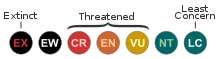
IUCN Red List of Threatened Plants Status : Not assessed.
Growth: S = slow M = medium F = fast. Soil: L = light (sandy) M = medium H = heavy (clay). pH: A = acid N = neutral B = basic (alkaline). Shade: F = full shade S = semi-shade N = no shade. Moisture: D = dry M = Moist We = wet Wa = water.
Now available:
Food Forest Plants for Mediterranean Conditions
350+ Perennial Plants For Mediterranean and Drier Food Forests and Permaculture Gardens.
[Paperback and eBook]
This is the third in Plants For A Future's series of plant guides for food forests tailored to
specific climate zones. Following volumes on temperate and tropical ecosystems, this book focuses
on species suited to Mediterranean conditions—regions with hot, dry summers and cool, wet winters,
often facing the added challenge of climate change.
Read More
Expert comment
Author
(Dunal.)A.Gray.
Botanical References
71274
Links / References
For a list of references used on this page please go here
Readers comment
| Add a comment |
|
If you have important information about this plant that may help other users please add a comment or link below. Only comments or links that are felt to be directly relevant to a plant will be included. If you think a comment/link or information contained on this page is inaccurate or misleading we would welcome your feedback at [email protected]. If you have questions about a plant please use the Forum on this website as we do not have the resources to answer questions ourselves.
* Please note: the comments by website users are not necessarily those held by PFAF and may give misleading or inaccurate information.
|
Subject : Chamaesaracha coronopus
|
|
|
|