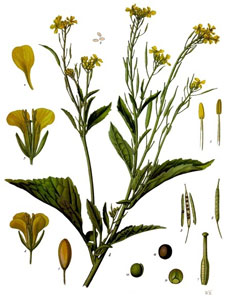
 |
|
http://commons.wikimedia.org/wiki/File:Koeh-168.jpg |
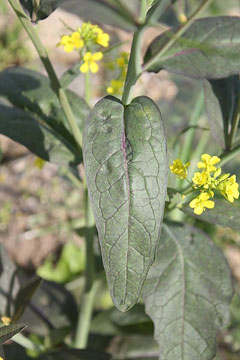 |
| http://commons.wikimedia.org/wiki/User:Dalgial |
Translate this page:
Summary
Physical Characteristics

 Brassica juncea is a ANNUAL growing to 0.8 m (2ft 7in) by 0.3 m (1ft).
See above for USDA hardiness. It is hardy to UK zone 7 and is not frost tender. It is in flower from June to August, and the seeds ripen from August to September. The species is hermaphrodite (has both male and female organs) and is pollinated by Bees. The plant is self-fertile.
Suitable for: light (sandy), medium (loamy) and heavy (clay) soils and prefers well-drained soil. Suitable pH: mildly acid, neutral and basic (mildly alkaline) soils and can grow in very acid and very alkaline soils.
It can grow in semi-shade (light woodland) or no shade. It prefers moist soil.
UK Hardiness Map
US Hardiness Map
Synonyms
B. japonica. B. juncea japonica. Sinapis juncea.
Plant Habitats
Cultivated Beds;
Edible Uses
Edible Parts: Flowers Leaves Oil Root Seed
Edible Uses: Condiment Oil
Leaves - raw or cooked[22, 33, 46, 52, 61]. A peppery flavour that can range from mild to hot, this is one of the most highly prized cooked vegetables in the Orient[206]. The leaves can also be eaten raw, when finely shredded they make a very acceptable addition to mixed salads[206]. The protein extracted from the leaves mixes well with banana pulp and is well adapted as a pie filling[183]. Flowers and young flowering stems - raw or cooked[52]. Sweet and succulent[133]. An edible semi-drying oil is obtained from the seed[1, 2, 17, 57, 183]. The seed contains 25 - 30% oil[74]. The seed is used as a mustard flavouring[171]. It is the source of 'brown mustard'[183], a prepared mustard that is milder than that produced from other species[238]. Pungency of mustard develops when cold water is added to the ground-up seed - an enzyme (myrosin) acts on a glycoside (sinigrin) to produce a sulphur compound. The reaction takes 10 - 15 minutes. Mixing with hot water or vinegar, or adding salt, inhibits the enzyme and produces a mild bitter mustard[238]. Black mustard comes from B. nigra and white mustard from Sinapis alba. The seed is also used whole in curries and pickles[238]. They are often heated in oil to destroy their pungency and give them a nutty flavour[238]. The root of some forms of this species is edible[183]. Sprouted seeds can be added to salads.
References More on Edible Uses
Medicinal Uses
Plants For A Future can not take any responsibility for any adverse effects from the use of plants. Always seek advice from a professional before using a plant medicinally.
Anodyne Antibiotic Aperient Diuretic Emetic Galactogogue Rubefacient Stimulant
Although not usually used medicinally, the seed is a warming stimulant herb with antibiotic effects[238]. Reported to be anodyne, aperitif, diuretic, emetic, rubefacient, and stimulant, Brown Mustard is a folk remedy for arthritis, foot ache, lumbago, and rheumatism[269]. The seed is used in the treatment of tumours in China[269]. In Korea, the seeds are used in the treatment of abscesses, colds, lumbago, rheumatism, and stomach disorders[269]. The root is used as a galactagogue in Africa[269]. Ingestion may impart a body odour repellent to mosquitoes[269]. Mustard oil is used in the treatment of skin eruptions and ulcers[269]. Believed to be aperient and tonic, the volatile oil is used as a counterirritant and stimulant[269]. In Java the plant is used as an antisyphilitic emmenagogue[269]. Leaves applied to the forehead are said to relieve headache[269]. The Chinese eat the leaves in soups for bladder, inflammation or haemorrhage[269].
References More on Medicinal Uses
The Bookshop: Edible Plant Books
Our Latest books on Perennial Plants For Food Forests and Permaculture Gardens in paperback or digital formats.

Edible Tropical Plants
Food Forest Plants for Hotter Conditions: 250+ Plants For Tropical Food Forests & Permaculture Gardens.
More

Edible Temperate Plants
Plants for Your Food Forest: 500 Plants for Temperate Food Forests & Permaculture Gardens.
More

More Books
PFAF have eight books available in paperback and digital formats. Browse the shop for more information.
Shop Now
Other Uses
Green manure Oil Repellent
There is some evidence that if this plant is grown as a green manure it is effective in reducing soil-borne root rots in pea crops[206]. This is attributed to chemicals that are given off as the plants decay[206]. Brassica juncea is used in phytoremediation to remove heavy metals, such as lead, from the soil in hazardous waste sites because it has a higher tolerance for these substances and stores the heavy metals in its cells. In particular, Schneider et al. found that Brassica juncea was particularly effective at removing cadmium from soil.
Special Uses
References More on Other Uses
Cultivation details
Succeeds in full sun in most well-drained moisture-retentive fertile soils[16, 200, 206]. Prefers a heavy soil and some shade[16]. Dislikes very hot weather[33]. Plants tolerate high rainfall and, although fairly deep rooted, are not very drought resistant[206]. Tolerates a pH in the range 4.3 to 8.3. Brown mustards is widely cultivated for its edible seed which is used to make the condiment 'brown mustard' and is also sprouted as the mustard of mustard and cress[50, 200]. It has only 70% of the pungency of black mustard (B. nigra) but can be harvested mechanically so is more viable commercially[238]. This species has also been cultivated in the Orient for many hundreds of years and a wide diversity of forms has been developed with edible leaves, stems, roots and seeds. These forms have been classified by the botanists as follows and separate entries have been made for each of them. B. juncea crispifolia. The curled or cutleaf mustards, this group has attractively curled edible leaves. B. juncea foliosa. The leaf mustards have quite large smooth-edged edible leaves. B. juncea japonica. Rather similar to B. juncea crispifolia and combined with that group by some botanists. B. juncea multiceps. The multishoot mustard group. B. juncea napiformis. A form with a swollen edible root. B. juncea rugosa. Large somewhat cabbage-like edible leaves. B. juncea strumata. A form with large edible leaf stalks. B. juncea tumida. A form with swollen edible stems. Plants take from 2 - 5 months from sowing to maturity, depending on the season and the cultivar[206]. They prefer a fairly high stable temperature and are well adapted to short day length[200]. Many are best grown in warmer climates than Britain but there are several cultivars that grow well in this country[206]. Plants have a rooting depth of between 90 - 120 cm[269]. A good bee plant[74].
References Carbon Farming Information and Carbon Sequestration Information
Temperature Converter
Type a value in the Celsius field to convert the value to Fahrenheit:
Fahrenheit:
The PFAF Bookshop
Plants For A Future have a number of books available in paperback and digital form. Book titles include Edible Plants, Edible Perennials, Edible Trees,Edible Shrubs, Woodland Gardening, and Temperate Food Forest Plants. Our new book is Food Forest Plants For Hotter Conditions (Tropical and Sub-Tropical).
Shop Now
Plant Propagation
Seed - sow in situ from early spring to early autumn in order to obtain a succession of edible leaves. Most varieties of Oriental vegetables belonging to this species are best sown from late June to early September otherwise they may bolt[206]. There are about 5,660 - 6,000 per 0.01 kg (1/3 oz)[269].
Other Names
If available other names are mentioned here
Mustard greens, Indian mustard, Chinese mustard, Jie Cai (in Mandarin) or Kai Choi (in Cantonese),[1] or leaf mustard . Cuba: mostaza; mostaza china; mostaza de la tierra.
Native Range
(× Brassarda juncea) North Caucasus, Transcaucasus.
Weed Potential
Right plant wrong place. We are currently updating this section.
Please note that a plant may be invasive in one area but may not in your area so it's worth checking.
This plant can be weedy or invasive. Noxious Weed Information: Michigan, US
(Brassica
mustard)
Noxious weed.
Conservation Status
IUCN Red List of Threatened Plants Status : This taxon has not yet been assessed.

| Related Plants
|
| Latin Name | Common Name | Habit | Height | Hardiness | Growth | Soil | Shade | Moisture | Edible | Medicinal | Other |
| Alliaria petiolata | Garlic Mustard | Biennial | 1.0 |
5-8
| | LMH | FS | MWe | 3 | 2 | 1 |
| Alyssum alyssoides | Pale Madwort | Annual | 0.2 |
4-8
| F | LM | SN | DM | 2 | 0 | 0 |
| Arabidopsis thaliana | Thale Cress, Mouseear cress | Annual/Biennial | 0.5 |
0-0
| | LMH | SN | DM | 0 | 1 | 1 |
| Arabis alpina | Alpine Rock Cress, Alpine rockcress | Perennial | 0.2 |
4-8
| | LM | SN | M | 2 | 0 | |
| Arabis caucasica | Rock Cress, Wall Rockcress | Perennial | 0.2 |
4-9
| M | LMH | SN | DM | 2 | 0 | 3 |
| Arabis hirsuta | Hairy rockcress, Mountain rockcress, Creamflower rockcress | Biennial/Perennial | 0.6 |
4-8
| | LMH | SN | DM | 1 | 0 | |
| Arabis lyrata | Rock Cress, Kamchatka rockcress, Lyrate rockcress | Biennial/Perennial | 0.3 |
4-8
| | LMH | SN | DM | 1 | 0 | |
| Arabis pendula | | Biennial | 0.9 |
-
| | LMH | FSN | M | 1 | 0 | |
| Arabis sagittata | | Biennial/Perennial | 0.6 |
-
| | LMH | SN | DM | 1 | 0 | |
| Arabis serrata | | Perennial | 0.3 |
6-9
| | LMH | SN | M | 1 | 0 | |
| Armoracia rusticana | Horseradish, Red Cole | Perennial | 0.7 |
4-9
| F | LMH | SN | M | 3 | 3 | 2 |
| Aubrieta deltoidea | Aubretia, Lilacbush, False Rockcress | Perennial | 0.2 |
4-9
| M | LM | SN | DM | 0 | 0 | 3 |
| Aurinia saxatilis | Golden Alyssum, Basket of gold | Perennial | 0.3 |
4-10
| M | LMH | N | DM | 0 | 0 | 3 |
| Barbarea australis | | Biennial/Perennial | 0.5 |
-
| | LMH | SN | M | 2 | 1 | |
| Barbarea orthoceras | American Yellowrocket | Perennial | 0.5 |
3-8
| | LMH | SN | M | 3 | 0 | 1 |
| Barbarea stricta | Small-flowered winter-cress | Biennial | 0.8 |
3-10
| F | LMH | N | MWe | 2 | 0 | 0 |
| Barbarea verna | Land Cress, Early yellowrocket | Biennial | 0.3 |
4-9
| | LMH | SN | M | 3 | 0 | 1 |
| Barbarea vulgaris | Yellow Rocket, Garden yellowrocket | Perennial | 0.4 |
3-9
| | LMH | SN | M | 3 | 1 | 1 |
| Brassica balearica | | Perennial | 0.0 |
-
| | LMH | N | M | 1 | 0 | |
| Brassica carinata | Abyssinian Cabbage | Annual | 1.0 |
9-12
| F | LMH | SN | M | 4 | 2 | 3 |
| Brassica cretica | Mustard | Perennial | 1.0 |
0-0
| | LMH | N | M | 2 | 0 | |
| Brassica elongata | Elongated mustard | Biennial/Perennial | 0.9 |
0-0
| | LMH | SN | M | 2 | 0 | 2 |
| Brassica juncea crispifolia | Curled Mustard | Annual | 0.3 |
6-9
| F | LMH | SN | M | 4 | 2 | 2 |
| Brassica juncea foliosa | Leaf Mustard | Annual | 0.3 |
6-9
| F | LMH | SN | M | 4 | 2 | 2 |
| Brassica juncea integrifolia crispifolia | Curled Mustard | Annual | 0.3 |
6-10
| F | LMH | SN | M | 4 | 2 | 2 |
| Brassica juncea integrifolia rugosa | Head Mustard | Annual | 0.6 |
6-10
| F | LMH | SN | M | 4 | 2 | 2 |
| Brassica juncea integrifolia strumata | Large Petiole Mustard | Annual | 0.8 |
6-10
| F | LMH | SN | M | 4 | 2 | 2 |
| Brassica juncea integrifolia subintegrifolia | Leaf Mustard | Annual | 0.3 |
6-10
| F | LMH | SN | M | 4 | 2 | 2 |
| Brassica juncea multiceps | Green In The Snow | Annual | 0.4 |
6-9
| F | LMH | SN | M | 4 | 2 | 2 |
|
|
Growth: S = slow M = medium F = fast. Soil: L = light (sandy) M = medium H = heavy (clay). pH: A = acid N = neutral B = basic (alkaline). Shade: F = full shade S = semi-shade N = no shade. Moisture: D = dry M = Moist We = wet Wa = water.
Now available:
Food Forest Plants for Mediterranean Conditions
350+ Perennial Plants For Mediterranean and Drier Food Forests and Permaculture Gardens.
[Paperback and eBook]
This is the third in Plants For A Future's series of plant guides for food forests tailored to
specific climate zones. Following volumes on temperate and tropical ecosystems, this book focuses
on species suited to Mediterranean conditions—regions with hot, dry summers and cool, wet winters,
often facing the added challenge of climate change.
Read More
Expert comment
Author
(L.)Czern.
Botanical References
200
Links / References
For a list of references used on this page please go here
Readers comment