 |
|
http://commons.wikimedia.org/wiki/File:Bletilla_striata_003.JPG |
 |
| http://commons.wikimedia.org/wiki/File:Bletilla_striata_001.JPG |
Translate this page:
Summary
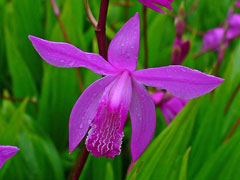
Bloom Color: Lavender.
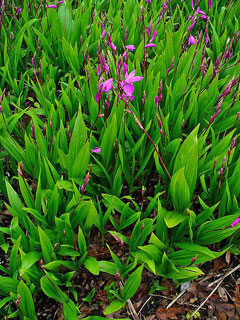
Main Bloom Time: Early summer, Late spring. Form: Irregular or sprawling, Spreading or horizontal, Upright or erect.
Physical Characteristics

 Bletilla striata is a BULB growing to 0.4 m (1ft 4in) by 0.3 m (1ft).
See above for USDA hardiness. It is hardy to UK zone 7. It is in flower from May to June. The species is hermaphrodite (has both male and female organs) and is pollinated by Insects.
Suitable for: medium (loamy) soils and prefers well-drained soil. Suitable pH: mildly acid, neutral and basic (mildly alkaline) soils. It can grow in semi-shade (light woodland). It prefers moist soil.
UK Hardiness Map
US Hardiness Map
Synonyms
Bletia hyacinthina.
Plant Habitats
Woodland Garden Dappled Shade; Shady Edge;
Edible Uses
Edible Parts:
Edible Uses: Gum
None known
References More on Edible Uses
Medicinal Uses
Plants For A Future can not take any responsibility for any adverse effects from the use of plants. Always seek advice from a professional before using a plant medicinally.
Antibacterial Antiinflammatory Antiphlogistic Demulcent Pectoral Skin Styptic Vulnerary
The hyacinth orchid is an important wound herb in China, where it has been used medicinally for over 1,500 years[238]. The root (actually a pseudobulb) is antibacterial, anti-inflammatory, antiphlogistic, demulcent, pectoral, skin, styptic and vulnerary[147, 176, 178]. It is taken internally in the treatment of haemorrhages of the stomach or lungs, uterine bleeding and nose bleeds[238]. It is particularly effective against the endotoxin produced by Haemophilus pertusis in whooping cough[176]. Externally, it is mixed with sesame oil and applied as a poultice to burns, cuts, abscesses and sores[238]. The pseudobulbs are harvested when the plant is dormant and are dried for use in decoctions and powders[238].
References More on Medicinal Uses
The Bookshop: Edible Plant Books
Our Latest books on Perennial Plants For Food Forests and Permaculture Gardens in paperback or digital formats.

Edible Tropical Plants
Food Forest Plants for Hotter Conditions: 250+ Plants For Tropical Food Forests & Permaculture Gardens.
More

Edible Temperate Plants
Plants for Your Food Forest: 500 Plants for Temperate Food Forests & Permaculture Gardens.
More

More Books
PFAF have eight books available in paperback and digital formats. Browse the shop for more information.
Shop Now
Other Uses
Gum Ink Size
The bulb is mucilaginous, it is used as a size to impart a glossiness to ink and also to make an invisible ink (seen by wetting the paper and holding it up to the light)[178].
Special Uses
References More on Other Uses
Cultivation details
Landscape Uses:Border, Container, Rock garden, Specimen, Woodland garden. Requires a friable, damp but well-drained soil enriched with leafmold[200]. Dislikes wet soils[200]. Requires shade from the midday sun[1]. Plants prefer a sheltered position in light shade, also succeeding in full sun in humus-rich soils[230]. Plants are hardy in favoured localities in Britain but they usually require greenhouse protection in this country[1]. Plants have grown well at Kew Botanical gardens, where they have formed large colonies[230]. Apply a good organic mulch in the late autumn or lift the bulbs and store them dry in a frost free place[200]. Plant out in spring and only just cover the bulb[200]. This species is cultivated in China as a medicinal plant[238]. Grows well with ferns in a woodland setting[200]. Orchids are, in general, shallow-rooting plants of well-drained low-fertility soils. Their symbiotic relationship with a fungus in the soil allows them to obtain sufficient nutrients and be able to compete successfully with other plants. They are very sensitive to the addition of fertilizers or fungicides since these can harm the symbiotic fungus and thus kill the orchid[230]. Plant the tubers no more than 5cm deep in the soil[233]. Special Features:Not North American native.
References Carbon Farming Information and Carbon Sequestration Information
Temperature Converter
Type a value in the Celsius field to convert the value to Fahrenheit:
Fahrenheit:
The PFAF Bookshop
Plants For A Future have a number of books available in paperback and digital form. Book titles include Edible Plants, Edible Perennials, Edible Trees,Edible Shrubs, Woodland Gardening, and Temperate Food Forest Plants. Our new book is Food Forest Plants For Hotter Conditions (Tropical and Sub-Tropical).
Shop Now
Plant Propagation
Seed - surface sow, preferably as soon as it is ripe, in the greenhouse and do not allow the compost to dry out. The seed of this species is extremely simple, it has a minute embryo surrounded by a single layer of protective cells. It contains very little food reserves and depends upon a symbiotic relationship with a species of soil-dwelling fungus. The fungal hyphae invade the seed and enter the cells of the embryo. The orchid soon begins to digest the fungal tissue and this acts as a food supply for the plant until it is able to obtain nutrients from decaying material in the soil[200]. It is best to use some of the soil that is growing around established plants in order to introduce the fungus, or to sow the seed around a plant of the same species and allow the seedlings to grow on until they are large enough to move. Division in autumn. Make sure that you keep plenty of soil with each plant. It is also said to be possible to transplant orchids after they have flowered but whilst they are still in leaf. Division is best carried out in the spring[230]. Each division should have a leading point and two, or preferably three, pseudobulbs/joints of the rhizome[230]. More propagating material can be obtained by cutting halfway through the rhizome during the previous growing season at the point where you wish to divide[230]. This will stimulate the production of growth buds at the point of division[230].
Other Names
If available other names are mentioned here
Native Range
TEMPERATE ASIA: China, Japan (Honshu (west), Kyushu, Ryukyu Islands, Shikoku), Korea, South TROPICAL ASIA: Myanmar
Weed Potential
Right plant wrong place. We are currently updating this section.
Please note that a plant may be invasive in one area but may not in your area so it's worth checking.
Conservation Status
IUCN Red List of Threatened Plants Status :
Growth: S = slow M = medium F = fast. Soil: L = light (sandy) M = medium H = heavy (clay). pH: A = acid N = neutral B = basic (alkaline). Shade: F = full shade S = semi-shade N = no shade. Moisture: D = dry M = Moist We = wet Wa = water.
Now available:
Food Forest Plants for Mediterranean Conditions
350+ Perennial Plants For Mediterranean and Drier Food Forests and Permaculture Gardens.
[Paperback and eBook]
This is the third in Plants For A Future's series of plant guides for food forests tailored to
specific climate zones. Following volumes on temperate and tropical ecosystems, this book focuses
on species suited to Mediterranean conditions—regions with hot, dry summers and cool, wet winters,
often facing the added challenge of climate change.
Read More
Expert comment
Author
(Thunb.)Rchb.f.
Botanical References
58200
Links / References
For a list of references used on this page please go here
Readers comment
| Add a comment |
|
If you have important information about this plant that may help other users please add a comment or link below. Only comments or links that are felt to be directly relevant to a plant will be included. If you think a comment/link or information contained on this page is inaccurate or misleading we would welcome your feedback at [email protected]. If you have questions about a plant please use the Forum on this website as we do not have the resources to answer questions ourselves.
* Please note: the comments by website users are not necessarily those held by PFAF and may give misleading or inaccurate information.
|
Subject : Bletilla striata
|
|
|
|