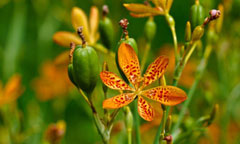
 |
|
http://picasaweb.google.com/lh/photo/Nt7EqAFjE2bodfVKURYvtg |
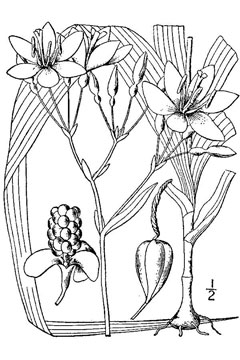 |
| USDA-NRCS PLANTS Database / Britton, N.L., and A. Brown. 1913. An illustrated flora of the northern United States, Canada and the British Possessions. Vol. 1: 542. |
Translate this page:
Summary
Bloom Color: Orange, Yellow.
Main Bloom Time: Late summer, Mid summer. Form: Upright or erect.
Physical Characteristics

 Belamcanda chinensis is a PERENNIAL growing to 1 m (3ft 3in) by 0.3 m (1ft) at a fast rate.
See above for USDA hardiness. It is hardy to UK zone 8. It is in flower from August to October, and the seeds ripen from September to November. The species is hermaphrodite (has both male and female organs).
Suitable for: light (sandy) and medium (loamy) soils and prefers well-drained soil. Suitable pH: mildly acid, neutral and basic (mildly alkaline) soils. It can grow in semi-shade (light woodland) or no shade. It prefers moist soil.
UK Hardiness Map
US Hardiness Map
Synonyms
Iris chinensis. Ixia chinensis.
Plant Habitats
Woodland Garden Sunny Edge; Dappled Shade;
Edible Uses
Edible Parts: Leaves
Edible Uses:
Leaves - cooked[105, 177]. Caution is advised, see the notes above on toxicity.
References More on Edible Uses
Medicinal Uses
Plants For A Future can not take any responsibility for any adverse effects from the use of plants. Always seek advice from a professional before using a plant medicinally.
Abortifacient Analgesic Antibacterial Antidote Antifungal Antiinflammatory Depurative Expectorant
Febrifuge Hepatic Pectoral Purgative Stomachic Tonic
The leopard lily has a very long history of use in traditional Chinese medicine. It is a bitter cooling herb that acts mainly on the lungs and the liver, lowering fevers and reducing inflammation[238]. It is effective against a number of bacterial, fungal and viral organisms[238] and has also been used as an antidote to snakebites[240]. The root contains several medically active constituents including flavonoids and isoflavonoids[279]. It also contains the glucosides belamcandin, tectoridin, shekanin and iridin[283]. It is analgesic, antibacterial, antifungal, anti-inflammatory, depurative, expectorant, febrifuge, pectoral, purgative, stomachic and tonic[46, 61, 147, 176, 178, 218, 238, 279, 283]. It is used in the treatment of acute laryngitis, acute tonsillitis, oedema of the glottis and cough with profuse sputum[176, 279]. The juice of the root is used in Nepal to treat liver complaints, where it has the added benefit of improving the appetite[272]. This juice is also used to abort a foetus during the first trimester of pregnancy[272]. The root should not be prescribed for pregnant women[238]. The root is harvested in the summer and autumn, and dried for later use[238].
References More on Medicinal Uses
The Bookshop: Edible Plant Books
Our Latest books on Perennial Plants For Food Forests and Permaculture Gardens in paperback or digital formats.

Edible Tropical Plants
Food Forest Plants for Hotter Conditions: 250+ Plants For Tropical Food Forests & Permaculture Gardens.
More

Edible Temperate Plants
Plants for Your Food Forest: 500 Plants for Temperate Food Forests & Permaculture Gardens.
More

More Books
PFAF have eight books available in paperback and digital formats. Browse the shop for more information.
Shop Now
Other Uses
Tannin
The root contains tannin[272].
Special Uses
References More on Other Uses
Cultivation details
Landscape Uses:Border, Container, Massing, Woodland garden. Requires a fairly rich sandy or loamy soil in a bright sunny position or light shade. Succeeds in most soils[187]. Requires a position that stays moist in the summer[187]. Plants grow best in areas with long hot summers[238]. A fairly hardy plant, tolerating temperatures down to about -15°c[187] if given a deep dry mulch over the winter. A short lived plant, the bulbs are usually lifted in the autumn and stored in a cool but frost-free place over the winter, replanting them in the spring[233]. They can be left in the ground in the milder areas of the country so long as the soil is well-drained[233]. Individual flowers only live for one day, but the plant produces a succession of blooms over a period of several weeks[238]. Slugs really love this plant and can destroy even quite large clumps as they come into growth in the spring[K]. Special Features:Not North American native, Naturalizing, Attracts butterflies, Suitable for cut flowers, Suitable for dried flowers, Attractive flowers or blooms.
References Carbon Farming Information and Carbon Sequestration Information
Temperature Converter
Type a value in the Celsius field to convert the value to Fahrenheit:
Fahrenheit:
The PFAF Bookshop
Plants For A Future have a number of books available in paperback and digital form. Book titles include Edible Plants, Edible Perennials, Edible Trees,Edible Shrubs, Woodland Gardening, and Temperate Food Forest Plants. Our new book is Food Forest Plants For Hotter Conditions (Tropical and Sub-Tropical).
Shop Now
Plant Propagation
Seed - best sown as soon as it is ripe in a cold frame. Pre-chill stored seed for 7 days and sow spring in a cold frame. The seed germinates in 2 - 8 weeks at 20°c[134]. Prick out the seedlings into individual pots as soon as they are large enough to handle. They can be planted out in early autumn and should flower in the following year[200]. Division in spring or early autumn[200]. Larger divisions can be planted straight into their permanent positions whilst smaller clumps are best potted up and kept in a cold frame until they are growing away well.
Other Names
If available other names are mentioned here
Native Range
TEMPERATE ASIA: Russian Federation (Primorye), China (Anhui Sheng, Zhejiang Sheng, Fujian Sheng, Heilongjiang Sheng, Henan Sheng, Hebei Sheng, Hunan Sheng, Hubei Sheng, Gansu Sheng, Jiangxi Sheng, Jiangsu Sheng, Jilin Sheng, Guangdong Sheng, Guizhou Sheng, Liaoning Sheng, Shanxi Sheng, Shandong Sheng, Shaanxi Sheng, Sichuan Sheng, Yunnan Sheng, Guangxi Zhuangzu Zizhiqu, Ningxia Huizi Zizhiqu, Xizang Zizhiqu, Hainan Sheng), Korea, Japan, Taiwan
Weed Potential
Right plant wrong place. We are currently updating this section.
Please note that a plant may be invasive in one area but may not
in your area so it's worth checking.
Conservation Status
IUCN Red List of Threatened Plants Status :

IUCN Red List
Growth: S = slow M = medium F = fast. Soil: L = light (sandy) M = medium H = heavy (clay). pH: A = acid N = neutral B = basic (alkaline). Shade: F = full shade S = semi-shade N = no shade. Moisture: D = dry M = Moist We = wet Wa = water.
Now available:
Food Forest Plants for Mediterranean Conditions
350+ Perennial Plants For Mediterranean and Drier Food Forests and Permaculture Gardens.
[Paperback and eBook]
This is the third in Plants For A Future's series of plant guides for food forests tailored to
specific climate zones. Following volumes on temperate and tropical ecosystems, this book focuses
on species suited to Mediterranean conditions—regions with hot, dry summers and cool, wet winters,
often facing the added challenge of climate change.
Read More
Expert comment
Author
(L.)DC.
Botanical References
58200
Links / References
For a list of references used on this page please go here
Readers comment