 |
|
http://commons.wikimedia.org/wiki/File:Basella_rubra_Blanco1.74.png |
 |
| http://commons.wikimedia.org/wiki/User:Shizhao |
Translate this page:
Summary
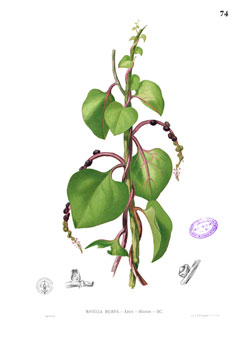
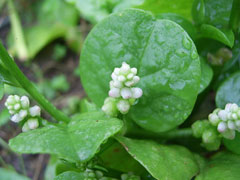
Malabar Spinach or Indian Spinach, Basella alba, is an annual or perennial climbing herb with red or green vines and leaves. The leaves are thick, fleshy, pointed at the tip, and arranged alternately along the vine. Flowers are white, pink, or red in short spikes and are located in the leaf axils. The fruits are round and soft, and can be red, white, or black in colour. The seeds are round and black.
The roots are cooked and used against diarrhoea. Paste of the root is used as a rubefacient while paste of leaves is used externally as treatment for boils and sores. The leaves and stems are cooked as well and eaten for their laxative properties. Leaf juice is used to treat catarrh in Nepal. It is also a demulcent, diuretic, and febrifuge. The flowers are used as an antidote to poisons. The whole plant is a febrifuge and its juice is reportedly safe for pregnant women. In fact, during labour, decoction of the plant can be used to ease pain and discomfort. The red juice of the fruit is used as eye drops against conjunctivitis. Not only does the Indian spinach exhibit various medicinal properties, it also provides food through its edible plant parts. It is considered as a leaf vegetable. The leaves and stem tips are edible either raw or cooked. Infusion of the leaves is a tea substitute. Fruit sap is used as a food colouring in pastries and sweets.
Physical Characteristics

 Basella alba is an evergreen Perennial Climber growing to 9 m (29ft 6in) at a fast rate.
See above for USDA hardiness. It is hardy to UK zone 10 and is frost tender. It is in flower from May to September, and the seeds ripen from July to October. The species is hermaphrodite (has both male and female organs). The plant is self-fertile.
It is noted for attracting wildlife.
Suitable for: light (sandy), medium (loamy) and heavy (clay) soils and prefers well-drained soil. Suitable pH: mildly acid, neutral and basic (mildly alkaline) soils and can grow in very acid soils.
It cannot grow in the shade. It prefers moist soil.
UK Hardiness Map
US Hardiness Map
Synonyms
B. cordifolia. B. rubra.
Plant Habitats
Cultivated Beds;
Edible Uses
Edible Parts: Leaves Shoots
Edible Uses: Colouring Tea
Leaves and stem tips - raw or cooked[200]. A pleasant mild spinach flavour[206], the leaves can be used as a spinach or added to salads[183]. Do not overcook the leaves or they will become slimy[206]. The mucilaginous qualities of the plant make it an excellent thickening agent in soups, stews etc where it can be used as a substitute for okra, Abelmoschatus esculentus[206]. A nutritional analysis of the leaves is available[218]. An infusion of the leaves is a tea substitute[183]. The purplish sap from the fruit is used as a food colouring in pastries and sweets. The colour is enhanced by adding some lemon juice[183].
References More on Edible Uses
| Composition
|
| Figures in grams (g) or miligrams (mg) per 100g of food.
|
|
|
Leaves (Dry weight)
|
|
- 275 Calories per 100g
- Water : 0%
- Protein: 20g; Fat: 3.5g; Carbohydrate: 54g; Fibre: 9g; Ash: 19g;
- Minerals - Calcium: 3000mg; Phosphorus: 0mg; Iron: 0mg; Magnesium: 0mg; Sodium: 0mg; Potassium: 0mg; Zinc: 0mg;
- Vitamins - A: 50mg; Thiamine (B1): 0.7mg; Riboflavin (B2): 1.8mg; Niacin: 7.5mg; B6: 0mg; C: 1200mg;
- Reference: [ ]
- Notes:
|
|
Medicinal Uses
Plants For A Future can not take any responsibility for any adverse effects from the use of plants. Always seek advice from a professional before using a plant medicinally.
Antidote Aperient Astringent Demulcent Diuretic Dysentery Febrifuge Laxative
Rubefacient
The roots are astringent. They are cooked and used in the treatment of diarrhoea[ 206 , 264 ]. A paste of the root is applied to swellings and is also used as a rubefacient[ 272 ]. The leaves and stems are cooked and eaten for their laxative properties[ 206 , 264 ]. The leaf juice is a demulcent, used in cases of dysentery[ 218 ]. It is also diuretic, febrifuge and laxative[ 218 ]. The leaf juice is used in Nepal to treat catarrh[ 272 ]. A paste of the leaves is applied externally to treat boils and sores[ 272 , 299 ]. The flowers are used as an antidote to poisons[ 218 ]. The plant is febrifuge, its juice is a safe aperient for pregnant women and a decoction has been used to alleviate labour[ 218 ]. The red juice of the fruit is used as eye drops to treat conjunctivitis[ 299 ].
References More on Medicinal Uses
The Bookshop: Edible Plant Books
Our Latest books on Perennial Plants For Food Forests and Permaculture Gardens in paperback or digital formats.

Edible Tropical Plants
Food Forest Plants for Hotter Conditions: 250+ Plants For Tropical Food Forests & Permaculture Gardens.
More

Edible Temperate Plants
Plants for Your Food Forest: 500 Plants for Temperate Food Forests & Permaculture Gardens.
More

More Books
PFAF have eight books available in paperback and digital formats. Browse the shop for more information.
Shop Now
Other Uses
Dye
A red dye is obtained from the juice of the fruits[206]. It has been used as a rouge and also as a dye for official seals[218]. Agroforestry Uses: The plant can be grown on living stakes, usually on a fence or on a hedge[ 617 ].
Ceylon spinach can be used as a ground cover to prevent soil erosion and as a climbing plant to shade other crops. It also enhances biodiversity by attracting beneficial insects. Other Uses The juice of the fruits yields a red dye [ 206 ]. The dye has been used as a rouge, an ink, for colouring foods and also as a dye for official seals[ 218, 299 ]. 1. Nectary - Flowers rich in nectar and pollen:
Yes – The flowers of Basella alba attract pollinators, making them beneficial for local ecosystems.
2. Wildlife - Food (Fruit, Seeds, Leaf litter, Shelter, Nesting, Roosting):
Yes, the leaves and stems are edible for humans and various wildlife. The plant’s dense growth can provide some cover for small creatures, but it is not primarily a nesting or roosting site.
3. Invertebrate Shelter (Overwintering sites, Leaf litter, Groundcover):
Yes – Basella alba’s foliage can provide some shelter for invertebrates, although it is not specifically known for overwintering sites.
4. Pest Confuser (Smell):
No – While it may have some aromatic properties, Basella alba is not primarily recognized for repelling pests or confusing them with its smell.
Special Uses
References More on Other Uses
Cultivation details
Requires a well-drained moisture-retentive soil rich in organic matter and a warm sunny sheltered position[200]. Prefers a sandy loam[206]. Tolerates fairly poor soils but does much better in rich soils[206]. Tolerates high rainfall[206]. Tolerates a pH in the range 4.3 to 7. A frost-tender perennial, it is not hardy outdoors in Britain but can be grown as a spring-sown annual[200]. A fast growing plant, capable of producing a crop within 70 days from seed in a warm climate[200, 264], though it requires a minimum daytime temperature of 15°c if it is to keep growing vigorously so it seldom does well outdoors in Britain[264]. It does tolerate low light levels plus night temperatures occasionally falling below 10°c, and so can do well in a cold greenhouse[206]. Plants do not flower if the length of daylight is more than 13 hours per day[200]. Widely cultivated for its edible leaves in the tropics[200], there are some named varieties[183]. It is an excellent hot weather substitute for spinach[183]. Some authorities recognize three different species, B. alba, B. rubra and B. cordifolia[206], they are all treated here as being part of one species[K]. Production: It is 4-6 weeks until the first harvest. It grows reasonably well on poor soils and is fairly resistant to pest and disease. Leaves will only store for one day at 20-30°C. Yields of 40 kg of leaves from a 10 metre square bed is possible over 75 days. Leaves are plucked from the vine. The leaves can be harvested throughout the growing season, typically from spring to late autumn, but they are best when young and tender.
Basella alba usually flowers in summer, typically from late spring to early summer. Basella alba is a fast-growing vine, often reaching maturity within 60 to 90 days, depending on conditions.
References Carbon Farming Information and Carbon Sequestration Information
Temperature Converter
Type a value in the Celsius field to convert the value to Fahrenheit:
Fahrenheit:
The PFAF Bookshop
Plants For A Future have a number of books available in paperback and digital form. Book titles include Edible Plants, Edible Perennials, Edible Trees,Edible Shrubs, Woodland Gardening, and Temperate Food Forest Plants. Our new book is Food Forest Plants For Hotter Conditions (Tropical and Sub-Tropical).
Shop Now
Plant Propagation
Easy from seed or cuttings.
Other Names
If available other names are mentioned here
Other Names: Adwera, Alogbati, Alugbati, Ama, Aworoke, Ban-poi, Basle soppu, Boroboro, Busum-muru, Ceylon spinach, Chakai, Chan Cai, Chan-Choi, Chunlueng, Delega, Enderema, Gendola, Inderema, Inika, Kattupasali, Kurakura, Libato, Luo kui, Maghi, Maifrai, Malabar nightshade, Mayal, Mndele, Mong toi, Mong toi, Myal-ki-bhaji, Ndelema, Ndera, Pabang, Pak plang, Pasali-Kirai, Phak plang, Po deng chaai, Poaya, Poi sag, Poi, Pui-shak, Remayong, Ronga pui sak, Ronga puroi sak, Saan choi, Shan ts'oi, She eje, Shoro, Sufed-bachla-ki-bhaji, Suped-bachla, Tsuru-murasaki, Vine spinach.
Native Range
Coming Soon
Weed Potential
Right plant wrong place. We are currently updating this section.
Please note that a plant may be invasive in one area but may not
in your area so it's worth checking.
None known
Conservation Status
IUCN Red List of Threatened Plants Status : This taxon has not yet been assessed.

IUCN Red List
Growth: S = slow M = medium F = fast. Soil: L = light (sandy) M = medium H = heavy (clay). pH: A = acid N = neutral B = basic (alkaline). Shade: F = full shade S = semi-shade N = no shade. Moisture: D = dry M = Moist We = wet Wa = water.
Now available:
Food Forest Plants for Mediterranean Conditions
350+ Perennial Plants For Mediterranean and Drier Food Forests and Permaculture Gardens.
[Paperback and eBook]
This is the third in Plants For A Future's series of plant guides for food forests tailored to
specific climate zones. Following volumes on temperate and tropical ecosystems, this book focuses
on species suited to Mediterranean conditions—regions with hot, dry summers and cool, wet winters,
often facing the added challenge of climate change.
Read More
Expert comment
Author
L.
Botanical References
200266
Links / References
For a list of references used on this page please go here
Readers comment