 |
|
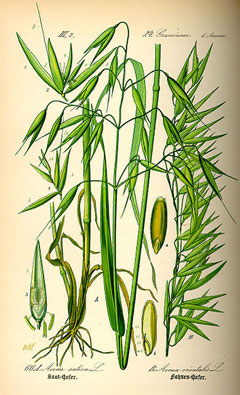
http://commons.wikimedia.org/wiki/File:Illustration_Avena_sativa0.jpg |
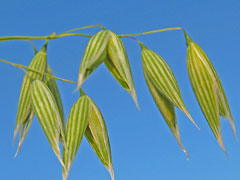 |
| http://commons.wikimedia.org/wiki/User:Merops |
Translate this page:
Summary
Physical Characteristics

 Avena sativa is a ANNUAL growing to 0.9 m (3ft) by 0.1 m (0ft 4in).
See above for USDA hardiness. It is hardy to UK zone 3 and is not frost tender. It is in flower from June to July, and the seeds ripen from August to October. The species is hermaphrodite (has both male and female organs) and is pollinated by Wind. The plant is self-fertile.
Suitable for: light (sandy), medium (loamy) and heavy (clay) soils, prefers well-drained soil and can grow in heavy clay and nutritionally poor soils. Suitable pH: mildly acid, neutral and basic (mildly alkaline) soils and can grow in very acid soils.
It cannot grow in the shade. It prefers dry or moist soil and can tolerate drought.
UK Hardiness Map
US Hardiness Map
Synonyms
Avena dispermis, Avena distans, Avena cinerea, Avena anglica, Avena algeriensis.
Plant Habitats
Cultivated Beds;
Edible Uses
Edible Parts: Oil Seed
Edible Uses: Coffee Oil
Seed - cooked[2, 34, 46, 177]. The seed ripens in the latter half of summer and, when harvested and dried, can store for several years. It has a floury texture and a mild, somewhat creamy flavour. It can be used as a staple food crop in either savoury or sweet dishes. Used as a cereal, it is probably best known as the breakfast cereal porridge but it can also be used in many other ways. The seed can be sprouted and used in salads[183], the grain can also be ground into a flour and used in making biscuits, sourdough etc[183]. It is fairly low in gluten, and so is not really suitable for making bread[269]. The seed is an especially good food for convalescents and people with stomach problems[13]. Oat flour produced in the dry-milling operation currently is used as an antioxidant in food products[269]. Oat flour inhibits rancidity and increases the length of shelf-stability of fatty foods such as vegetable oils[269]. Whilst cultivated oats average about 17% protein, scientists screening thousands of samples of cultivated and wild species found that the wild species averaged 27% with some forms ranging up to 37%[269]. Oats are also one of the cereals used as a basic ingredient for making whisky[7]. Oats are harvested when grain is in the hard dough stage and straw is slightly green (when the moisture content of the grain is 14% or less). If too ripe, shattering causes seed loss. Crop is usually cut with binder and left in the field until dry and then threshed. In mechanized societies, oats are combined directly from standing grain. For this type of harvesting, crop must be fully ripe, usually when the straw has lost greenness and glumes have become white. Crop may be combined from windrow, or cut with a header harvester when the crop is dead ripe. Seeds are threshed and cleaned by winnowing, and artificially dried to below 14% moisture for storage[269]. The roasted seed is a coffee substitute[177, 183]. An edible oil is obtained from the seed, it is used in the manufacture of breakfast cereals[61].
References More on Edible Uses
Medicinal Uses
Plants For A Future can not take any responsibility for any adverse effects from the use of plants. Always seek advice from a professional before using a plant medicinally.
Anticholesterolemic Antidiarrhoeal Antirheumatic Antiseborrheic Antispasmodic Cancer Cardiac Diuretic
Eczema Emollient Hypoglycaemic Nervine Nutritive Poultice Stimulant
Whilst used mainly as a food, oat grain does also have medicinal properties[238]. In particular oats are a nutritious food that gently restores vigour after debilitating illnesses, helps lower cholesterol levels in the blood and also increases stamina[254]. The seed is a mealy nutritive herb that is antispasmodic, cardiac, diuretic, emollient, nervine and stimulant[4, 7, 21, 165]. The seed contains the antitumor compound b-sitosterol and has been used as a folk remedy for tumours[269]. A gruel made from the ground seed is used as a mild nutritious aliment in inflammatory cases, fevers and after parturition[4]. It should be avoided in cases of dyspepsia accompanied with acidity of the stomach[4]. A tincture of the ground seed in alcohol is useful as a nervine and uterine tonic[4]. A decoction strained into a bath will help to soothe itchiness and eczema[254]. A poultice made from the ground seeds is used in the treatment of eczema and dry skin[238]. When consumed regularly, oat germ reduces blood cholesterol levels[238]. Oat straw and the grain are prescribed to treat general debility and a wide range of nervous conditions[254. They are mildly antidepressant, gently raising energy levels and supporting an over-stressed nervous system[254]. They are of particular value in helping a person to cope with the exhaustion that results from multiple sclerosis, chronic neurological pain and insomnia[254]. Oats are thought to stimulate sufficient nervous energy to help relieve insomnia[254]. An alcoholic extraction of oats has been reported to be a deterrent for smoking, though reports that oat extract helped correct the tobacco habit have been disproven[269]. A tincture of the plant has been used as a nerve stimulant and to treat opium addiction. In an article riddled with errors, the Globe (February 28, 1984) reports that oat straw, usually taken as a tea, is a sexual nerve tonic[269]. The German Commission E Monographs, a therapeutic guide to herbal medicine, approve Avena sativa for inflammation of the skin, warts (see [302] for critics of commission E).
References More on Medicinal Uses
The Bookshop: Edible Plant Books
Our Latest books on Perennial Plants For Food Forests and Permaculture Gardens in paperback or digital formats.

Edible Tropical Plants
Food Forest Plants for Hotter Conditions: 250+ Plants For Tropical Food Forests & Permaculture Gardens.
More

Edible Temperate Plants
Plants for Your Food Forest: 500 Plants for Temperate Food Forests & Permaculture Gardens.
More

More Books
PFAF have eight books available in paperback and digital formats. Browse the shop for more information.
Shop Now
Other Uses
Biomass Cosmetic Fibre Mulch Oil Paper Repellent Thatching
The straw has a wide range of uses such as for bio-mass, fibre, mulch, paper-making, building board and thatching[74, 141, 171]. It has also been used as a stuffing material for mattresses and these are said to be of great benefit for sufferers from rheumatism[7, 254]. Some caution is advised in its use as a mulch since oat straw can infest strawberries with stem and bulb eelworm. Oat hulls are basic in production of furfural, a chemical intermediate in the production of many industrial products such as nylon, lubricating oils, butadiene, phenolic resin glues, and rubber tread compositions[269]. Oats hulls supply about 22% of the required furfural raw materials. Rice hulls, corn cobs, bagasse, and beech woods make up much of the remainder[269]. Oats hulls are also used in the manufacture of construction boards, cellulose pulp and as a filter in breweries[269]. A handful of the grains, thrown into the bath water, will help to keep the skin soft because of their emollient action[7]. An extract of oat straw prevents feeding by the striped cucumber beetle[269].
Special Uses
References More on Other Uses
Cultivation details
Oats are an easily grown crop that succeeds in any moderately fertile soil in full sun[200]. They prefer a poor dry soil[134] and tolerate cool moist conditions[13]. Plants are reported to tolerate an annual precipitation of 20 to 180cm, an average annual temperature range of 5 to 26°C, and a pH of 4.5 to 8.6[269]. They thrive on a wide range of soils of ample, but not excessive, fertility[269]. Well-drained neutral soils in regions where annual rainfall is 77cm or more are best[269]. Loam soils are best, especially silt and clay loams[269]. The plants are also reported to tolerate aluminium, disease, frost, fungus, herbicides, hydrogen fluoride, mycobacterium, nematode, rust, SO2, smut, and virus[269]. Oats have a long history of cultivation as a food crop and are believed to be derived chiefly from two species, wild oat (A. fatua L.) and wild red oat (A. sterilis L.)[269]. They are widely cultivated for their seed, used as a source of protein, as well as for hay, as winter cover, and are used as a pasture crop in the growing or 'milk' stage[269]. Oats are long-day plants, grown in cool climates in the Old and New World temperate zones, succeeding under variable conditions[269]. Oats usually are not very winter hardy, although winter hardy cvs have been developed[269]. A very hardy plant according to another report, the cultivated oat succeeds as far north as latitude 70°n[142] and is widely cultivated in temperate zones for its edible seed, there are many named varieties[183]. Although lower yielding than wheat (Triticum spp.), it is able to withstand a wider range of climatic conditions and is therefore more cultivated in cooler and wetter areas[13]. Hot dry weather just before heading causes heads to blast and yields of seed to decrease[269]. Self-pollination is normal, but cross-pollination by wind also occurs[269]. If you wish to save the seed for sowing, each variety should be isolated about 180 metres away from other varieties[269]. Oats grow well with vetch but they inhibit the growth of apricot trees[18, 201]. Oats are in general easily grown plants but, especially when grown on a small scale, the seed is often completely eaten out by birds. Some sort of netting seems to be the best answer on a garden scale. Avena sativa, commonly known as common oat, is a cool-season annual typically suited to USDA Hardiness Zones 3 through 10. While not a perennial, it is relatively cold-tolerant during its early growth stages and can withstand light frosts, making it ideal for early spring or fall planting depending on the region. Oats grow best in temperatures between 55 and 75°F (13 to 24°C) and are generally sown in the spring in colder zones or in the fall in warmer zones for use as a winter cover crop. Though it won’t survive hard frosts like some perennial grasses, its fast growth and tolerance of cooler conditions make it a popular choice for short-season grain production, as well as for use as green manure, forage, or mulch in regenerative and organic farming systems.
References Carbon Farming Information and Carbon Sequestration Information
Temperature Converter
Type a value in the Celsius field to convert the value to Fahrenheit:
Fahrenheit:
The PFAF Bookshop
Plants For A Future have a number of books available in paperback and digital form. Book titles include Edible Plants, Edible Perennials, Edible Trees,Edible Shrubs, Woodland Gardening, and Temperate Food Forest Plants. Our new book is Food Forest Plants For Hotter Conditions (Tropical and Sub-Tropical).
Shop Now
Plant Propagation
Seed - sow in situ in early spring or in the autumn. Only just cover the seed. Germination should take place within 2 weeks.
Other Names
If available other names are mentioned here
Common oat, Oats. In Scottish English, oats may be referred to as corn.
Native Range
Coming Soon
Weed Potential
Right plant wrong place. We are currently updating this section.
Please note that a plant may be invasive in one area but may not
in your area so it's worth checking.
This plant can be weedy or invasive.
Conservation Status
IUCN Red List of Threatened Plants Status : No assessment available.
IUCN Red List
Growth: S = slow M = medium F = fast. Soil: L = light (sandy) M = medium H = heavy (clay). pH: A = acid N = neutral B = basic (alkaline). Shade: F = full shade S = semi-shade N = no shade. Moisture: D = dry M = Moist We = wet Wa = water.
Now available:
Food Forest Plants for Mediterranean Conditions
350+ Perennial Plants For Mediterranean and Drier Food Forests and Permaculture Gardens.
[Paperback and eBook]
This is the third in Plants For A Future's series of plant guides for food forests tailored to
specific climate zones. Following volumes on temperate and tropical ecosystems, this book focuses
on species suited to Mediterranean conditions—regions with hot, dry summers and cool, wet winters,
often facing the added challenge of climate change.
Read More
Expert comment
Author
L.
Botanical References
17
Links / References
For a list of references used on this page please go here
Readers comment