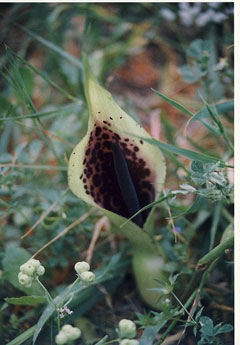
 |
|
http://commons.wikimedia.org/wiki/User:Eitan_f |
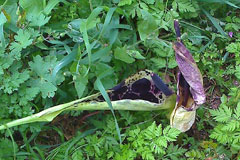 |
| http://flickr.com/photos/lucianaluciana/ |
Translate this page:
Summary
Taxonomic Note: This genus was formerly classified in the family Lemnaceae. Modern classifications include it within the Araceae.
Physical Characteristics

 Arum dioscoridis is a PERENNIAL growing to 0.3 m (1ft) by 0.3 m (1ft in).
See above for USDA hardiness. It is hardy to UK zone 8 and is not frost tender. It is in leaf from October to July, in flower in May. The species is monoecious (individual flowers are either male or female, but both sexes can be found on the same plant) and is pollinated by Flies.
Suitable for: light (sandy), medium (loamy) and heavy (clay) soils. Suitable pH: mildly acid, neutral and basic (mildly alkaline) soils. It can grow in full shade (deep woodland) semi-shade (light woodland) or no shade. It prefers moist soil.
UK Hardiness Map
US Hardiness Map
Synonyms
A. hygrophyllum. Boiss.
Plant Habitats
Woodland Garden Dappled Shade; Shady Edge; not Deep Shade;
Edible Uses
Edible Parts: Root
Edible Uses:
Tuber - cooked and used as a vegetable[2, 61, 105, 177]. It must be thoroughly dried or cooked before being eaten, see the notes above on toxicity.
References More on Edible Uses
Medicinal Uses
Plants For A Future can not take any responsibility for any adverse effects from the use of plants. Always seek advice from a professional before using a plant medicinally.
Abortifacient
The root is abortifacient[61].
References More on Medicinal Uses
The Bookshop: Edible Plant Books
Our Latest books on Perennial Plants For Food Forests and Permaculture Gardens in paperback or digital formats.

Edible Tropical Plants
Food Forest Plants for Hotter Conditions: 250+ Plants For Tropical Food Forests & Permaculture Gardens.
More

Edible Temperate Plants
Plants for Your Food Forest: 500 Plants for Temperate Food Forests & Permaculture Gardens.
More

More Books
PFAF have eight books available in paperback and digital formats. Browse the shop for more information.
Shop Now
Other Uses
References More on Other Uses
Cultivation details
Prefers a humus rich soil and abundant water in the growing season[1]. Grows well in woodland conditions[1]. Succeeds in sun or shade. This species is not hardy in the colder areas of the country, it tolerates temperatures down to between -5 and -10°c[200]. Because it comes into growth in the late autumn it is best grown by a warm wall or in a bulb frame[90] A polymorphic species[200]. The inflorescence is pollinated by flies and it smells of dung and carrion in order to attract the flies[200]. It also has the remarkable ability to heat itself above the ambient air temperature to such a degree that it is quite noticeable to the touch[4]. This probably protects the flowers from damage by frost, or allows it to penetrate frozen ground. Members of this genus are rarely if ever troubled by browsing deer[233].
References Carbon Farming Information and Carbon Sequestration Information
Temperature Converter
Type a value in the Celsius field to convert the value to Fahrenheit:
Fahrenheit:
The PFAF Bookshop
Plants For A Future have a number of books available in paperback and digital form. Book titles include Edible Plants, Edible Perennials, Edible Trees,Edible Shrubs, Woodland Gardening, and Temperate Food Forest Plants. Our new book is Food Forest Plants For Hotter Conditions (Tropical and Sub-Tropical).
Shop Now
Plant Propagation
Seed - best sown in a greenhouse or cold frame as soon as it is ripe[134]. The seed usually germinates in 1 - 6 months at 15°c[134]. Stored seed should be sown in the spring in a greenhouse and can be slow to germinate, sometimes taking a year or more. A period of cold stratification might help to speed up the process. Sow the seed thinly, and allow the seedlings to grow on without disturbance for their first year, giving occasional liquid feeds to ensure that they do not become mineral deficient. When the plants are dormant in the autumn, divide up the small corms, planting 2 - 3 in each pot, and grow them on in light shade in the greenhouse for a further year, planting out when dormant in the autumn. Division of the corms in summer after flowering[200]. Larger corms can be planted out direct into their permanent positions, though it is best to pot up the smaller corms and grow them on for a year in a cold frame before planting them out.
Other Names
If available other names are mentioned here
Native Range
Coming Soon
Weed Potential
Right plant wrong place. We are currently updating this section.
Please note that a plant may be invasive in one area but may not in your area so it's worth checking.
Conservation Status
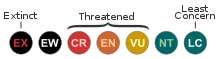
IUCN Red List of Threatened Plants Status :
| Related Plants
|
| Latin Name | Common Name | Habit | Height | Hardiness | Growth | Soil | Shade | Moisture | Edible | Medicinal | Other |
| Acer saccharum | Sugar Maple, Florida Maple, Hard Maple, Rock Maple | Tree | 30.0 |
4-8
| S | LMH | SN | M | 4 | 2 | 4 |
| Acer saccharum grandidentatum | Big-Tooth Maple, Canyon Maple, Rocky Mountain Sugar Maple | Tree | 12.0 |
5-8
| | LMH | SN | M | 4 | 0 | 3 |
| Acer saccharum nigrum | Black Maple | Tree | 25.0 |
4-6
| S | LMH | SN | M | 4 | 1 | 2 |
| Amorphophallus paeoniifolius | Elephant Yam, Whitespot giant arum | Perennial | 0.8 |
11-12
| | LM | SN | M | 4 | 2 | 2 |
| Amorphophallus rivieri | Devil's Tongue, Umbrella Arum, Leopard Palm, Snake Palm | Perennial | 0.8 |
10-11
| | LM | SN | M | 2 | 2 | 1 |
| Arisarum vulgare | Friar's Cowl | Perennial | 0.5 |
6-9
| | LM | FS | M | 2 | 0 | 3 |
| Arum italicum | Italian lords and ladies, Italian Arum | Perennial | 0.4 |
5-9
| | LMH | FSN | DM | 2 | 0 | |
| Arum maculatum | Cuckoo Pint | Perennial | 0.5 |
5-9
| | LMH | FSN | M | 2 | 1 | 1 |
| Asarum arifolium | | Perennial | 0.2 |
6-9
| | LMH | FS | M | 0 | 1 | 2 |
| Asarum blumei | | Perennial | 0.2 |
6-9
| | LMH | FS | M | 0 | 1 | |
| Asarum canadense | Snake Root, Canadian wildginger, Canada Wild Ginger, Wild Ginger | Perennial | 0.1 |
3-9
| S | LMH | FS | M | 3 | 3 | 3 |
| Asarum caudatum | Wild Ginger, British Columbia wildginger | Perennial | 0.1 |
6-10
| F | LMH | FS | M | 3 | 2 | 3 |
| Asarum dilatatum | | Perennial | 0.0 |
-
| | LMH | FS | M | 2 | 0 | |
| Asarum europaeum | Asarabacca, European Wild Ginger | Perennial | 0.1 |
4-8
| S | LMH | FS | M | 0 | 2 | 3 |
| Asarum forbesii | Du Heng | Perennial | 0.2 |
-
| | LMH | FS | M | 0 | 1 | |
| Asarum heterotropoides | | Perennial | 0.2 |
-
| | LMH | FS | M | 0 | 2 | |
| Asarum maximum | | Perennial | 0.5 |
6-9
| | LMH | FS | M | 0 | 1 | |
| Asarum nipponicum | | Perennial | 0.1 |
-
| | LMH | FS | M | 1 | 0 | |
| Asarum reflexum | | Perennial | 0.2 |
5-9
| | LMH | FS | M | 2 | 0 | |
| Asarum shuttleworthii | Asarabacca, Mottled Wild Ginger | Perennial | 0.1 |
5-9
| F | LMH | FS | M | 2 | 0 | 2 |
| Asarum sieboldii | Wild Ginger | Perennial | 0.2 |
-
| | LMH | FS | M | 0 | 2 | |
| Asarum splendens | Chinese Wild Ginger | Perennial | 0.2 |
5-9
| S | LM | FS | DM | 3 | 0 | 3 |
| Asarum takaoi | | Perennial | 0.1 |
-
| | LMH | FS | M | 1 | 0 | |
| Calla palustris | Water Arum | Perennial | 0.3 |
4-8
| | LMH | N | WeWa | 2 | 2 | |
| Carum carvi | Caraway | Biennial | 0.6 |
3-9
| | LMH | SN | M | 4 | 3 | 3 |
| Hedysarum alpinum | Alpine chainpod or Sweetvetch | Perennial | 1.0 |
2-8
| | LMH | N | M | 4 | 2 | 4 |
| Hedysarum arcticum | | Perennial | 0.3 |
-
| | LMH | N | M | 2 | 0 | |
| Hedysarum boreale | Northern Chainpod | Perennial | 0.6 |
3-7
| | LMH | N | M | 1 | 0 | 3 |
| Hedysarum boreale mackenzii | Liquorice Root | Perennial | 0.1 |
3-7
| | LMH | N | M | 4 | 0 | |
|
|
Growth: S = slow M = medium F = fast. Soil: L = light (sandy) M = medium H = heavy (clay). pH: A = acid N = neutral B = basic (alkaline). Shade: F = full shade S = semi-shade N = no shade. Moisture: D = dry M = Moist We = wet Wa = water.
Now available:
Food Forest Plants for Mediterranean Conditions
350+ Perennial Plants For Mediterranean and Drier Food Forests and Permaculture Gardens.
[Paperback and eBook]
This is the third in Plants For A Future's series of plant guides for food forests tailored to
specific climate zones. Following volumes on temperate and tropical ecosystems, this book focuses
on species suited to Mediterranean conditions—regions with hot, dry summers and cool, wet winters,
often facing the added challenge of climate change.
Read More
Expert comment
Author
Sm.
Botanical References
200
Links / References
For a list of references used on this page please go here
Readers comment
| Add a comment |
|
If you have important information about this plant that may help other users please add a comment or link below. Only comments or links that are felt to be directly relevant to a plant will be included. If you think a comment/link or information contained on this page is inaccurate or misleading we would welcome your feedback at [email protected]. If you have questions about a plant please use the Forum on this website as we do not have the resources to answer questions ourselves.
* Please note: the comments by website users are not necessarily those held by PFAF and may give misleading or inaccurate information.
|
Subject : Arum dioscoridis
|
|
|
|