 |
|
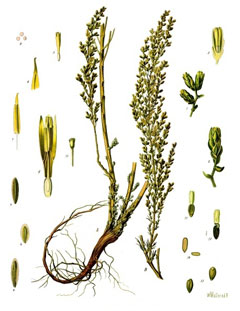
http://commons.wikimedia.org/wiki/File:Koeh-165.jpg |
 |
|
Translate this page:
Summary
Cina or Santonica (Artemisia cina) is a herbaceous, perennial plant growing 20-40cm tall, occasionally up to 70cm. The plant is harvested from the wild, and also cultivated as the source of the anthelmintic drug alpha-santonin. It is Iran to Central Asia. It is a subshrub or perennial and grows primarily in the temperate biome.
Physical Characteristics

 Artemisia cina is a deciduous Shrub growing to 1 m (3ft 3in) at a medium rate.
See above for USDA hardiness. It is hardy to UK zone 7. It is in flower from August to October, and the seeds ripen from August to October. The species is hermaphrodite (has both male and female organs) and is pollinated by Wind.
Suitable for: light (sandy) and medium (loamy) soils and prefers well-drained soil. Suitable pH: neutral and basic (mildly alkaline) soils. It can grow in semi-shade (light woodland). It prefers dry or moist soil and can tolerate drought.
UK Hardiness Map
US Hardiness Map
Synonyms
Plant Habitats
Cultivated Beds;
Edible Uses
References More on Edible Uses
Medicinal Uses
Plants For A Future can not take any responsibility for any adverse effects from the use of plants. Always seek advice from a professional before using a plant medicinally.
Digestive Febrifuge Homeopathy Vermifuge
Cina is one of the safest and most reliable vermifuges, used especially on children[4]. Because of its bitter flavour, it is usually mixed with liquorice or some other pleasantly flavoured herb. The unexpanded floral heads and the seed contain the vermicide 'santonin'[4, 61, 171, 218]. This is an effective and rapid treatment for round worms, it is also effective for thread worms, though it does not affect tapeworms[4]. The plant is also used as a febrifuge and as an aid to the digestion[232]. Caution is advised in the use of this plant since it is poisonous in large doses[4]. This plant should not be used by pregnant women[254]. The dried flowers are used to make a homeopathic remedy[232]. This is particularly useful for complaints of the nervous system and the digestive tract[232]. A homeopathic remedy made from the plant is used to rid children of worms[238].
References More on Medicinal Uses
The Bookshop: Edible Plant Books
Our Latest books on Perennial Plants For Food Forests and Permaculture Gardens in paperback or digital formats.

Edible Tropical Plants
Food Forest Plants for Hotter Conditions: 250+ Plants For Tropical Food Forests & Permaculture Gardens.
More

Edible Temperate Plants
Plants for Your Food Forest: 500 Plants for Temperate Food Forests & Permaculture Gardens.
More

More Books
PFAF have eight books available in paperback and digital formats. Browse the shop for more information.
Shop Now
Other Uses
References More on Other Uses
Cultivation details
We have very little information on this species and do not know if it will be hardy in Britain. Although this plant has woody stems, these tend to die back each winter, giving the plant a herbaceous habit. It is cultivated as a medicinal plant in Russia and N. America[61, 171, 266]. The following notes are based on the genus's general needs. Easily grown in a well-drained circumneutral or slightly alkaline loamy soil, preferring a sunny position[1, 200]. Established plants are very drought-tolerant [200]. Plants are longer lived, more hardy, and more aromatic when they are grown in a poor, dry soil[245]. Plants in this genus are notably resistant to honey fungus[200]. Members of this genus are rarely, if ever, troubled by browsing deer[233]. Zone 6–9 is a cautious estimate, but we did not locate a sufficiently authoritative cultivar-style hardiness listing.
References Carbon Farming Information and Carbon Sequestration Information
Temperature Converter
Type a value in the Celsius field to convert the value to Fahrenheit:
Fahrenheit:
The PFAF Bookshop
Plants For A Future have a number of books available in paperback and digital form. Book titles include Edible Plants, Edible Perennials, Edible Trees,Edible Shrubs, Woodland Gardening, and Temperate Food Forest Plants. Our new book is Food Forest Plants For Hotter Conditions (Tropical and Sub-Tropical).
Shop Now
Plant Propagation
Seed - surface sow from late winter to early summer in a greenhouse[200]. When large enough to handle, prick the seedlings out into individual pots and plant them out in the summer. Cuttings of half-ripe wood, July/August in a frame. Division in spring or autumn.
Other Names
If available other names are mentioned here
Cina; Santonica; Levant Wormseed
Native Range
TEMPERATE ASIA: Kazakhstan (southeast), Kyrgyzstan, China (Xinjiang Uygur Zizhiqu (northwest))
Weed Potential
Right plant wrong place. We are currently updating this section.
Please note that a plant may be invasive in one area but may not in your area so it's worth checking.
Conservation Status
IUCN Red List of Threatened Plants Status : Not listed.
| Related Plants
|
| Latin Name | Common Name | Habit | Height | Hardiness | Growth | Soil | Shade | Moisture | Edible | Medicinal | Other |
| Artemisia abrotanum | Southernwood | Shrub | 1.2 |
4-8
| M | LMH | SN | DM | 1 | 3 | 3 |
| Artemisia absinthium | Wormwood, Absinthium. | Perennial | 1.0 |
4-9
| M | LM | SN | DM | 1 | 3 | 3 |
| Artemisia annua | Qing Hao, Sweet sagewort | Annual | 3.0 |
6-9
| F | LM | SN | DM | 1 | 4 | 2 |
| Artemisia anomala | Anomalous Wormwood | Perennial | 1.0 |
8-10
| M | LMH | SN | M | 0 | 2 | 0 |
| Artemisia arborescens | Tree Wormwood | Shrub | 1.0 |
8-10
| F | LM | N | DM | 0 | 2 | 3 |
| Artemisia argyi | Chinese Mugwort | Perennial | 1.5 |
4-9
| F | LM | SN | DM | 0 | 2 | 0 |
| Artemisia biennis | Biennial Wormwood | Annual/Biennial | 1.0 |
3-8
| F | LM | SN | DM | 1 | 1 | 1 |
| Artemisia californica | California Sagebrush | Shrub | 2.0 |
7-10
| F | LM | N | DM | 0 | 2 | 3 |
| Artemisia campestris | Field Southernwood | Perennial | 1.5 |
3-8
| M | LM | SN | DM | 1 | 2 | 1 |
| Artemisia campestris glutinosa | Sticky Field Wormwood | Perennial | 1.5 |
5-9
| M | LM | SN | DM | 0 | 0 | 1 |
| Artemisia capillaris | Yin Chen Hao | Shrub | 0.5 |
6-9
| M | LM | SN | DM | 1 | 3 | 0 |
| Artemisia carruthii | Carruth Wormwood | Perennial | 0.4 |
4-9
| M | LM | N | DM | 1 | 0 | 0 |
| Artemisia caruifolia | Carrot-leaved Wormwood | Annual | 1.0 |
0-0
| | LM | SN | DM | 1 | 3 | 1 |
| Artemisia dracunculoides | Russian Tarragon, Tarragon, French Tarragon | Perennial | 1.0 |
5-8
| M | LM | SN | DM | 2 | 1 | 3 |
| Artemisia dracunculus | Tarragon, French Tarragon | Perennial | 0.6 |
5-9
| M | LM | SN | DM | 4 | 2 | 3 |
| Artemisia filifolia | Sand Sage, Sand sagebrush | Shrub | 1.2 |
3-7
| M | LM | SN | DM | 0 | 2 | 3 |
| Artemisia frigida | Fringed Wormwood, Prairie sagewort | Perennial | 0.3 |
3-8
| M | LM | N | DM | 2 | 2 | 3 |
| Artemisia glacialis | Glacier Wormwood | Perennial | 0.2 |
4-8
| S | LMH | N | DM | 1 | 2 | 0 |
| Artemisia gmelinii | Russian Wormwood, Gmelin's wormwood | Perennial | 1.5 |
3-7
| M | LMH | N | DM | 1 | 1 | 2 |
| Artemisia herba-alba | White Wormwood | Shrub | 0.3 |
7-10
| F | LM | N | DM | 0 | 3 | 3 |
| Artemisia indica | Indian Wormwood; Indian Mugwort | Annual/Perennial | 1.2 |
6-9
| F | LM | SN | DM | 3 | 3 | 2 |
| Artemisia japonica | Japanese Wormwood | Perennial | 1.0 |
7-10
| F | LMH | SN | DM | 1 | 2 | 1 |
| Artemisia keiskeana | Keiske’s Wormwood | Perennial | 0.6 |
5-8
| F | LMH | SN | DM | 2 | 1 | 2 |
| Artemisia laciniata | Siberian wormwood | Perennial | 1.0 |
3-7
| S | LMH | SN | DM | 1 | 0 | 0 |
| Artemisia lactiflora | White Mugwort | Perennial | 1.5 |
4-8
| S | LMH | SN | M | 0 | 2 | |
| Artemisia lancea | Lance-leaved Wormwood | Perennial | 1.2 |
4-9
| F | LMH | SN | DM | 1 | 1 | 0 |
| Artemisia ludoviciana | White Sage, Louisiana Sage, Prairie Sage, Western Mugwort | Perennial | 1.0 |
3-9
| M | LM | SN | DM | 2 | 2 | 2 |
| Artemisia ludoviciana gnaphalodes | White Sage | Perennial | 1.0 |
4-8
| M | LM | SN | DM | 0 | 2 | 1 |
| Artemisia maritima | Sea Wormwood | Shrub | 0.6 |
6-9
| M | LM | N | DM | 1 | 2 | 1 |
|
|
Growth: S = slow M = medium F = fast. Soil: L = light (sandy) M = medium H = heavy (clay). pH: A = acid N = neutral B = basic (alkaline). Shade: F = full shade S = semi-shade N = no shade. Moisture: D = dry M = Moist We = wet Wa = water.
Now available:
Food Forest Plants for Mediterranean Conditions
350+ Perennial Plants For Mediterranean and Drier Food Forests and Permaculture Gardens.
[Paperback and eBook]
This is the third in Plants For A Future's series of plant guides for food forests tailored to
specific climate zones. Following volumes on temperate and tropical ecosystems, this book focuses
on species suited to Mediterranean conditions—regions with hot, dry summers and cool, wet winters,
often facing the added challenge of climate change.
Read More
Expert comment
Author
O.Berg.
Botanical References
266
Links / References
For a list of references used on this page please go here
Readers comment