 |
|
https://edibleplants.org/ |
 |
|
Translate this page:
Summary
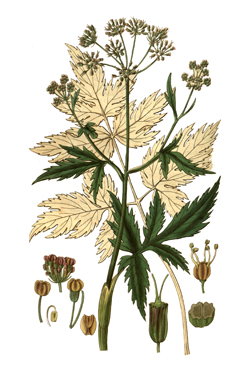
Arracacia xanthorrhiza or otherwise known as Arracacha is a perennial root crop with a short, cylindrical stem of up to 10 cm in diameter. It grows up to 1 m tall. It is commonly cultivated in small scale operations for its edible starchy roots. The tuber is cooked and is considered as a staple food in some parts of South America, usually as a potato substitute. It is also a good source of starch. The leaves are used as a flavouring, or eaten either raw or cooked and mixed in salads. The stems are as well cooked and eaten as vegetables.
Physical Characteristics

 Arracacia xanthorrhiza is a PERENNIAL growing to 1 m (3ft 3in).
See above for USDA hardiness. It is hardy to UK zone 9 and is frost tender. The species is hermaphrodite (has both male and female organs) and is pollinated by Insects. The plant is self-fertile.
Suitable for: medium (loamy) soils and prefers well-drained soil. Suitable pH: mildly acid, neutral and basic (mildly alkaline) soils. It can grow in semi-shade (light woodland) or no shade. It prefers moist soil.
UK Hardiness Map
US Hardiness Map
Synonyms
A. esculenta. Conium arracacia.
Plant Habitats
Cultivated Beds; South Wall. By. West Wall. By.
Edible Uses
Edible Parts: Leaves Root Stem
Edible Uses: Condiment
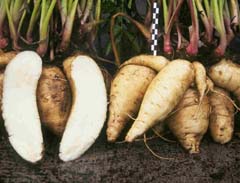
Tuber - cooked[ 22 , 46 , 61 , 97 , 171 ]. Both long and fine roots and edible, tuberous and fusiform roots emerge from the stem[ 418 ]. Very palatable and easily digested[ 1 , 196 ], the root is used as a staple food in some parts of S. America[ 2 ]. The root contains 10 - 25% starch, it is high in calcium and vitamin A[ 196 ]. It is used as a potato substitute, its flavour is between that of parsnips and sweet chestnuts with a hint of sweetness[ 2 , 183 ]. The sweetness increases in storage[ 196 ]. The root is also used as the source of starch used in other foods[ 183 ]. The roots can be 5 - 25cm long and up to 8cm in diameter[ 418 ]. The roots are harvested in the autumn and have a relatively short storage life[ 196 ]. Leaves. Used as a flavouring[ 177 ]. The leaves are used in the same way as celery in raw or cooked salads[ 418 ]. Young stems - raw or cooked as a vegetable[ 183 , 196 ]. The stems are sometimes blanched and used like celery in salads[ 196 , 301 ].
References More on Edible Uses
Medicinal Uses
Plants For A Future can not take any responsibility for any adverse effects from the use of plants. Always seek advice from a professional before using a plant medicinally.
None known
References More on Medicinal Uses
The Bookshop: Edible Plant Books
Our Latest books on Perennial Plants For Food Forests and Permaculture Gardens in paperback or digital formats.

Edible Tropical Plants
Food Forest Plants for Hotter Conditions: 250+ Plants For Tropical Food Forests & Permaculture Gardens.
More

Edible Temperate Plants
Plants for Your Food Forest: 500 Plants for Temperate Food Forests & Permaculture Gardens.
More

More Books
PFAF have eight books available in paperback and digital formats. Browse the shop for more information.
Shop Now
Other Uses
References More on Other Uses
Cultivation details
Cultivation of this plant usually takes place at higher elevation of 1,800 - 3,500 metres in the Tropics, though it can also be grown at lower elevations down to 600 metres[ 300 , 418 ]. It grows best in areas where annual daytime temperatures are within the range 14 - 21°c, but can tolerate 10 - 28°c[ 418 ]. It prefers a mean annual rainfall in the range 800 - 1,200mm, but tolerates 600 - 1,800mm[ 418 ]. Requires a sunny position[ 418 ]. Prefers a good loam. Grows best in a well-drained sandy loam with a pH in the range of 5 to 6[ 196 , 300 ]. Prefers a pH in the range 5 - 6, tolerating 4.5 - 6.5. Plants take about 120 - 240 days from planting to produce a first crop and 300 - 400 days to produce a crop of mature tubers[ 196 ]. At harvest time there can be as many as 10 tubers each the size of a carrot formed around the central root196]. One plant can yield 2 - 3 kg of edible roots, total yields of 40 tonnes per hectare are possible[ 196 ]. Preventing the plant from flowering can increase yields[ 196 ]. Plants might be sensitive to daylength, possibly requiring short days to initiate tuber production, and so may not be suitable for temperate climates[ 196 , 300 ]. They also have a longer growing season than potatoes and are frost-tender so need a relatively long growing season[ 196 ]. Plants do not always produce viable seed in S. America[ 196 ].
References Carbon Farming Information and Carbon Sequestration Information
Temperature Converter
Type a value in the Celsius field to convert the value to Fahrenheit:
Fahrenheit:
The PFAF Bookshop
Plants For A Future have a number of books available in paperback and digital form. Book titles include Edible Plants, Edible Perennials, Edible Trees,Edible Shrubs, Woodland Gardening, and Temperate Food Forest Plants. Our new book is Food Forest Plants For Hotter Conditions (Tropical and Sub-Tropical).
Shop Now
Plant Propagation
Seed - sow in a seedbed or containers and only just cover the seed. Do not allow the compost to dry out. Germination is often poor, less than 50%[ 196 ]. Since this species is believed to be a hybrid it will probably not breed true from seed. Plant out when about 10cm tall. Division. The plant forms a clump of tubers around a central root, each tuber can be used to grow a new plant. Traditionally the base of the tuber is repeatedly slashed to stimulate shoots to form and encourage a uniform arrangement of lateral roots. They are then left for a few days to heal before planting them out[ 196 ].
Other Names
If available other names are mentioned here
arracacha, peruvian carrot.
Spanish: arracacha; arracha (Bolivia); racacha (Bolivia); virraca (Bolivia).
French: pomme de terre céleri.
Brazil: batata baroa; mandioquinha.
Native Range
SOUTHERN AMERICA: Bolivia, Ecuador, Peru (Ancash, Ayacucho, Junín)
Weed Potential
Right plant wrong place. We are currently updating this section.
Please note that a plant may be invasive in one area but may not in your area so it's worth checking.
Conservation Status
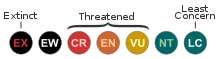
IUCN Red List of Threatened Plants Status : This taxon has not yet been assessed.
Growth: S = slow M = medium F = fast. Soil: L = light (sandy) M = medium H = heavy (clay). pH: A = acid N = neutral B = basic (alkaline). Shade: F = full shade S = semi-shade N = no shade. Moisture: D = dry M = Moist We = wet Wa = water.
Now available:
Food Forest Plants for Mediterranean Conditions
350+ Perennial Plants For Mediterranean and Drier Food Forests and Permaculture Gardens.
[Paperback and eBook]
This is the third in Plants For A Future's series of plant guides for food forests tailored to
specific climate zones. Following volumes on temperate and tropical ecosystems, this book focuses
on species suited to Mediterranean conditions—regions with hot, dry summers and cool, wet winters,
often facing the added challenge of climate change.
Read More
Expert comment
Author
Bancr.
Botanical References
1
Links / References
For a list of references used on this page please go here
Readers comment