 |
|
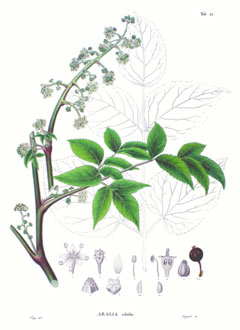
http://commons.wikimedia.org/wiki/File:Aralia_cordata_SZ25.png |
 |
|
Translate this page:
Summary
Physical Characteristics

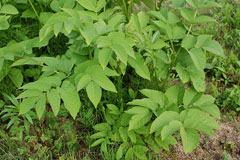
 Aralia cordata is a PERENNIAL growing to 1.8 m (6ft).
See above for USDA hardiness. It is hardy to UK zone 5 and is frost tender. It is in flower from July to August. The species is hermaphrodite (has both male and female organs) and is pollinated by Bees.
Suitable for: light (sandy), medium (loamy) and heavy (clay) soils and can grow in nutritionally poor soil. Suitable pH: mildly acid, neutral and basic (mildly alkaline) soils. It can grow in full shade (deep woodland) or semi-shade (light woodland). It prefers moist soil.
UK Hardiness Map
US Hardiness Map
Synonyms
A. edulis. A. nutans.
Plant Habitats
Woodland Garden Dappled Shade; Shady Edge;
Edible Uses
Edible Parts: Leaves Root Shoots Stem
Edible Uses:
Young branched shoots - cooked or raw[2, 46, 61, 105, 177, 279]. They can be up to 1.5 metres long and have a mild and agreeable flavour[116]. They are usually blanched and are crisp and tender with a unique lemon-like flavour[183]. They can be sliced and added to salads, soups etc[206]. The shoots contain about 1.1% protein, 0.42% fat, 0.8% soluble carbohydrate, 0.55% ash[179]. Root - cooked[22, 105, 177]. Used like scorzonera[2].
References More on Edible Uses
| Composition
|
| Figures in grams (g) or miligrams (mg) per 100g of food.
|
|
|
Shoots (Fresh weight)
|
|
- 0 Calories per 100g
- Water : 0%
- Protein: 1.1g; Fat: 0.42g; Carbohydrate: 0.8g; Fibre: 0g; Ash: 0.55g;
- Minerals - Calcium: 0mg; Phosphorus: 0mg; Iron: 0mg; Magnesium: 0mg; Sodium: 0mg; Potassium: 0mg; Zinc: 0mg;
- Vitamins - A: 0mg; Thiamine (B1): 0mg; Riboflavin (B2): 0mg; Niacin: 0mg; B6: 0mg; C: 0mg;
- Reference: [ ]
- Notes:
|
|
Medicinal Uses
Plants For A Future can not take any responsibility for any adverse effects from the use of plants. Always seek advice from a professional before using a plant medicinally.
Analgesic Antiinflammatory Carminative Diuretic Febrifuge Stimulant Stomachic Tonic
The root is sometimes used in China as a substitute for ginseng (Panax species)[218]. It is said to be analgesic, antiinflammatory, carminative, diuretic, febrifuge, stimulant, stomachic and tonic[218, 279]. The root contains an essential oil, saponins, sesquiterpenes and diterpene acids[279]. It is used in Korea to treat the common cold and migraines[279].
References More on Medicinal Uses
The Bookshop: Edible Plant Books
Our Latest books on Perennial Plants For Food Forests and Permaculture Gardens in paperback or digital formats.
Edible Tropical Plants
Food Forest Plants for Hotter Conditions: 250+ Plants For Tropical Food Forests & Permaculture Gardens.
More
Edible Temperate Plants
Plants for Your Food Forest: 500 Plants for Temperate Food Forests & Permaculture Gardens.
More
More Books
PFAF have eight books available in paperback and digital formats. Browse the shop for more information.
Shop Now
Other Uses
References More on Other Uses
Cultivation details
Prefers a good deep loam and a semi-shady position[1, 134]. Requires a sheltered position[1]. Plants are hardier when grown in poorer soils[200]. Tolerates a pH in the range 5.0 to 7.4. Dormant plants are hardy to about -25°c[187]. The young growth in spring, even on mature plants, is frost-tender and so it is best to grow the plants in a position sheltered from the early morning sun[K]. This is a commonly cultivated food crop in Japan, where it is grown for its edible shoots. There are several named varieties[2, 46, 58, 116]. The plant is heat tolerant in zones 9 through 6. (Plant Hardiness Zones show how well plants withstand cold winter temperatures.
Plant Heat Zones show when plants would start suffering from the heat.
The Plant Heat Zone map is based on the number of "heat days" experienced in a given area where the temperature climbs to over 86 degrees F (30°C).
At this temperature, many plants begin to suffer physiological damage. Heat Zones range from 1 (no heat days) to 12 (210 or more heat days).
For example Heat Zone. 11-1 indicates that the plant is heat tolerant in zones 11 through 1.) For polyculture design as well as the above-ground architecture (form - tree, shrub etc. and size shown above) information on the habit and root pattern is also useful and given here if available. The plant growth habit is a clumper with limited spread [1-2].
References Carbon Farming Information and Carbon Sequestration Information
Temperature Converter
Type a value in the Celsius field to convert the value to Fahrenheit:
Fahrenheit:
The PFAF Bookshop
Plants For A Future have a number of books available in paperback and digital form. Book titles include Edible Plants, Edible Perennials, Edible Trees,Edible Shrubs, Woodland Gardening, and Temperate Food Forest Plants. Our new book is Food Forest Plants For Hotter Conditions (Tropical and Sub-Tropical).
Shop Now
Plant Propagation
Seed - best sown as soon as ripe in a cold frame. Stored seed requires 3 - 5 months of cold stratification. Germination usually takes place within 1 - 4 months at 20°c[134]. When large enough to handle, prick the seedlings out into individual pots and grow them on in light shade in a greenhouse for at least their first winter. Once the plants are 25cm or more tall, they can be planted out into their permanent positions, late spring or early summer being the best time to do this. Root cuttings 8cm long, December in a cold frame[11, 78]. Store the roots upside down in sand and pot up in March/April. High percentage[78]. Division of suckers in late winter[11]. Very easy, the suckers can be planted out direct into their permanent positions if required.
Other Names
If available other names are mentioned here
Cimakina, Japanese Spikenard, Mountain asparagus, Oudo, Tu dang gui, Udo, Japanese asparagus [1-4].
Native Range
TEMPERATE ASIA: Gyeongsangbuk-do (Ulleung-do), Hokkaidô, Honshu, Korea, Kyushu, Shikoku, South,Japan.
Weed Potential
Right plant wrong place. We are currently updating this section.
Please note that a plant may be invasive in one area but may not in your area so it's worth checking.
Conservation Status
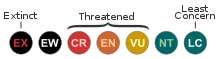
IUCN Red List of Threatened Plants Status :
| Related Plants
|
| Latin Name | Common Name | Habit | Height | Hardiness | Growth | Soil | Shade | Moisture | Edible | Medicinal | Other |
| Aralia chinensis | Chinese Angelica Tree, Pumila Spirea, Chinese Astilbe | Shrub | 3.5 |
4-8
| M | LMH | FS | M | 2 | 2 | |
| Aralia continentalis | Manchurian Spikenard | Perennial | 2.0 |
7-10
| | LMH | FS | M | 2 | 0 | |
| Aralia elata | Japanese Angelica Tree, Angelica Tree | Tree | 6.0 |
4-9
| M | LMH | SN | M | 3 | 2 | 2 |
| Aralia hispida | Bristly Sarsaparilla | Shrub | 1.0 |
3-7
| | LMH | SN | DM | 2 | 1 | 2 |
| Aralia mandschurica | Manchurian Angelica Tree | Shrub | 3.5 |
4-8
| | LMH | SN | M | 2 | 2 | |
| Aralia nudicaulis | Wild Sarsaparilla | Perennial | 0.4 |
4-8
| | LMH | FS | M | 4 | 3 | 3 |
| Aralia racemosa | American Spikenard | Perennial | 1.8 |
4-8
| | LMH | FS | M | 3 | 3 | 2 |
| Aralia schmidtii | Sakhalin Spikenard | Perennial | 3.0 |
4-8
| | LMH | FS | M | 2 | 0 | |
| Aralia spinosa | Hercule's Club, Aralia spinosa, American Angelica Tree, Hercules' Club, Devil's Walking Stick | Tree | 9.0 |
5-9
| S | LMH | FS | M | 2 | 2 | 2 |
| Eleutherococcus chiisanensis | | Shrub | 0.0 |
-
| | LMH | SN | M | 2 | 0 | |
| Eleutherococcus divaricatus | | Shrub | 3.5 |
5-9
| | LMH | SN | M | 2 | 0 | |
| Eleutherococcus gracylistylus | Wu Jia Pi | Shrub | 3.0 |
5-9
| | LMH | SN | M | 1 | 3 | |
| Eleutherococcus innovans | Taka-No-Tsume | Tree | 6.0 |
6-9
| | LMH | N | M | 1 | 0 | |
| Eleutherococcus japonicus | | Shrub | 3.0 |
-
| | LMH | SN | M | 1 | 0 | |
| Eleutherococcus senticosus | Siberian Ginseng | Shrub | 2.0 |
3-7
| S | LMH | SN | M | 2 | 5 | |
| Eleutherococcus seoulensis | | Shrub | 0.0 |
-
| | LMH | SN | M | 1 | 0 | |
| Eleutherococcus sessiliflorus | | Shrub | 4.5 |
4-8
| | LMH | SN | M | 2 | 3 | |
| Eleutherococcus sieboldianus | Ukogi, Five Leafed Aralia | Shrub | 3.0 |
4-8
| S | LMH | SN | M | 3 | 0 | 2 |
| Eleutherococcus spinosus | | Shrub | 3.0 |
4-8
| | LMH | SN | M | 2 | 2 | 2 |
| Eleutherococcus trifoliatus | | Shrub | 6.0 |
6-9
| | LMH | SN | M | 1 | 1 | |
| Hedera helix | Ivy, English ivy, Algerian ivy, Baltic Ivy, Common Ivy | Climber | 15.0 |
5-11
| M | LMH | FSN | MWe | 0 | 3 | 4 |
| Hedera nepalensis | Nepal Ivy | Climber | 15.0 |
7-10
| M | LMH | FSN | MWe | 0 | 2 | |
| Kalopanax sciadophylloides | | Tree | 0.0 |
-
| | LMH | SN | M | 1 | 0 | |
| Kalopanax septemlobus | Tree Aralia, Castor aralia | Tree | 25.0 |
4-8
| S | LMH | SN | M | 2 | 1 | 2 |
| Kirkophytum lyallii | | Perennial | 0.2 |
-
| | LMH | SN | M | 1 | 0 | |
| Oplopanax horridus | Devil's Club | Shrub | 2.0 |
4-8
| | LMH | FS | M | 2 | 2 | 1 |
| Panax ginseng | Ginseng, Chinese ginseng | Perennial | 0.8 |
5-9
| | LMH | FS | M | 2 | 5 | |
| Panax japonicus | Japanese Ginseng | Perennial | 0.6 |
-
| | LMH | FS | M | 1 | 1 | 1 |
| Panax pseudoginseng | Ginseng, Japanese ginseng | Perennial | 1.0 |
5-9
| S | LMH | FS | M | 1 | 3 | |
|
|
Growth: S = slow M = medium F = fast. Soil: L = light (sandy) M = medium H = heavy (clay). pH: A = acid N = neutral B = basic (alkaline). Shade: F = full shade S = semi-shade N = no shade. Moisture: D = dry M = Moist We = wet Wa = water.
Now available:
Food Forest Plants for Mediterranean Conditions
350+ Perennial Plants For Mediterranean and Drier Food Forests and Permaculture Gardens.
[Paperback and eBook]
This is the third in Plants For A Future's series of plant guides for food forests tailored to
specific climate zones. Following volumes on temperate and tropical ecosystems, this book focuses
on species suited to Mediterranean conditions—regions with hot, dry summers and cool, wet winters,
often facing the added challenge of climate change.
Read More
Expert comment
Author
Thunb.
Botanical References
58200275
Links / References
For a list of references used on this page please go here
Readers comment
| Add a comment |
|
If you have important information about this plant that may help other users please add a comment or link below. Only comments or links that are felt to be directly relevant to a plant will be included. If you think a comment/link or information contained on this page is inaccurate or misleading we would welcome your feedback at [email protected]. If you have questions about a plant please use the Forum on this website as we do not have the resources to answer questions ourselves.
* Please note: the comments by website users are not necessarily those held by PFAF and may give misleading or inaccurate information.
|
|