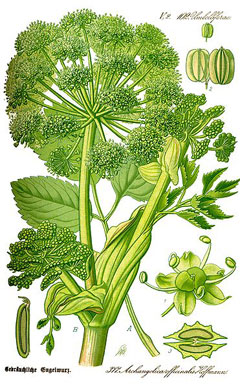
 |
|
http://commons.wikimedia.org/wiki/File:Illustration_Angelica_archangelica0_clean.jpg |
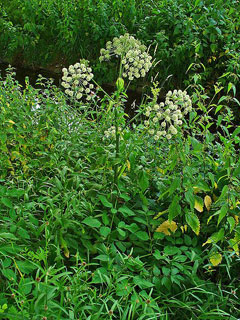 |
| http://commons.wikimedia.org/wiki/File:Angelica_archangelica_001.JPG |
Translate this page:
Summary
Physical Characteristics

 Angelica archangelica is a BIENNIAL growing to 1.5 m (5ft) by 0.8 m (2ft 7in).
See above for USDA hardiness. It is hardy to UK zone 4 and is not frost tender. It is in flower from July to August, and the seeds ripen from August to September. The species is hermaphrodite (has both male and female organs) and is pollinated by Insects. The plant is self-fertile.
It is noted for attracting wildlife.
Suitable for: light (sandy), medium (loamy) and heavy (clay) soils. Suitable pH: mildly acid, neutral and basic (mildly alkaline) soils and can grow in very acid soils.
It can grow in semi-shade (light woodland) or no shade. It prefers moist soil.
UK Hardiness Map
US Hardiness Map
Synonyms
Archangelica officinalis.
Plant Habitats
Woodland Garden Dappled Shade; Shady Edge;
Edible Uses
Edible Parts: Leaves Root Seed Stem Shoots
Edible Uses: Condiment
Leaves - raw or cooked[2, 4, 14, 27, 37, 52]. A liquorice-like flavour[183], they can be used as a flavouring in mixed salads[K]. They are also used to sweeten tart fruits[K]. Stalks and young shoots - cooked or raw[2, 37]. The stalks should be peeled[115], they can be used like celery[183]. They can also be used to sweeten tart fruits[52] and to make jam[244]. They are often crystallised in sugar and used as sweets and cake decorations[244]. The stems are best harvested in the spring[244]. An essential oil is obtained from the root and seeds, it is used as a food flavouring[46, 57, 100, 183]. Root - cooked[2]. Seed - used as a flavouring in liqueurs such as Chartreuse[244]. A tea can be made from the leaves, seed or roots[183].
References More on Edible Uses
Medicinal Uses
Plants For A Future can not take any responsibility for any adverse effects from the use of plants. Always seek advice from a professional before using a plant medicinally.
Antispasmodic Carminative Diaphoretic Diuretic Expectorant Stimulant Stomachic Tonic
Appetizer Urinary
Angelica has a long folk-history of use as a medicinal herb, in particular for the treatment of digestive disorders and problems with blood circulation[4, 254]. The root is the most active medicinally, it should be harvested in the autumn of its first year of growth, sliced longitudinally if necessary and dried quickly[4]. If well stored, the root retains its medicinal virtues for many years[4]. The leaves and seeds can also be used[4]. The leaves are harvested and dried in late spring before the plant comes into flower[244]. The plant is antispasmodic, carminative, diaphoretic, diuretic, expectorant, stimulant, stomachic, tonic[4, 9, 14, 21, 46, 165]. An infusion is used to ease flatulence, indigestion, chronic bronchitis and typhus[244]. It stimulates blood flow to the peripheral parts of the body and so is of value in treating poor circulation - it is considered a specific treatment for Buerger's disease, a condition that narrows the arteries of the hands and feet[254]. Angelica is contra-indicated for people with a tendency towards diabetes since its use can increase sugar levels in the urine[4]. This plant should not be prescribed for pregnant women[238], nor should the juice be allowed to come into contact with the eyes[244]. An essential oil from the seeds is sometimes used as a rub to relieve rheumatic conditions[244]. The German Commission E Monographs, a therapeutic guide to herbal medicine, approve Angelica archangelica fruit for fevers and colds, infection of the urinary tract, dyspeptic complaints and loss of appetite. The root has been approved for dyspeptic complaints and loss of appetite. (see [302] for critics of commission E). No health hazards or side-effects if the proper administration of therapeutic dosages. Avoid sunbathing and intensive UV radiation for the duration of a treatment [301].
References More on Medicinal Uses
The Bookshop: Edible Plant Books
Our Latest books on Perennial Plants For Food Forests and Permaculture Gardens in paperback or digital formats.

Edible Tropical Plants
Food Forest Plants for Hotter Conditions: 250+ Plants For Tropical Food Forests & Permaculture Gardens.
More

Edible Temperate Plants
Plants for Your Food Forest: 500 Plants for Temperate Food Forests & Permaculture Gardens.
More

More Books
PFAF have eight books available in paperback and digital formats. Browse the shop for more information.
Shop Now
Other Uses
Essential
An essential oil from the root and seeds is used in perfumery, medicinally and as a food flavouring[4, 46, 57, 100]. The oil from the seeds has a musk-like aroma and is often used to flavour liqueurs[245]. The dried root contains 0.35% essential oil, the seed about 1.3%[240]. Yields of the essential oil vary according to location, plants growing at higher altitudes have higher yields with a better aroma[240].
Special Uses
Attracts Wildlife Scented Plants
References More on Other Uses
Cultivation details
Requires a deep moist fertile soil in dappled shade or full sun[52, 200]. Tolerates a pH in the range 4.5 to 7.3. A very hardy plant, tolerating severe frosts without damage[4]. Although by nature biennial, the plants are reliably perennial if they are prevented from setting seed[200]. Angelica is occasionally cultivated in the herb garden, mainly for its culinary uses[46]. The plants have a pervading aromatic odour[4]. The growing plant is almost untroubled by pests and diseases[4]. It attracts bees and hoverflies to the garden, helping to create a natural balance of insect pests and predators[24]. When well-sited, the plant will often self-sow - sometimes to the point of nuisance[245].
References Carbon Farming Information and Carbon Sequestration Information
Temperature Converter
Type a value in the Celsius field to convert the value to Fahrenheit:
Fahrenheit:
The PFAF Bookshop
Plants For A Future have a number of books available in paperback and digital form. Book titles include Edible Plants, Edible Perennials, Edible Trees,Edible Shrubs, Woodland Gardening, and Temperate Food Forest Plants. Our new book is Food Forest Plants For Hotter Conditions (Tropical and Sub-Tropical).
Shop Now
Plant Propagation
Seed - best sown in a cold frame as soon as it is ripe since the seed only has a short viability[200]. Seed can also be sown in the spring, though germination rates will be lower. It requires light for germination[200]. When large enough to handle, prick the seedlings out into individual pots and grow them on in a cold frame for their first winter, planting them out into their permanent positions in the spring. The seed can also be sow in situ as soon as it is ripe.
Other Names
If available other names are mentioned here
Native Range
TEMPERATE ASIA: Russian Federation-Ciscaucasia (Ciscaucasia), Georgia, Russian Federation (Tyumen) EUROPE: Denmark, Finland, Iceland, Norway, Sweden, Czech Republic, Germany, Netherlands, Slovakia, Russian Federation (European part), Belarus, Estonia, Lithuania, Latvia, Moldova, Ukraine (north & central), Croatia, Serbia
Weed Potential
Right plant wrong place. We are currently updating this section.
Please note that a plant may be invasive in one area but may not
in your area so it's worth checking.
Conservation Status
IUCN Red List of Threatened Plants Status :

IUCN Red List
| Related Plants
|
| Latin Name | Common Name | Habit | Height | Hardiness | Growth | Soil | Shade | Moisture | Edible | Medicinal | Other |
| Angelica acutiloba | Dong Dang Gui | Perennial | 0.7 |
6-9
| | LMH | SN | M | 2 | 1 | |
| Angelica anomala | | Perennial | 1.5 |
-
| | LMH | SN | M | 0 | 2 | |
| Angelica atropurpurea | Purplestem Angelica | Perennial | 3.0 |
4-8
| | LMH | SN | M | 2 | 2 | |
| Angelica crucifolia | | Perennial | 0.8 |
-
| | LMH | SN | M | 2 | 0 | |
| Angelica dahurica | Bai Zhi | Biennial/Perennial | 1.8 |
-
| | LMH | SN | M | 2 | 3 | |
| Angelica decursiva | | Perennial | 1.5 |
-
| | LMH | SN | M | 2 | 2 | |
| Angelica edulis | | Perennial | 3.0 |
-
| | LMH | SN | M | 2 | 0 | |
| Angelica genuflexa | Kneeling Angelica | Perennial | 1.0 |
-
| | LMH | SN | M | 2 | 1 | 1 |
| Angelica gigas | Giant Angelica, Purple Parsnip, Korean Angelica | Perennial | 1.8 |
4-8
| M | LMH | SN | M | 2 | 2 | |
| Angelica glauca | | Perennial | 2.0 |
-
| | LMH | SN | M | 2 | 1 | 1 |
| Angelica japonica | | Perennial | 1.0 |
-
| | LMH | N | M | 3 | 0 | |
| Angelica keiskei | | Perennial | 1.2 |
-
| | LMH | SN | M | 2 | 0 | |
| Angelica koreana | | Perennial | 1.0 |
-
| | LMH | SN | M | 2 | 0 | |
| Angelica laxiflora | | Perennial | 0.0 |
-
| | LMH | SN | M | 0 | 1 | |
| Angelica megaphylla | | Perennial | 2.0 |
-
| | LMH | SN | M | 2 | 0 | |
| Angelica montana | | Perennial | 1.5 |
-
| | LMH | SN | M | 2 | 0 | |
| Angelica polymorpha | | Perennial | 1.0 |
-
| | LMH | SN | M | 2 | 2 | |
| Angelica pubescens | Du Huo | Perennial | 1.8 |
6-9
| | LMH | SN | M | 2 | 3 | |
| Angelica sinensis | Dang Gui - Dong Quai - Chinese Angelica | Perennial | 1.0 |
6-9
| | LMH | SN | M | 0 | 5 | 1 |
| Angelica sylvestris | Wild Angelica,Woodland angelica | Biennial | 1.5 |
4-8
| | LMH | FSN | M | 3 | 2 | 1 |
| Angelica uchiyamanae | | Perennial | 0.0 |
-
| | LMH | SN | M | 0 | 1 | |
| Angelica ursina | | Perennial | 3.0 |
-
| | LMH | SN | M | 2 | 0 | |
| Aralia chinensis | Chinese Angelica Tree, Pumila Spirea, Chinese Astilbe | Shrub | 3.5 |
4-8
| M | LMH | FS | M | 2 | 2 | |
| Aralia elata | Japanese Angelica Tree, Angelica Tree | Tree | 6.0 |
4-9
| M | LMH | SN | M | 3 | 2 | 2 |
| Aralia mandschurica | Manchurian Angelica Tree | Shrub | 3.5 |
4-8
| | LMH | SN | M | 2 | 2 | |
| Aralia spinosa | Hercule's Club, Aralia spinosa, American Angelica Tree, Hercules' Club, Devil's Walking Stick | Tree | 9.0 |
5-9
| S | LMH | FS | M | 2 | 2 | 2 |
|
Growth: S = slow M = medium F = fast. Soil: L = light (sandy) M = medium H = heavy (clay). pH: A = acid N = neutral B = basic (alkaline). Shade: F = full shade S = semi-shade N = no shade. Moisture: D = dry M = Moist We = wet Wa = water.
Now available:
Food Forest Plants for Mediterranean Conditions
350+ Perennial Plants For Mediterranean and Drier Food Forests and Permaculture Gardens.
[Paperback and eBook]
This is the third in Plants For A Future's series of plant guides for food forests tailored to
specific climate zones. Following volumes on temperate and tropical ecosystems, this book focuses
on species suited to Mediterranean conditions—regions with hot, dry summers and cool, wet winters,
often facing the added challenge of climate change.
Read More
Expert comment
Author
L.
Botanical References
17200
Links / References
For a list of references used on this page please go here
Readers comment
| Add a comment |
|
If you have important information about this plant that may help other users please add a comment or link below. Only comments or links that are felt to be directly relevant to a plant will be included. If you think a comment/link or information contained on this page is inaccurate or misleading we would welcome your feedback at [email protected]. If you have questions about a plant please use the Forum on this website as we do not have the resources to answer questions ourselves.
* Please note: the comments by website users are not necessarily those held by PFAF and may give misleading or inaccurate information.
|
Subject : Angelica archangelica
|
|
|
|