 |
|
http://commons.wikimedia.org/wiki/User:Noodle_snacks |
 |
|
Translate this page:
Summary
Taxonomic Note: This genus was formerly classified in the family Alliaceae. Modern classifications include it within the Amaryllidaceae.
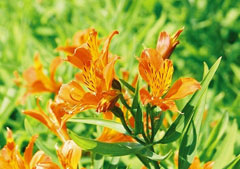
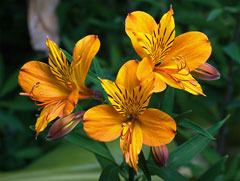
Bloom Color: Orange.
Main Bloom Time: Early summer, Late summer, Mid summer. Form: Upright or erect.
Physical Characteristics

 Alstroemeria aurea is a PERENNIAL growing to 1 m (3ft 3in) by 1 m (3ft 3in) at a medium rate.
See above for USDA hardiness. It is hardy to UK zone 7 and is not frost tender. It is in leaf from February to August, in flower from June to July. The species is hermaphrodite (has both male and female organs) and is pollinated by Insects.
Suitable for: light (sandy), medium (loamy) and heavy (clay) soils and prefers well-drained soil. Suitable pH: mildly acid, neutral and basic (mildly alkaline) soils. It can grow in semi-shade (light woodland) or no shade. It prefers moist soil and can tolerate drought. The plant can tolerate maritime exposure.
UK Hardiness Map
US Hardiness Map
Synonyms
A. aurantiaca. D.Don.
Plant Habitats
Woodland Garden Sunny Edge; Cultivated Beds;
Edible Uses
Edible Parts: Root
Edible Uses:
Although no reports have been seen for this species, the root of many members of this genus are edible and a source of starch that is very nutritious. It is most likely that this species can be used in the same way.
References More on Edible Uses
Medicinal Uses
Plants For A Future can not take any responsibility for any adverse effects from the use of plants. Always seek advice from a professional before using a plant medicinally.
None known
References More on Medicinal Uses
The Bookshop: Edible Plant Books
Our Latest books on Perennial Plants For Food Forests and Permaculture Gardens in paperback or digital formats.

Edible Tropical Plants
Food Forest Plants for Hotter Conditions: 250+ Plants For Tropical Food Forests & Permaculture Gardens.
More

Edible Temperate Plants
Plants for Your Food Forest: 500 Plants for Temperate Food Forests & Permaculture Gardens.
More

More Books
PFAF have eight books available in paperback and digital formats. Browse the shop for more information.
Shop Now
Other Uses
References More on Other Uses
Cultivation details
Landscape Uses:Border, Container, Foundation, Massing. Requires a fertile, moisture retentive well-drained soil and a warm situation in sun or semi-shade[200]. Another report says that it is easily grown in any soil in sun or part shade[190]. Established plants are drought tolerant[190]. Plants succeed in maritime gardens[233]. Plants have proved very tolerant of neglect on our trial grounds in Cornwall, one clump grew and thrived in rank grass for a number of years until increasing shade from trees began to reduce its vigour[K]. This is the hardiest member of the genus, tolerating temperatures down to between -10 and -15°c, especially if the roots are mulched in the winter[187]. Young plants are best given a protective mulch for their first winter or two[233]. Somewhat intolerant of root disturbance[1], the roots are fleshy and brittle[200]. The plant can be rather invasive, spreading by means of thin fleshy roots[187]. Special Features: Attractive foliage, Suitable for cut flowers.
References Carbon Farming Information and Carbon Sequestration Information
Temperature Converter
Type a value in the Celsius field to convert the value to Fahrenheit:
Fahrenheit:
The PFAF Bookshop
Plants For A Future have a number of books available in paperback and digital form. Book titles include Edible Plants, Edible Perennials, Edible Trees,Edible Shrubs, Woodland Gardening, and Temperate Food Forest Plants. Our new book is Food Forest Plants For Hotter Conditions (Tropical and Sub-Tropical).
Shop Now
Plant Propagation
Seed - best sown in individual pots in a cold frame as soon as it is ripe although seedlings can be transplanted successfully if they are moved with care whilst small. Pre-soak stored seed for 12 hrs in warm water, warm stratify for 4 weeks at 25°c and then reduce the temperature to 10°c. Excising a small bit of the seed near the embryo after the seed has been warm stratified helps to speed up the germination process[164]. Plant out about 20cm deep into their permanent positions in late summer or autumn[200]. Division in April or October with care since the plant resents root disturbance[133]. Ensure each portion has a growth bud[111]. This species is so prolific that large clumps can be dug up in late summer for re-establishment[233].
Other Names
If available other names are mentioned here
Native Range
SOUTHERN AMERICA: Argentina (Chubut, Neuquén, Río Negro), Chile (Biobío, Aisén del General Carlos Ibañez del Campo, La Araucanía, Los Lagos (c.))
Weed Potential
Right plant wrong place. We are currently updating this section.
Please note that a plant may be invasive in one area but may not in your area so it's worth checking.
Conservation Status
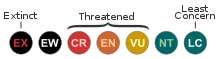
IUCN Red List of Threatened Plants Status :
Growth: S = slow M = medium F = fast. Soil: L = light (sandy) M = medium H = heavy (clay). pH: A = acid N = neutral B = basic (alkaline). Shade: F = full shade S = semi-shade N = no shade. Moisture: D = dry M = Moist We = wet Wa = water.
Now available:
Food Forest Plants for Mediterranean Conditions
350+ Perennial Plants For Mediterranean and Drier Food Forests and Permaculture Gardens.
[Paperback and eBook]
This is the third in Plants For A Future's series of plant guides for food forests tailored to
specific climate zones. Following volumes on temperate and tropical ecosystems, this book focuses
on species suited to Mediterranean conditions—regions with hot, dry summers and cool, wet winters,
often facing the added challenge of climate change.
Read More
Expert comment
Author
Graham.
Botanical References
200
Links / References
For a list of references used on this page please go here
Readers comment