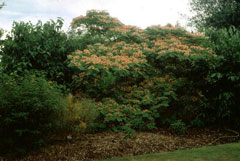
 |
|
(c) ken Fern, Plants For A Future 2010 |
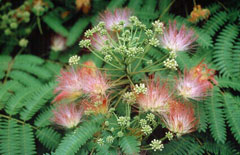 |
| (c) ken Fern, Plants For A Future 2010 |
Translate this page:
Summary
Bloom Color: Pink.
Main Bloom Time: Early summer, Early spring, Late summer, Late spring, Mid summer, Mid spring. Form: Spreading or horizontal, Vase.
Physical Characteristics

 Albizia julibrissin is a deciduous Tree growing to 12 m (39ft) by 10 m (32ft) at a fast rate.
See above for USDA hardiness. It is hardy to UK zone 7 and is not frost tender. It is in flower from July to August, and the seeds ripen from September to November. The species is hermaphrodite (has both male and female organs).
It can fix Nitrogen.
Suitable for: light (sandy), medium (loamy) and heavy (clay) soils, prefers well-drained soil and can grow in nutritionally poor soil. Suitable pH: mildly acid, neutral and basic (mildly alkaline) soils and can grow in very alkaline and saline soils.
It cannot grow in the shade. It prefers dry or moist soil and can tolerate drought. The plant can tolerates strong winds but not maritime exposure.
UK Hardiness Map
US Hardiness Map
Synonyms
Acacia mollis. Acacia julibrissin.
Plant Habitats
Woodland Garden Canopy; Secondary; Sunny Edge; South Wall. By.
Edible Uses
Edible Parts: Flowers Leaves
Edible Uses: Gum Tea
Young leaves - cooked. An aromatic flavour[2, 106, 178, 179], they are used as a potherb[183]. Flowers - cooked. Eaten as a vegetable[183]. The dried leaves are a tea substitute[177, 183].
References More on Edible Uses
Medicinal Uses
Plants For A Future can not take any responsibility for any adverse effects from the use of plants. Always seek advice from a professional before using a plant medicinally.
Analgesic Anthelmintic Carminative Digestive Diuretic Oxytoxic Plaster Plaster
Sedative Stimulant Tonic Vulnerary
The flower heads are carminative, digestive, sedative and tonic[176, 218, 238]. They are used internally in the treatment of insomnia, irritability, breathlessness and poor memory[176, 238]. The flowers are harvested as they open and are dried for later use[238]. The stembark is anodyne, anthelmintic, carminative, discutient, diuretic, oxytocic, sedative, stimulant, tonic, vermifuge and vulnerary[176, 178, 218]. It is used internally in the treatment of insomnia, irritability, boils and carbuncles[238]. Externally, it is applied to injuries and swellings[238]. The bark is harvested in spring or late summer and is dried for later use[238]. A gummy extract obtained from the plant is used as a plaster for abscesses, boils etc and also as a retentive in fractures and sprains[218].
References More on Medicinal Uses
The Bookshop: Edible Plant Books
Our Latest books on Perennial Plants For Food Forests and Permaculture Gardens in paperback or digital formats.

Edible Tropical Plants
Food Forest Plants for Hotter Conditions: 250+ Plants For Tropical Food Forests & Permaculture Gardens.
More

Edible Temperate Plants
Plants for Your Food Forest: 500 Plants for Temperate Food Forests & Permaculture Gardens.
More

More Books
PFAF have eight books available in paperback and digital formats. Browse the shop for more information.
Shop Now
Other Uses
Fodder Gum Plaster Plaster
A gummy extract of the plant is used as a plaster[178]. No more details are given. Wood - dense, hard, strong, takes a good polish. Used for furniture, industrial applications, firewood etc[74, 158, 272].
Special Uses
Carbon Farming Nitrogen Fixer
References More on Other Uses
Cultivation details
Agroforestry Services: Alley crop Agroforestry Services: Contour hedgerow Agroforestry Services: Crop shade Agroforestry Services: Nitrogen Fodder: Bank Fodder: Insect Industrial Crop: Biomass Management: Coppice Management: Standard Regional Crop
Requires a well-drained moisture retentive soil and a very sunny position[200]. Succeeds in dry soils. Highly fertile soils can promote soft sappy growth which is frost tender[200]. Trees tolerate a high pH, saline soils, high winds and drought[200, 238]. They also succeed in poor soils[238]. Trees prefer a more continental climate than Britain[11] and when dormant are hardy to about -20°c in such a zone[200]. They are only hardy to about -10°c in the maritime climate of this country[200]. The young growth in spring, even on mature plants, is frost-tender and so it is best to grow the plants in a position sheltered from the early morning sun[K]. They succeed on a sunny wall at Kew[11], and also in a more open but sunny sheltered position there[K], but only really succeed outdoors in the mildest areas of Britain[1]. If killed back to the ground by a severe winter, plants can often resprout from the base[200]. The form 'Rosea' is hardier and more compact, succeeding even in the drier parts of Britain if given some protection[11]. Plants are quite tolerant of pruning and can be fan-trained for growing on a wall. Any pruning is best done in late winter or early spring[202]. Often grown as a summer bedding plant[1]. Quite tolerant of being transplanted[200]. Plants often produce suckers[200]. Plants in this genus are notably resistant to honey fungus[200]. This species has a symbiotic relationship with certain soil bacteria, these bacteria form nodules on the roots and fix atmospheric nitrogen. Some of this nitrogen is utilized by the growing plant but some can also be used by other plants growing nearby[200]. Special Features:Attracts birds, Attractive foliage, Not North American native, Invasive, Fragrant flowers, Blooms are very showy.
Carbon Farming
-
Agroforestry Services: Alley crop
Integrates annual crops with rows of perennials.
-
Agroforestry Services: Contour hedgerow
Alley cropping systems on the contour of slopes.
-
Agroforestry Services: Crop shade
Plants providing crop shade especially trees.
-
Agroforestry Services: Nitrogen
Plants that contribute to nitrogen fixation include the legume family – Fabaceae.
-
Fodder: Bank
Fodder banks are plantings of high-quality fodder species. Their goal is to maintain healthy productive animals. They can be utilized all year, but are designed to bridge the forage scarcity of annual dry seasons. Fodder bank plants are usually trees or shrubs, and often legumes. The relatively deep roots of these woody perennials allow them to reach soil nutrients and moisture not available to grasses and herbaceous plants.
-
Fodder: Insect
Plants grown for useful fodder insects.
-
Industrial Crop: Biomass
Three broad categories: bamboos, resprouting woody plants, and giant grasses. uses include: protein, materials (paper, building materials, fibers, biochar etc.), chemicals (biobased chemicals), energy - biofuels
-
Management: Coppice
Cut to the ground repeatedly - resprouting vigorously. Non-destructive management systems maintaining the soil organic carbon.
-
Management: Standard
Plants grow to their standard height. Harvest fruit, seeds, or other products. Non-Destructive management systems.
-
Regional Crop
These crops have been domesticated and cultivated regionally but have not been adopted elsewhere and are typically not traded globally, Examples in this broad category include perennial cottons and many nuts and staple fruits.
References Carbon Farming Information and Carbon Sequestration Information
Temperature Converter
Type a value in the Celsius field to convert the value to Fahrenheit:
Fahrenheit:
The PFAF Bookshop
Plants For A Future have a number of books available in paperback and digital form. Book titles include Edible Plants, Edible Perennials, Edible Trees,Edible Shrubs, Woodland Gardening, and Temperate Food Forest Plants. Our new book is Food Forest Plants For Hotter Conditions (Tropical and Sub-Tropical).
Shop Now
Plant Propagation
Seed - pre-soak 24 hours in hot water and sow March/April in a greenhouse or sow as soon as it is ripe in a cold frame[113]. Germinates in 2 - 3 months at 19°c. Scarification helps[133]. There are about 11,000 seeds to a pound, about 25 - 33% of which germinate[227]. Prick out the seedlings into individual pots of fairly rich soil when they are large enough to handle and grow them on in the greenhouse for at least their first winter. Plant out in late spring or early summer and consider giving them some protection from the cold for their first winter or two outdoors[K]. Root cuttings, late winter in a greenhouse[113, 200]. Cuttings of half-ripe wood, July/August in a frame[200]. Suckers planted out in late winter[200].
Other Names
If available other names are mentioned here
Native Range
TEMPERATE ASIA: Iran (north), Turkey (northeast), Azerbaijan (southeast), China, Japan, Taiwan TROPICAL ASIA: Bhutan, India (north), Nepal, Pakistan (Kashmir), Myanmar (north)
Weed Potential
Right plant wrong place. We are currently updating this section.
Please note that a plant may be invasive in one area but may not in your area so it's worth checking.
This plant can be weedy or invasive in Florida and Tennessee.
Conservation Status
IUCN Red List of Threatened Plants Status : This taxon has not yet been assessed.
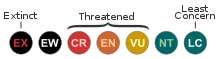
Growth: S = slow M = medium F = fast. Soil: L = light (sandy) M = medium H = heavy (clay). pH: A = acid N = neutral B = basic (alkaline). Shade: F = full shade S = semi-shade N = no shade. Moisture: D = dry M = Moist We = wet Wa = water.
Now available:
Food Forest Plants for Mediterranean Conditions
350+ Perennial Plants For Mediterranean and Drier Food Forests and Permaculture Gardens.
[Paperback and eBook]
This is the third in Plants For A Future's series of plant guides for food forests tailored to
specific climate zones. Following volumes on temperate and tropical ecosystems, this book focuses
on species suited to Mediterranean conditions—regions with hot, dry summers and cool, wet winters,
often facing the added challenge of climate change.
Read More
Expert comment
Author
Durazz.
Botanical References
1151200
Links / References
For a list of references used on this page please go here
Readers comment