 |
|
|
 |
| http://commons.wikimedia.org/wiki/User:Ies |
Translate this page:
Summary
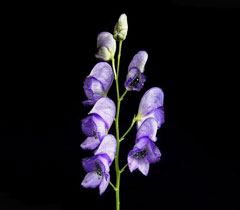
Bloom Color: Blue.
Main Bloom Time: Late summer, Mid summer. Form: Irregular or sprawling, Upright or erect.
Physical Characteristics

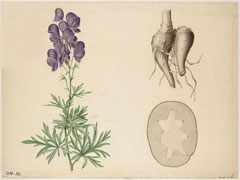
 Aconitum napellus is a PERENNIAL growing to 1.5 m (5ft) by 0.3 m (1ft in).
See above for USDA hardiness. It is hardy to UK zone 6 and is not frost tender. It is in leaf from February to October, in flower from July to August, and the seeds ripen from June to July. The species is hermaphrodite (has both male and female organs) and is pollinated by Bees.
Suitable for: light (sandy), medium (loamy) and heavy (clay) soils and can grow in heavy clay soil. Suitable pH: mildly acid, neutral and basic (mildly alkaline) soils and can grow in very acid and very alkaline soils.
It can grow in semi-shade (light woodland) or no shade. It prefers moist soil.
UK Hardiness Map
US Hardiness Map
Synonyms
Plant Habitats
Woodland Garden Dappled Shade;
Edible Uses
Some reports suggest the root is edible if cooked[2, 177], but these should be treated with extreme caution due to the highly toxic nature of the plant[K].
References More on Edible Uses
Medicinal Uses
Plants For A Future can not take any responsibility for any adverse effects from the use of plants. Always seek advice from a professional before using a plant medicinally.
Analgesic Anodyne Antirheumatic Diaphoretic Diuretic Febrifuge Homeopathy Irritant
Sedative
Aconite has been used since ancient times, especially as an antidote to poisoning[244]. Since the entire plant is itself very toxic, however, any use should be under the guidance of a skilled practitioner[4]. All parts of the plant are used medicinally. The root is the most important and this is harvested as soon as the plant dies down in the autumn and is dried before use[4]. The other parts of the plant are less important and are used fresh, being harvested when the plant is coming into flower[4]. The root is analgesic, anodyne, antirheumatic, diaphoretic, diuretic, irritant and sedative[4, 7, 9, 165, 200]. Due to its poisonous nature, it is not normally used internally though it has been used in the treatment of fevers[200]. Externally, it is applied to unbroken skin in the treatment of rheumatism, painful bruises, neuralgia etc[200, 254]. All parts of the plant, except the root, are harvested when the plant is in flower and used to make a homeopathic medicine[232]. This is analgesic and sedative and is used especially in the treatment of fevers, inflammation, bronchitis, neuralgia etc[9, 232].
References More on Medicinal Uses
The Bookshop: Edible Plant Books
Our Latest books on Perennial Plants For Food Forests and Permaculture Gardens in paperback or digital formats.

Edible Tropical Plants
Food Forest Plants for Hotter Conditions: 250+ Plants For Tropical Food Forests & Permaculture Gardens.
More

Edible Temperate Plants
Plants for Your Food Forest: 500 Plants for Temperate Food Forests & Permaculture Gardens.
More

More Books
PFAF have eight books available in paperback and digital formats. Browse the shop for more information.
Shop Now
Other Uses
References More on Other Uses
Cultivation details
Landscape Uses:Border, Container, Massing, Woodland garden. Thrives in most soils and in the light shade of trees[1]. Grows well in heavy clay soils. Prefers a moist soil in sun or semi-shade[200]. Plants only thrive in a sunny position if the soil remains moist throughout the growing season[238]. Prefers a calcareous soil. Tolerates a pH in the range 4.5 to 7.5. Plants take 2 - 3 years to flower when grown from seed[244]. Grows well in open woodlands[1, 4]. The flowers are very attractive to bees[244]. Members of this genus seem to be immune to the predations of rabbits and deer[233]. Although the plant is a perennial, individual roots only live for one year and die after flowering. Each root produces a number of 'daughter' roots before it dies and these can be used for propagating the plant[4]. A greedy plant, inhibiting the growth of nearby species, especially legumes[54]. An aggregate species which is divided by some botanists into many species[17, 76]. Special Features:Not North American native, Naturalizing, All or parts of this plant are poisonous, Suitable for cut flowers.
References Carbon Farming Information and Carbon Sequestration Information
Temperature Converter
Type a value in the Celsius field to convert the value to Fahrenheit:
Fahrenheit:
The PFAF Bookshop
Plants For A Future have a number of books available in paperback and digital form. Book titles include Edible Plants, Edible Perennials, Edible Trees,Edible Shrubs, Woodland Gardening, and Temperate Food Forest Plants. Our new book is Food Forest Plants For Hotter Conditions (Tropical and Sub-Tropical).
Shop Now
Plant Propagation
Seed - best sown as soon as it is ripe in a cold frame[111]. The seed can be stratified and sown in spring but will then be slow to germinate[133]. When large enough to handle, prick the seedlings out into individual pots and grow them on in a cold frame for their first winter. Plant them out in late spring or early summer. Division - best done in spring but it can also be done in autumn[1, 111]. Another report says that division is best carried out in the autumn or late winter because the plants come into growth very early in the year[233].
Other Names
If available other names are mentioned here
Native Range
EUROPE: United Kingdom, Austria, Belgium, Switzerland, Czech Republic, Germany, Poland (south), Slovakia, Russian Federation (European part), Ukraine (west), Bosnia and Herzegovina, Croatia, Italy (north), Romania, Serbia, Slovenia, Spain, France (incl. Corsica)
Weed Potential
Right plant wrong place. We are currently updating this section.
Please note that a plant may be invasive in one area but may not in your area so it's worth checking.
Conservation Status
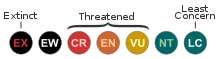
IUCN Red List of Threatened Plants Status :
Growth: S = slow M = medium F = fast. Soil: L = light (sandy) M = medium H = heavy (clay). pH: A = acid N = neutral B = basic (alkaline). Shade: F = full shade S = semi-shade N = no shade. Moisture: D = dry M = Moist We = wet Wa = water.
Now available:
Food Forest Plants for Mediterranean Conditions
350+ Perennial Plants For Mediterranean and Drier Food Forests and Permaculture Gardens.
[Paperback and eBook]
This is the third in Plants For A Future's series of plant guides for food forests tailored to
specific climate zones. Following volumes on temperate and tropical ecosystems, this book focuses
on species suited to Mediterranean conditions—regions with hot, dry summers and cool, wet winters,
often facing the added challenge of climate change.
Read More
Expert comment
Author
L.
Botanical References
17200
Links / References
For a list of references used on this page please go here
Readers comment