Crataegus Species - The Hawthorns
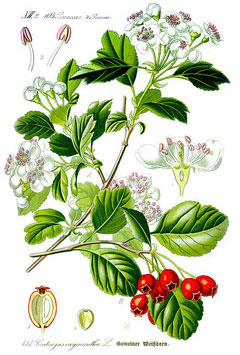 The genus Crataegus, which includes the two British native hawthorns, comprises some 100 -200 species of deciduous trees and shrubs depending upon which botanists you want to believe. Crataegus is part of the rose family, which contains many of our cultivated temperate fruits such as apples, pears, plums, cherries, peaches and apricots. The fruits of the British native hawthorns are also edible but, as most people who have tried them will testify, there are much nicer fruits around. Many other species in this large genus, however, have much more interesting fruits - some of these are absolutely delicious and easily rival the best of our cultivated crops. It isn't clear why this genus has never received much attention from the fruit grower or breeder, since it has excellent potential as a fruit crop and must be one of the easiest of plants to grow, tolerating most sites and conditions. It is also a very diverse genus, growing in many areas of the world and ranging in size from small shrubs to large trees.
Cultivation.
In general they prefer a well-drained but moisture-retentive loamy soil, but they will succeed in most other situations including heavy clays and very chalky soils. Once established they are quite drought tolerant, though they will also tolerate quite wet soils and some species succeed even where the water stands in winter. Many species are also very wind tolerant, some of them succeeding in maritime exposure, and they can be included as part of a shelter-belt planting. They are also tolerant of atmospheric pollution and so grow well in towns, cities, by main roads and industrial estates. For the highest fruit production, it is best to grow the plants in as sunny a position as possible, though they will also succeed in semi-shade. A position on the sunny edge of a woodland is probably ideal.
Plants in this genus is seldom overly troubled by pests or diseases and once planted can usually be left to look after themselves so long as they have a good mulch to keep down weed competition whilst they are small. They are, however, susceptible to fireblight, a disease that affects many of the trees and shrubs in the family Rosaceae. There is no effective treatment for this disease and, should you be unfortunate enough for any of your plants to contract it, then the only thing to do is to grub up and burn the infected plant in order to prevent the disease from spreading. The disease is not very common, fortunately, but many growers do recommend that you keep your cultivated apples away from Crataegus and other members of the family such as Cotoneasters and Pyracanthas as a precaution.
Propagation
Propagation is not without its difficulties. The genus as a whole is rather promiscuous and plants tend to spread their pollen around without respect for other species. Hybridisation is rife when plants of more than one species are grown together and so, if you want to produce the true species from seed, then you either have to obtain your seed from a wild stand of the plants or cover the flowers with an insect-excluding device and hand pollinate. If you are not too worried about breeding true to type, of course, then this natural tendency to hybridize does offer plenty of opportunity to try and produce new superior fruiting cultivars.
Once you have obtained your seed, you then have to germinate it. As with many other trees and shrubs, hawthorn seeds have inbuilt mechanisms to delay germination. This ensures that the seed does not germinate as soon as it is ripe in the autumn, and then have to face all the rigours of winter with very little opportunity to establish itself beforehand. Where possible, sow the seed in pots as soon as it is ripe in the autumn and place the pots in a cold frame or perhaps even outdoors by the side of a north-facing wall. What is important is that the seed is exposed to the rigours of winter so that it will be ready to germinate in the spring. It is also very important to protect the seed from the attentions of mice or any other creature that might decide to make a meal of it. Seed can be very slow and erratic to germinate; you might find a few will germinate in the following spring though most will wait for another winter to pass before coming into growth. A few more will hang about for yet another year before germinating. One way that can reduce your waiting time is to harvest the seed ‘green’ (just before it is fully ripe, when the embryo has fully developed but before the seedcoat hardens) and sow it immediately in a cold frame. It takes some experience to know the right stage but, if timed well, most of the seed will germinate in the spring.
If you cannot obtain fresh seed, then stored seed should be sown as soon as you can obtain it and left in a safe place in a cold frame or outdoors in order to be weathered. Be patient, it will take at least 18 months before any will germinate. You might be able to reduce this time somewhat if you soak the seed overnight in warm water, then place it in a plastic bag with a small amount of moist sand or peat substitute and seal the bag to keep the moisture in. Store the bag in a dark place for 3 months at 15C and then for another 3 months at 4C before potting up the seed. Check the bag occasionally, remove any seeds if they have germinated and pot them up straight away. Much of the seed may still take 18 months to germinate.
Other ways of trying to reduce the germination time include scarifying the seed before sowing it. You do this by filing away some of the outer woody shell of the seed, being very careful not to damage the seed itself. On a small scale this can be done by individually filing away the coat of each seed with something like a nail file. On a commercial scale, sulphuric acid is used to eat the coat away -timing is very critical here and the seed must be thoroughly washed afterwards to remove the acid. Fermenting the seed for a few days in the fruit pulp may also speed up the germination process.
If you have a superior fruiting form then you need to propagate it vegetatively in order to ensure that you produce plants that are identical to the parent. Unfortunately, hawthorns are extremely difficult if not impossible from cuttings and so grafting is the only satisfactory method of increase. Seedling hawthorns can be used as the rootstock - either of our two native species can be used or, alternatively, you can graft onto a seedling of the same species as your graftwood. There is quite a bit of scope for developing dwarfing rootstocks in much the same way as rootstocks have been bred for apples, though there may be no-one working in this field at present.
Grafting is best carried out in late winter to early spring, once the sap is rising in the trees but before they come into leaf. So long as you follow a few basic rules, grafting is quite a simple operation and even the complete novice can have good results.
The Fruit.
Let's get on to the benefits of all this planting work - the fruit. This can vary widely from species to species, though the basic structure is always the same. Externally, it is somewhat like a small apple, the thin skin covering a fleshy pulp. The colour of the ripe fruit ranges from yellow, through green to red and on to dark purple. The woody seeds are not apple like, up to five of them are formed at the centre of the fruit and they often stick together in a clump, acting effectively like a cherry stone. Fruit size varies from species to species, with the largest about an inch in diameter. The texture is also very variable, some species are hard, dry and powdery, others are mealy, some are crisp and juicy whilst at least one is soft and juicy rather like a cherry. The flavour can range from bitter, through boring and on to absolutely delicious. Most of the species ripen their fruit in early to mid-autumn.
For maximum nutritional value, eat the fruit raw if you like it. It is also possible to dry fruit for later use, or to cook it for use in preserves etc.
As mentioned earlier, different species range in size from small shrubs about 7ft tall to fairly large trees 30ft or more in height. Most species develop thorns on their branches and in some species these are 2 inches or more long. These thorns shouldn't cause any real problem with harvesting the fruits, though some species do form a mass of thin branches that makes it difficult to get your hands into them. Fortunately, most of the fruit is carried on the outside of the plant.
Flowering is in the early to late spring, usually just before the leaves open. The plants look particularly beautiful at this time, as they do when laden down with fruit in the autumn.
Pruning is not really a priority with hawthorns, though a bit of formative pruning to young trees can be helpful, and cutting out diseased or badly placed branches on older trees can also be of benefit. The plants flower and form their fruit on short new sideshoots that are formed in the spring, mainly on young wood that grew the previous year. Hawthorns are exceedingly tolerant of any pruning and are capable of regenerating even if cut right back into old wood. The British native species are often used as hedging plants, but there is nothing to stop you trying out some of the species in the list below as hedging. Don’t forget, though, that regular trimming will greatly reduce any fruit crops since it will remove the young wood.
Other uses.
Apart from their delicious flavour, hawthorn fruits have been shown to have a tonic effect on the heart. Fruits of our native species are often used in the treatment of weak heart conditions, especially if this is accompanied by high blood pressure. Most, if not all, other species will have a similar action on the body.
The young leaves of our native hawthorn can be eaten raw. They are not strongly flavoured, but make a pleasant addition to salads. The leaves of other species mention in this section can also be eaten in moderation. However, if you try any leaves that have a noticeable bitter almond flavour these should not be eaten since they are mildly toxic.
The wood of all hawthorn species is very hard and strong. If you ever find yourself in the position of having to grub out a tree then the wood is ideal for tool handles and other small items.
The Species
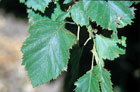 Crataegus arnoldiana grows up to 20ft tall, though I have yet to see specimens more than 15ft tall. This is one of my favourite fruits, it is almost an inch in diameter and has a sweet flavour with a soft juicy but mealy flesh.
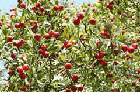 Crataegus azarolus. The azarole grows about 20ft tall and is sometimes cultivated in the Mediterranean for its fruit. This is about an inch in diameter and is said to have a pleasant acid taste though this is one of the species that I have yet to try. In warm temperate areas the fruit develops more fruit sugars and has a fragrant sugary pulp with a slightly acid flavour. In cooler zones, however, the fruit does not develop so well and is best cooked or used in preserves.
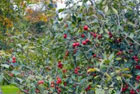 Crataegus baroussana. The plant is unlikely to grow taller than 5ft. The fruits are up to an inch in diameter and are pleasantly sweet. This species, therefore, seems to have excellent potential for small gardens or other sites where space is limited. The plant is native to Mexico so it might not be hardy in the colder areas of Britain
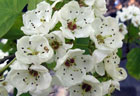 Crataegus durobrivensis. This species is not known in a truly wild situation and is possibly a hybrid, so don't expect it to come true from seed. It grows about 15ft tall and the fruit, which is about 3/4 inch in diameter, is sweet and fairly juicy when fully ripe with a hint of apple in its flavour.
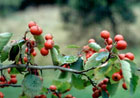 Crataegus ellwangeriana. This species is probably another hybrid. It grows about 20ft tall and the fruit, which is juicy and acid, makes very pleasant eating. The fruit is about 3/4 inch in diameter.
 Crataegus illinoensis. The fruit of this species is very similar in taste and size to C. arnoldiana, mentioned earlier. I'm not sure how tall the tree will grow, possibly 20ft.
Crataegus missouriensis. This tree grows about 20ft tall. The fruit is about the size of a large cherry with a sweet, soft and fairly juicy flesh.
.jpg) Crataegus schraderana. This tree, which also grows about 20ft tall, produces juicy fruits around a half to three quarters of an inch in diameter, with an extremely pleasant flavour. Ken Fern said that it has one of the most delicious fruits he'd ever eaten from a plant of the temperate zone, and that he would far rather eat this fruit than a strawberry!
Crataegus schraderana. This tree, which also grows about 20ft tall, produces juicy fruits around a half to three quarters of an inch in diameter, with an extremely pleasant flavour. Ken Fern said that it has one of the most delicious fruits he'd ever eaten from a plant of the temperate zone, and that he would far rather eat this fruit than a strawberry!
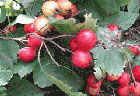 Crataegus submollis. This species grows about 25ft tall. The fruit is sub-acid, dry and mealy according to the books, but you may find it better than expected.
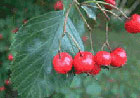 Crataegus succulenta. Growing about 20 ft tall this species has some of the largest fruits in the genus with specimens up to one and three quarters of an inch in diameter. This fruit has a sweet, juicy and pulpy flesh that is excellent raw or for making jellies.
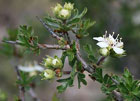 Crataegus tanacetifolia. This is a larger tree that can reach 30ft tall. The fruit is quite different from those species mentioned above, it is juicy and much firmer with a distinct apple-like flavour. The fruit is up to 1 inch in diameter.
Conclusion.
This genus, as a whole, is very easily grown and contains many species with delicious fruits, though virtually none of them has ever been bred for their fruit. Because they hybridize freely, there is an excellent potential to produce superior fruiting cultivars and, with the wide diversity in size of the plants ranging from small shrubs to quite large trees, there should be species suitable for small gardens as well as large sites.
Suppliers.
A number of nurseries offer Crataegus species, though few offer many of the species mentioned in this article. The best supplier I have come across to date has been:-
Thornhayes Nursery, St. Andrew's Wood, Dulford, Cullompton, Devon. EX15 2DF. Telephone 01884 266746.
This nursery has an excellent range of Crataegus species and also many other fruiting trees, including over 100 varieties of traditional westcountry apples.
Database
The database has more details on these plants: Crataegus arnoldiana, Crataegus azarolus, Crataegus baroussana, Crataegus durobrivensis, Crataegus ellwangeriana, Crataegus missouriensis, Crataegus schraderiana, Crataegus submollis, Crataegus succulenta, Crataegus tanacetifolia.
